AI Content Creator Tools
Last updated: April 2, 2026
Quick Answer: AI Content Creator Tools are software platforms that use machine learning and natural language processing to research, write, optimize, and publish content automatically.
In 2026, the best tools go beyond basic text generation, they handle keyword research, SEO scoring, brand voice matching, and direct CMS publishing, cutting content production time by hours per week while improving search rankings.
Key Takeaways
- AI content creator tools now cover the full content lifecycle: research, writing, optimization, and publishing — not just drafting.
- 68% of creators prefer AI built directly into existing platforms rather than standalone tools, signaling a clear shift toward integrated workflows.
- Native AI integration within content management systems saves creators an average of 2.5 hours weekly.
- The best tools match your brand voice, analyze competitors, and target featured snippets automatically.
- Ethical AI content practices and compliance with search engine guidelines are non-negotiable for long-term organic growth.
- ROI from content automation compounds over time — the more content you publish, the more organic traffic compounds.
- Pricing ranges from free (with limitations) to $39+/month for professional-grade AI SEO writers.
- Tools like Jasper AI, BlogBuster, and Junia AI lead for written content; Synthesia and VEED.IO lead for AI video content.
What Are AI Content Creator Tools and Who Are They For?
AI content creator tools are software platforms that automate the research, creation, optimization, and distribution of digital content using artificial intelligence.
They serve bloggers, marketing teams, e-commerce brands, agencies, and SaaS companies that need to produce consistent, high-ranking content without scaling headcount.
These tools are not just “autocomplete on steroids.” The best platforms in 2026 combine AI SEO writers, automatic content generation engines, keyword discovery, competitor analysis, and automated SEO publishing into a single workflow.
Who benefits most:
- Solo bloggers who need to publish 3–5 articles per week without a writing team
- Digital marketing agencies managing 10+ client content calendars
- E-commerce brands targeting long-tail product keywords at scale
- SaaS companies building topical authority through content clusters
Who should be cautious:
- Brands in highly regulated industries (legal, medical, finance) where AI-generated content needs heavy human review
- Creators whose value proposition is deeply personal, narrative-driven storytelling
How Do AI Content Creator Tools Actually Work?
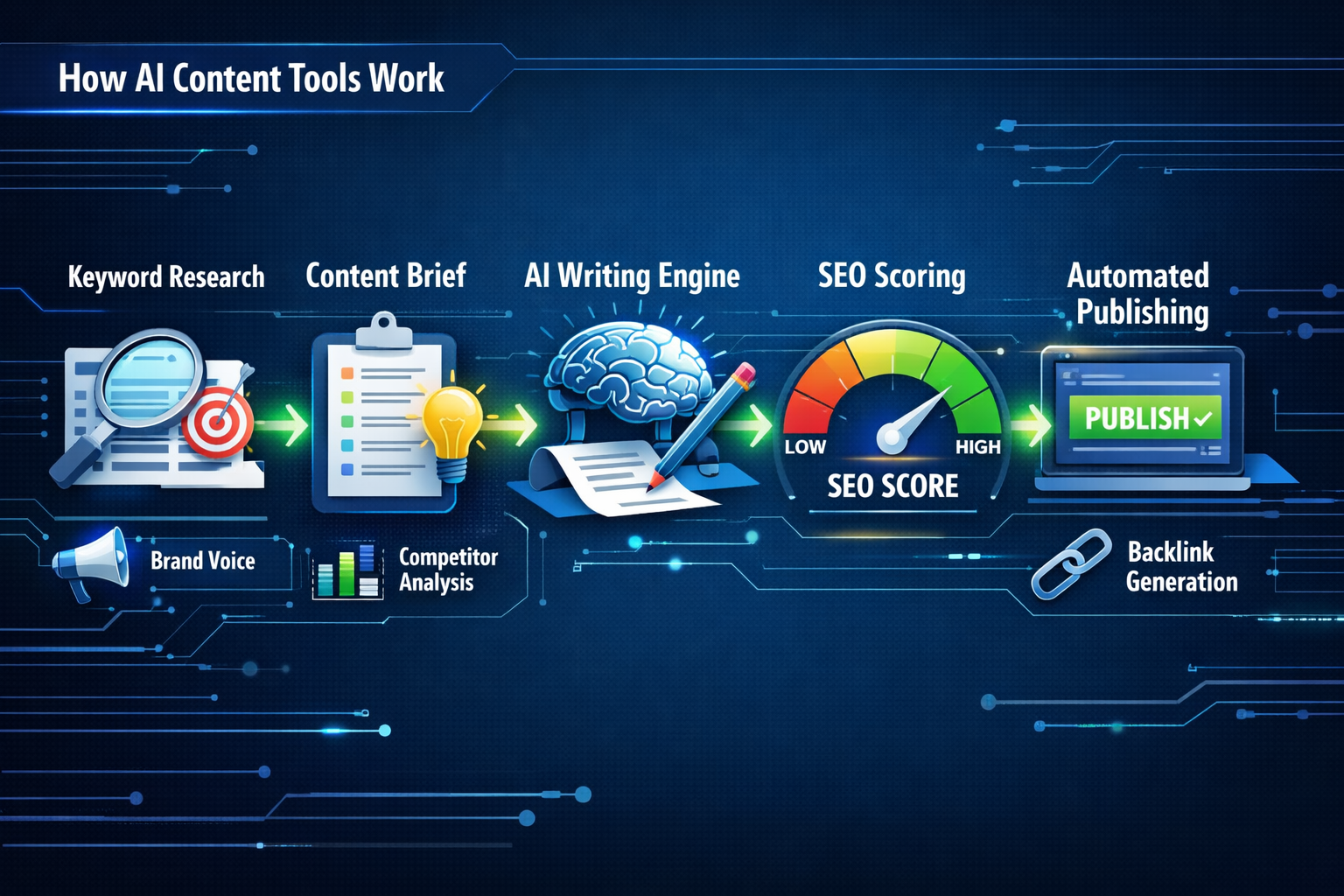
Most AI content creator tools follow a five-stage pipeline: keyword input → content brief generation → AI drafting → SEO optimization → publishing. Understanding each stage helps you choose the right tool and set realistic expectations.
Stage 1: Keyword Research and Topic Discovery
The tool analyzes search volume, competition, and semantic clusters around your target keyword.
Advanced platforms use AI-powered keyword discovery to surface related terms your competitors are missing, what SEO professionals call “semantic SEO gaps.”
Stage 2: Content Brief and Structure
The AI generates an outline based on top-ranking pages, common questions (from sources like People Also Ask), and your specified word count. This is where competitor analysis happens automatically.
Stage 3: AI Writing and Drafting
Using large language models and natural language processing, the tool produces a full draft. Better platforms let you input brand voice guidelines so the output sounds like your team wrote it, not a generic AI.
Stage 4: SEO Optimization and Scoring
The draft is scored against on-page SEO criteria: keyword density, heading structure, internal linking suggestions, meta description, and readability. Some tools integrate directly with tools like Surfer SEO or Clearscope.
Stage 5: Automated Publishing
The finished article publishes directly to WordPress, Webflow, Shopify, or your CMS of choice — no copy-pasting required. This is the feature that saves the most time in a real content automation workflow.
Which AI Content Creator Tools Lead the Market in 2026?
The market has split into two clear categories: AI SEO writing tools for long-form content, and AI video creation tools for multimedia content. Here’s a practical breakdown of the leading platforms.
AI SEO Writing Tools
| Tool | Best For | Starting Price | Key Feature |
|---|---|---|---|
| BlogBuster | Automated SEO blog publishing | Free trial available | Auto-publish to CMS + SEO scoring |
| Junia AI | Long-form SEO articles | Freemium | Brand voice + competitor analysis |
| Jasper AI | Enterprise content teams | $39/month | 50+ templates, campaign workflows |
| ChatGPT | Ideation + drafting | Free / $20/month | Multipurpose, integrates with Sora 2 |
AI Video Creation Tools
| Tool | Best For | Starting Price | Key Feature |
|---|---|---|---|
| Synthesia | Corporate training, e-learning | Custom pricing | 120+ languages, AI avatars |
| VEED.IO | Talking-head videos, courses | Freemium | Drag-and-drop, no editing experience needed |
| InVideo | Social media video | $30/month | 1,000+ templates, Shutterstock library |
| Adobe Express | Commercial image + video ads | Freemium | Firefly integration, copyright-safe |
Google’s Veo 3.1 now powers multiple platforms for cinematic 4K video generation, including the newly launched Google Pomelli Animate, which converts static content into short-form videos optimized for Reels, TikTok, and YouTube Shorts.
What Should You Look for in AI Content Creator Tools?
The right AI content creator tool depends on your publishing volume, SEO goals, and existing tech stack. Don’t pay for features you won’t use, but don’t underinvest in capabilities that directly affect your organic traffic growth.
Must-Have Features for SEO-Focused Teams
- Automated keyword research built into the content brief stage
- Brand voice memory so every article sounds consistent
- Direct CMS publishing (WordPress, Webflow, Shopify)
- On-page SEO scoring before publishing
- Competitor content analysis to identify gaps
Features That Separate Good Tools from Great Ones
- Topical cluster planning — maps out a 3–6 month content calendar around pillar topics
- Predictive performance analytics — estimates traffic potential before you write
- Internal linking automation — suggests and inserts relevant links from your existing content
- Compliance checks — flags content that may conflict with Google’s helpful content guidelines
“The tools that win long-term aren’t the ones that write the fastest — they’re the ones that help you build a content ecosystem that compounds.” — A common insight from content strategists who’ve run large-scale AI content programs.
How Do AI Content Creator Tools Handle SEO and Search Rankings?
AI content creator tools improve search rankings by combining keyword targeting, semantic content coverage, and technical SEO optimization in a single workflow. The key is that they don’t just write — they write with ranking intent built in.
Here’s what the best AI-driven content strategy tools do for SEO specifically:
- Semantic keyword coverage: They identify and include LSI (latent semantic indexing) keywords that signal topical depth to search engines — terms like “machine learning content creation,” “content intelligence,” and “algorithmic content strategy.”
- Featured snippet targeting: The tool structures answers as definitions, numbered lists, or comparison tables, the formats Google pulls for featured snippets.
- Search intent matching: The AI identifies whether a keyword is informational, commercial, or transactional and adjusts the content structure accordingly.
- Automatic meta generation: Title tags and meta descriptions are generated and scored for click-through rate potential.
Common mistake: Many teams use AI tools to generate content but skip the SEO scoring step, publishing drafts that are well-written but poorly structured for search. Always run the SEO audit before publishing.
What Are the Privacy, Ethics, and Compliance Considerations?
This is the area most competitor guides skip entirely — and it’s where real risk lives for brands using AI content creator tools at scale.
Data Privacy
- Check whether the tool trains its models on your content inputs. If it does, proprietary information or client data could influence outputs for other users.
- Tools like Jasper AI and enterprise-tier platforms typically offer data isolation agreements.
- For regulated industries, confirm the tool is SOC 2 compliant.
Google Compliance
Google’s helpful content system evaluates whether content is created primarily for people or primarily for search engines.
AI-generated content is not inherently penalized, but thin, low-value, or misleading AI content is.
Best practice: Use AI to draft and structure, then add human expertise, original data points, and first-hand perspective before publishing.
Ethical AI Content Creation
- Disclose AI-assisted content where your audience expects transparency (journalism, academic contexts).
- Don’t use AI tools to generate fake reviews, fabricated testimonials, or misleading product claims.
- Verify all factual claims before publishing, AI models can produce plausible-sounding but inaccurate information.
How Do You Calculate ROI from AI Content Creator Tools?
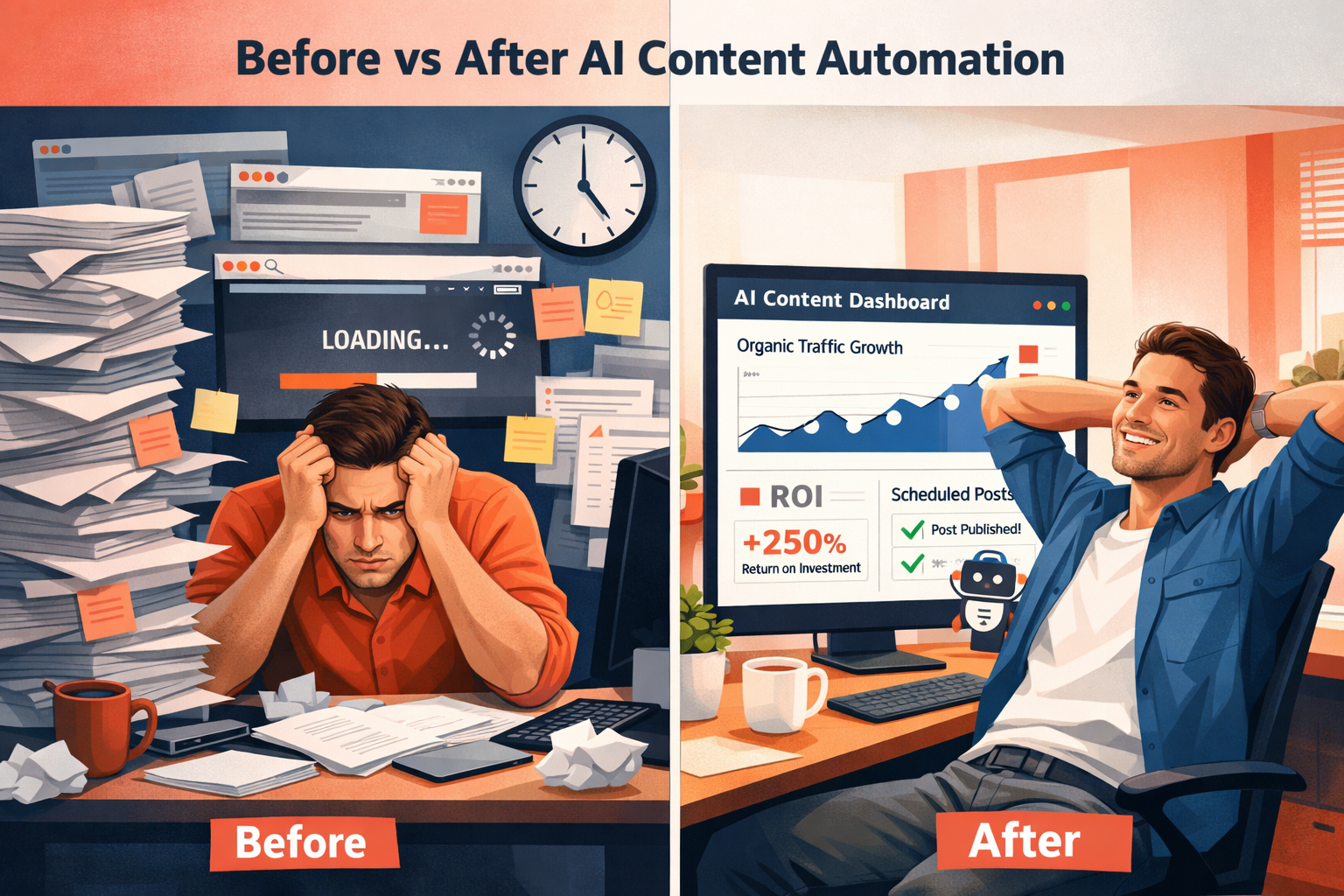
Content automation ROI compounds over time, which makes it different from most marketing spend. A single AI-generated article that ranks on page one can drive traffic for years.
Simple ROI Framework
- Calculate current content cost: (Hours per article × hourly rate) + freelancer fees
- Calculate AI tool cost: Monthly subscription ÷ articles published per month
- Measure traffic value: Organic sessions × estimated CPC for those keywords
- Compare: (Traffic value − tool cost) ÷ tool cost = ROI %
Example estimate (assumptions: 10 articles/month, $0.50 average CPC, 500 sessions per article):
- Traffic value: 10 × 500 × $0.50 = $2,500/month
- Tool cost: $39/month (Jasper AI individual plan)
- Estimated ROI: ~6,300% (before accounting for time savings)
These numbers vary significantly based on your niche, keyword difficulty, and content quality. Treat this as a directional framework, not a guarantee.
FAQ: AI Content Creator Tools
Q: Can AI content creator tools fully replace human writers?
Not in 2026. They replace the research, structuring, and first-draft stages effectively. Human writers add expertise, original insight, and brand personality that AI currently can’t replicate consistently.
Q: Will Google penalize AI-generated content?
Google penalizes low-quality, unhelpful content regardless of how it was produced. High-quality AI-assisted content that serves readers is not penalized.
Q: How long does it take to see SEO results from AI-published content?
Typically 3–6 months for new content to rank, depending on domain authority and keyword competition. Content automation accelerates results by increasing publishing volume.
Q: What’s the best AI content tool for a solo blogger on a budget?
Start with Junia AI (freemium) or BlogBuster for automated publishing. Both offer entry-level access without requiring a large monthly commitment.
Q: Do AI content tools work for non-English content?
Yes. Synthesia supports 120+ languages for video content. Most major AI writing tools support at least 25+ languages, though quality varies outside English.
Q: How do I maintain brand voice with AI-generated content?
Use tools that offer brand voice memory (Jasper AI, Junia AI). Feed the tool 3–5 examples of your best existing content and specify tone guidelines (formal/casual, technical/accessible).
Q: Can AI tools handle technical or niche industry content?
Yes, but with limitations. They perform well for structured topics with clear facts. For highly specialized fields (medical, legal, engineering), treat AI output as a first draft requiring expert review.
Q: What’s the difference between an AI writing assistant and a full AI content workflow tool?
An AI writing assistant (like basic ChatGPT) helps with drafting. A full AI content workflow tool handles keyword research, brief creation, writing, SEO scoring, and CMS publishing in one pipeline.
Conclusion: Building a Content Strategy That Scales
The shift toward AI Content Creator Tools isn’t about replacing creativity, it’s about removing the bottlenecks that prevent consistent, high-quality publishing.
In 2026, the brands winning in organic search are the ones that publish more, optimize faster, and iterate based on data.
Your actionable next steps:
- Audit your current content workflow — identify where you lose the most time (research, drafting, or publishing).
- Choose a tool that matches your bottleneck — if publishing is slow, prioritize CMS integration; if research is slow, prioritize keyword automation.
- Start with BlogBuster for automated SEO publishing or Junia AI for long-form content with brand voice control.
- Set a 90-day content target — commit to a publishing cadence and measure organic traffic at the 60 and 90-day marks.
- Add human expertise to every AI draft — a single original insight or data point per article dramatically improves both quality and ranking potential.
Content automation works.
But it works best when you treat AI as a skilled research assistant and first-draft writer, not a replacement for strategic thinking.
Also Worth Checking Out –> BlogSeo.io
References
[1] 10 Best Ai Tools To Use For Content Creation – https://www.getblend.com/blog/10-best-ai-tools-to-use-for-content-creation/
[2] Best All In One Ai Tool Content Creation Workflow – BlogSeo.io
[3] 1 Ai Tool You Should Know About In 2026 – https:// wordrocket.ai
[4] Ai Tools 2026 Guide – https://elementor.com/blog/ai-tools-2026-guide/