
Best SEO For Small Business
Last updated: March 24, 2026
Quick Answer
The Best SEO For Small Business in 2026 focuses on local search dominance, mobile-first optimization, and creating valuable content that directly addresses customer needs.
Small businesses should prioritize Google My Business optimization, local keyword targeting, and building authentic customer reviews while maintaining fast-loading, mobile-friendly websites.
Key Takeaways
• Local SEO is non-negotiable — 76% of local searches result in store visits within 24 hours
• Mobile optimization comes first — Google uses mobile-first indexing for all websites
• Google My Business drives local visibility — Complete profiles get 2x more customer actions
• Customer reviews boost rankings — Fresh reviews signal business activity to search engines
• Page speed affects conversions — Every second of delay reduces conversions by 7%
• Content should solve problems — Answer customer questions to rank for long-tail keywords
• Local citations build authority — Consistent NAP (Name, Address, Phone) across directories matters
• Technical SEO prevents problems — Broken links and crawl errors hurt small business rankings
What Makes SEO Different for Small Businesses?
Small business SEO differs significantly from enterprise SEO because you’re competing locally rather than nationally, working with limited budgets, and need faster results to impact revenue. Your focus should be on dominating local search results and capturing customers ready to buy.
Key differences include:
- Geographic targeting — You serve specific cities or regions, not global markets
- Lower competition — Easier to rank for “dentist in Springfield” than “dentist”
- Direct ROI impact — Every new customer has immediate business value
- Resource constraints — You can’t compete with enterprise budgets or teams
- Personal relationships — Local reputation and word-of-mouth amplify SEO efforts
Choose local SEO if: Your business serves customers in specific geographic areas, you have a physical location, or you provide services within driving distance.
Avoid national SEO if: You’re just starting out, have limited budget, or serve local markets — you’ll waste resources competing against giants.
How to Dominate Local Search Results
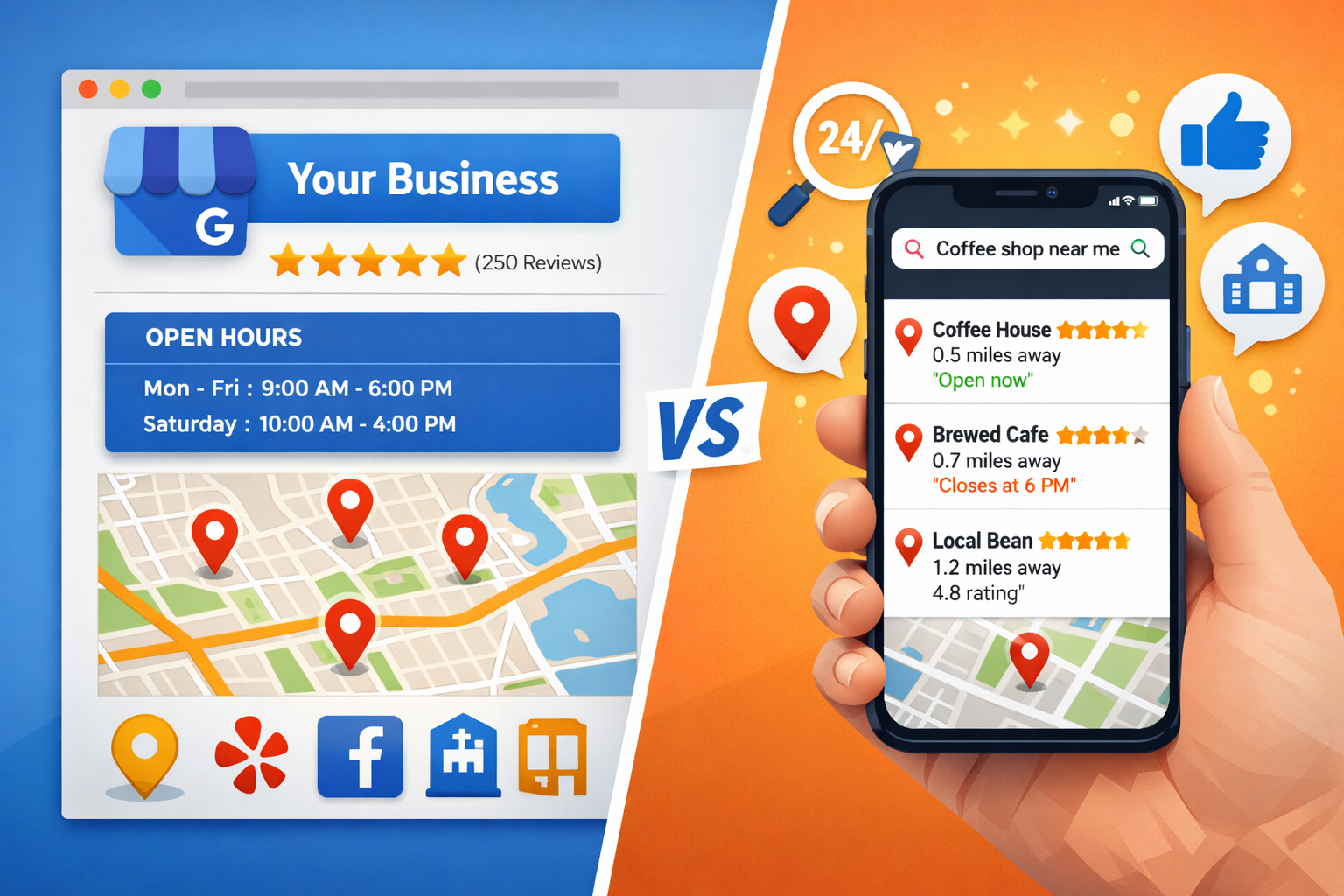
Local search dominance starts with claiming and optimizing your Google My Business profile, then expanding to other local directories and review platforms. This foundation determines whether customers find you when searching for businesses like yours.
Essential local SEO steps:
- Claim your Google My Business listing — Verify ownership and complete every section
- Optimize for local keywords — Include city names in titles and content
- Build local citations — List your business in relevant directories
- Collect customer reviews — Ask satisfied customers to leave Google reviews
- Create location-specific content — Write about local events, news, or community involvement
Common mistake: Using inconsistent business information across directories. Your name, address, and phone number must match exactly everywhere.
Pro tip: Add photos regularly to your Google My Business profile. Businesses with photos get 42% more requests for directions and 35% more click-throughs to their websites.
Best SEO For Small Business: Technical Foundation
Your website’s technical foundation determines whether search engines can find, crawl, and index your content effectively. Small businesses often overlook technical SEO, but fixing basic issues can dramatically improve rankings.
Critical technical elements:
- Mobile responsiveness — Your site must work perfectly on phones and tablets
- Page loading speed — Aim for under 3 seconds on mobile
- SSL certificate — Secure sites rank higher and build customer trust
- Clean URL structure — Use descriptive URLs like /services/plumbing-repair
- XML sitemap — Help search engines understand your site structure
- Local schema markup — Code that tells search engines you’re a local business
Quick technical audit checklist:
✅ Site loads in under 3 seconds
✅ All pages display correctly on mobile
✅ No broken links or 404 errors
✅ SSL certificate installed (https://)
✅ Google Analytics and Search Console connected
✅ XML sitemap submitted to Google
Edge case: If you serve multiple locations, create separate pages for each with unique content, don’t duplicate the same template with just city names changed.
Content Strategy That Drives Local Traffic
Effective small business content answers the specific questions your local customers ask while naturally incorporating location-based keywords. Focus on solving problems rather than selling products.
High-impact content types:
- Service area pages — Detailed pages for each city or neighborhood you serve
- FAQ sections — Answer common customer questions
- Local guides — “Best restaurants near our shop” or “Local events this month”
- Case studies — Real customer success stories with local relevance
- How-to articles — Educational content related to your services
Content optimization strategy:
- Research local keywords — Use tools like Google Keyword Planner for location-specific terms
- Write for humans first — Search engines reward content people actually read
- Include location naturally — Don’t stuff city names awkwardly into content
- Update regularly — Fresh content signals an active business
- Link internally — Connect related pages to help visitors and search engines navigate
Decision rule: Choose evergreen topics if you have limited time, content that stays relevant for years provides better long-term value than trending topics.
Review Management and Reputation SEO
Customer reviews directly impact local search rankings and influence purchasing decisions. A systematic approach to review management can become your strongest SEO asset.
Review optimization process:
- Ask at the right time — Request reviews when customers are happiest
- Make it easy — Send direct links to your Google My Business review page
- Respond to all reviews — Thank positive reviewers and address concerns professionally
- Monitor review platforms — Track Google, Yelp, Facebook, and industry-specific sites
- Use reviews in marketing — Feature positive reviews on your website and social media
Review request best practices:
- Timing matters — Ask immediately after successful service completion
- Personal approach works — Face-to-face requests get higher response rates
- Follow up appropriately — One email reminder is acceptable, more becomes spam
- Incentivize legally — Check platform rules before offering rewards for reviews
Common mistake: Only asking happy customers for reviews. A mix of review timing creates more authentic patterns that search engines trust.
Measuring Your Small Business SEO Success
Track metrics that directly connect to business revenue rather than vanity metrics that don’t impact your bottom line. Focus on local visibility, website traffic quality, and conversion rates.
Essential SEO metrics for small businesses:
| Metric | Why It Matters | How to Track |
|---|---|---|
| Local ranking positions | Shows visibility for key terms | Google My Business insights |
| Organic traffic growth | Measures SEO effectiveness | Google Analytics |
| Click-to-call rate | Indicates local intent | Phone tracking numbers |
| Direction requests | Shows foot traffic potential | Google My Business |
| Review velocity | Impacts local rankings | Monthly review counts |
| Conversion rate | Connects traffic to revenue | Goal tracking in Analytics |
Monthly SEO reporting checklist:
✅ Track rankings for 10-15 key local keywords
✅ Monitor Google My Business insights
✅ Review organic traffic trends
✅ Analyze top-performing content
✅ Check new review acquisition
✅ Measure phone calls and form submissions
Pro tip: Set up Google Analytics goals for phone calls, contact forms, and direction requests to see which SEO efforts drive actual business results.
🎯 Small Business SEO Priority Calculator
🎯 Your SEO Action Plan:
FAQs
Q: How long does it take to see SEO results for a small business?
Local SEO improvements typically show results within 3-6 months, with Google My Business optimization often showing impact within 2-4 weeks. Technical fixes and new content may take longer to influence rankings.
Q: Should I hire an SEO agency or do it myself?
Start with DIY basics like Google My Business optimization and review collection. Consider hiring help if you lack time, have a complex website, or aren’t seeing results after 6 months of consistent effort.
Q: How much should a small business spend on SEO?
Most small businesses should budget $500-2000 monthly for SEO, including tools, content creation, and potential professional help. Start smaller and increase investment as you see positive ROI.
Q: What’s the most important ranking factor for local businesses?
Google My Business optimization combined with consistent customer reviews has the strongest impact on local search rankings. These signals tell Google you’re an active, legitimate local business.
Best SEO For Small Business: FAQs
Q: Do I need to blog regularly for good SEO?
Regular blogging helps but isn’t essential. Focus on creating high-quality pages that answer customer questions rather than publishing frequent low-value content. Quality beats quantity for small businesses.
Q: How do I compete with larger businesses in search results?
Target location-specific keywords where big companies can’t compete effectively. “Plumber in downtown Springfield” is easier to rank for than “plumber” and captures customers ready to hire locally.
Q: Should I focus on Google or other search engines?
Google dominates local search with over 90% market share. Focus your efforts on Google My Business, Google reviews, and ranking in Google search results before considering other platforms.
Q: What are the biggest SEO mistakes small businesses make?
The most common mistakes include neglecting Google My Business, having inconsistent business information across directories, ignoring mobile optimization, and trying to rank for overly competitive national keywords instead of local terms.
Q: How important are backlinks for small business SEO?
Local citations and mentions from community organizations matter more than traditional backlinks for small businesses. Focus on getting listed in local directories, chamber of commerce sites, and industry associations.
Q: Can I do SEO if I don’t have a physical storefront?
Yes, service-area businesses can still use local SEO by targeting the cities they serve. Create location-specific pages, use local keywords, and build citations even without a physical address customers visit.
Q: How do I track if my SEO is working?
Monitor Google My Business insights, track local keyword rankings, measure website traffic from organic search, and most importantly, track phone calls and contact form submissions that turn into customers.
Q: Is it worth paying for Google Ads if I’m doing SEO?
SEO and Google Ads work well together for small businesses. Use ads for immediate visibility while building long-term SEO results. Local service ads can be especially effective for service-based businesses.
Conclusion
The Best SEO For Small Business in 2026 starts with dominating local search through Google My Business optimization, systematic review collection, and mobile-first website performance.
Unlike enterprise SEO, small business success comes from geographic targeting and building authentic local relationships that search engines can measure.
Your immediate action steps:
- Claim and complete your Google My Business profile — This single action provides the fastest SEO impact
- Audit your website’s mobile performance — Use Google’s Mobile-Friendly Test and PageSpeed Insights
- Start asking satisfied customers for reviews — Implement a simple system to request Google reviews
- Create location-specific content — Write about local events, customers, or community involvement
- Track your progress — Set up Google Analytics and monitor local keyword rankings monthly
Remember that small business SEO is a marathon, not a sprint.
Consistent effort on these fundamentals will build sustainable local search visibility that drives real customers to your business.
Focus on serving your local community well, and search engines will reward that commitment with higher rankings and increased visibility.
SEO Unique Articles and Backlinks: Blog SEO