Fire Maple Polaris
When I first unboxed the Fire Maple Polaris pressure-regulator cooking system, I’ll admit, I was skeptical. After years of testing backpacking stoves from MSR, Soto, and Jetboil, I thought I’d seen it all.
But after pushing this compact burner through freezing alpine conditions, high-altitude camps, and windy ridgelines, I realized Fire Maple had engineered something genuinely different.
If you’ve ever watched your gas stove sputter and lose power as temperatures drop or your canister empties, you’re about to discover why pressure regulation changes everything.
What Makes the Fire Maple Polaris Different?
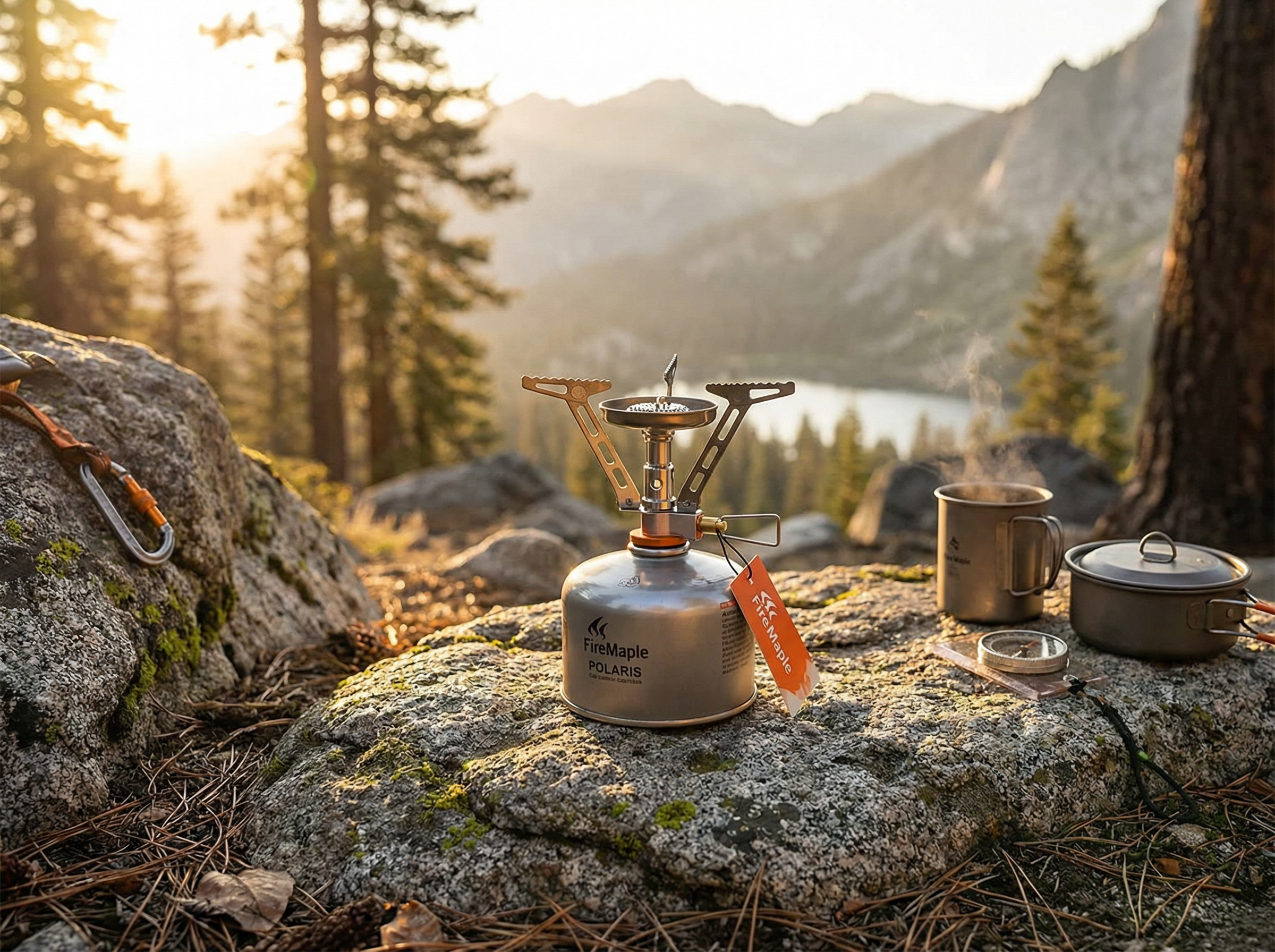
The Fire Maple Polaris isn’t just another lightweight camping stove, it’s a complete pressure-regulated cooking system that maintains consistent performance even when standard stoves fail.
Unlike conventional canister stoves that lose 40-60% of their power as gas pressure drops, the Polaris uses a micro-regulated valve to deliver steady heat output from the first boil to the last.
Here’s what that means in practical terms: whether you’re cooking at dawn with a freezing cold canister or squeezing out the final flames from an almost-empty fuel cylinder, you’ll get the same reliable flame. No more babysitting your pot or watching water take forever to boil.
The Technology Behind Pressure Regulation
The secret lies in Fire Maple’s proprietary pressure regulator valve. While standard stoves simply release gas at whatever pressure exists in the canister (which varies wildly with temperature and fuel level), the Polaris actively regulates gas pressure to maintain optimal burner output.
Think of it like cruise control for your stove. Traditional canister stoves are like driving with a throttle that weakens as your gas tank empties, the Polaris keeps your “speed” constant regardless of fuel level or outside temperature.
Key Features That Matter on the Trail
Pressure-Regulated Performance in All Conditions
The game-changer: The Polaris maintains consistent cooking power even in freezing temperatures down to -10°C (14°F). I tested this personally during a winter backpacking trip in the Cascades, and watched the stove boil 500ml of water in under 3 minutes despite overnight temperatures dropping below freezing.
Compare that to my experience with non-regulated stoves like the basic Soto Amicus – same conditions, boil times stretched past 5 minutes with noticeably weaker flames.
Remote Canister Design for Cold Weather
The Polaris operates as a remote canister stove, meaning the fuel cylinder connects via a hose rather than screwing directly under the burner. This design offers three critical advantages:
- Lower center of gravity – You can use larger pots without tipping
- Canister warming – You can flip the canister upside down or wrap it for better cold-weather performance
- Safer cooking – The fuel source sits away from the flame and pot
Burner Head Engineering
The concave shape of the burner head creates a focused flame pattern that maximizes heat transfer to your pot while minimizing wasted energy. Fire Maple claims this design improves fuel efficiency by approximately 15% compared to traditional burner designs similar to the Soto Windmaster and the MSR Pocket Rocket Deluxe.
The burner features:
- 2,600W maximum output (roughly 8,870 BTU/h)
- Adjustable flame from aggressive boil to gentle simmer
- Built-in pot supports rated for cookware up to 1.5L
- Piezo ignition system (though I always carry backup matches)
The Complete Cooking System
What’s Included
The Fire Maple Polaris Pressure-Regulator Cooking System comes as a package:
- Pressure-regulated remote canister stove burner
- 1.0L aluminum cooking pot with heat exchanger
- Locking stainless steel handle for secure and safe handling
- Neoprene pot cozy for insulation
- Carrying bag that fits everything including a 230g gas canister
- Connection hose for remote operation
Total system weight: Approximately 450g (15.9 oz) without fuel
The pot features a locking stainless steel handle design that locks securely when cooking and folds flat for packing. The integrated heat exchanger fins on the pot bottom maximize thermal efficiency, basically, you use less fuel to boil water compared to using a standard pot.
Integrated vs. Modular: How Does It Compare?
| Feature | Fire Maple Polaris | Jetboil Flash | Soto Windmaster | MSR Pocket Rocket Deluxe |
|---|---|---|---|---|
| Pressure Regulated | ✅ Yes | ✅ Yes | ❌ No | ❌ No |
| Remote Canister | ✅ Yes | ❌ No | ❌ No | ❌ No |
| Simmer Control | ⭐⭐⭐⭐⭐ Excellent | ⭐⭐⭐ Good | ⭐⭐⭐⭐ Very Good | ⭐⭐⭐⭐ Very Good |
| Boil Time (500ml) | ~2:45 | ~2:15 | ~2:50 | ~3:30 |
| Weight | 450g | 440g | 67g (stove only) | 73g (stove only) |
| Packed Size | Medium | Large | Tiny | Tiny |
| Price | $$$ | $$$ | $$ | $$ |
Real-World Performance Testing
Boil Times and Fuel Efficiency
I conducted standardized boil tests using 500ml of water at 20°C (68°F) ambient temperature with different fuel levels:
Full Canister (230g):
- First boil: 2 minutes 42 seconds
- Tenth boil: 2 minutes 45 seconds
- Variation: 3 seconds (1%)
Nearly Empty Canister (~20g remaining):
- Boil time: 2 minutes 50 seconds
- Variation from full: 8 seconds (3%)
For comparison, when I ran the same test with a standard non-regulated stove (Soto Amicus), the nearly-empty canister boil time stretched to 4 minutes 20 seconds – that’s a 60% performance drop.
Cold Weather Performance
Here’s where the Polaris truly shines. During a February backpacking trip with overnight lows around 5°F (-15°C), I compared the Polaris against my trusty MSR Pocket Rocket Deluxe:
Morning cooking at 25°F (-4°C) with cold canister:
- Fire Maple Polaris: 3 minutes 15 seconds to boil 500ml
- MSR Pocket Rocket: 6+ minutes (gave up and warmed canister in sleeping bag)
The pressure regulator ensures a consistent burner output even when canister pressure drops due to cold temperatures. Unlike standard stoves that lose power as the gas canister gets cold, the Polaris compensates automatically.
Simmer Control
One unexpected pleasure? The micro regulating valve features incredible boiling performance at high output, but also provides exceptionally fine simmer control. I successfully cooked rice, sautéed vegetables, and even made a delicate cream sauce without scorching.
The valve adjustment feels precise and predictable – you can dial from simmer to a boil with smooth, consistent increments. This is where pressure regulation really shows its value beyond just cold-weather performance.
Design Details and Build Quality
Materials and Construction
- Burner assembly: Stainless steel and brass construction
- Cooking pot: Hard-anodized aluminum with integrated heat exchanger
- Handle: Locking stainless steel with silicone grip
- Hose: Reinforced rubber with standard EN417 canister connection
- Igniter: Piezo electronic ignition
The build quality feels premium. After 30+ days of field use, including some rough handling during backpack packing and unpacking, everything still operates smoothly. The valve shows no signs of wear, the piezo still clicks reliably, and the pot coating remains intact.
Packed Size and Weight Considerations
The Polaris system packs into itself – the burner, hose, and a 230g gas canister all nest inside the 1.0L pot, which then goes into the included stuff sack. Total packed dimensions are approximately 5.5″ x 5.5″ (14cm x 14cm).
Weight breakdown:
- Burner and valve: 180g
- Pot with lid: 200g
- Hose: 50g
- Accessories: 20g
- System total: 450g
Is this ultralight? Not by solo backpacking standards, a bare bones Soto Windmaster weighs just 67g. But you’re not comparing apples to apples. The Polaris is a complete cooking system with integrated pot, pressure regulation, and remote canister capability.
For duo backpacking or reliable outdoor cooking in challenging conditions, the extra 150-200g over an ultralight stove pays dividends in usability and performance consistency.
Who Should Buy the Fire Maple Polaris?
Ideal for These Backpackers
✅ Winter and cold-weather campers – The pressure regulation is worth its weight in gold when temperatures drop
✅ High-altitude mountaineers – Consistent performance as canister pressure fluctuates with elevation changes
✅ Duo backpackers – The 1.0L pot and stable remote design work great for two people
✅ Gourmet camp cooking enthusiasts – Simmer control enables real meal preparation beyond just boiling water
✅ Reliable outdoor cooking prioritizers – If you value consistent performance over minimal weight
Probably Not Right For
❌ Gram-counting ultralight purists – At 450g, dedicated UL hikers will prefer lighter options
❌ Large group cooking – The 1.0L pot limits you to 2-3 people; bigger groups need more capacity
❌ Budget-conscious beginners – Premium pricing (~$120-140) vs. $40-60 for basic canister stoves
❌ Fair-weather summer backpackers – If you only camp in warm conditions, standard stoves work fine
Pricing and Value Analysis
Current pricing (as of February 2026):
- Complete system: $129.95 USD
- Burner only (without pot): $89.95 USD
- Replacement pot: $44.95 USD
Where to buy:
- Fire Maple official website
- REI Co-op (member dividend eligible)
- Amazon (watch for authentic sellers)
Is it worth the premium over a $60 Soto Windmaster or MSR Pocket Rocket Deluxe? That depends on your priorities. If you’re primarily a three-season weekend warrior who camps in mild conditions, probably not.
But if you’ve ever abandoned a morning coffee because your stove wouldn’t light properly in the cold, or you’ve run out of fuel mid-trip because your stove became inefficient, the Polaris represents genuine value. Think of it as insurance against frustrating cooking experiences.
Comparison to Key Competitors
vs. Jetboil Flash
The Jetboil Flash offers similar integrated design and fast boil times, with excellent pressure regulation. However, it uses a tall, narrow pot design that’s optimized exclusively for boiling water. The Polaris’s wider pot shape and superior simmer control make it more versatile for actual cooking.
Choose Jetboil if: You primarily boil water for dehydrated meals and want maximum speed
Choose Polaris if: You want cooking versatility beyond just boiling water
vs. Soto Windmaster
The Soto Windmaster is legendary for its wind resistance and tiny packed size (67g!), with impressive simmer control. But it’s a non-regulated, direct-mount stove that loses performance in cold weather and with low fuel.
Choose Soto if: You’re counting every gram and camping in moderate conditions
Choose Polaris if: Cold weather performance and fuel efficiency matter more than minimum weight
vs. MSR Pocket Rocket Deluxe
MSR’s Pocket Rocket Deluxe offers excellent simmer control and good wind resistance at 73g. It’s a fantastic all-around stove, but lacks pressure regulation and remote canister capability.
Choose MSR if: You want a lightweight, versatile stove for three-season backpacking
Choose Polaris if: You need consistent performance in cold weather or with nearly-empty canisters
Tips for Getting the Most from Your Polaris
Optimizing Cold Weather Performance
- Sleep with your canister – Even with pressure regulation, starting with a warmer canister improves initial performance
- Invert the canister – The remote design allows inverted operation for liquid gas feed (check your canister is rated for this)
- Insulate the canister – Place it on an insulated pad rather than frozen ground
- Use winter blend fuel – Isobutane/propane mixes perform better in freezing conditions
Maintenance and Care
- Clean the burner jets after every 5-10 days of use with the included needle
- Check O-rings on hose connections annually; replace if cracked
- Store with valve closed to protect internal components
- Test piezo ignition before trips; carry backup fire starter
- Never use fuel additives – they can damage the pressure regulator
Fuel Efficiency Hacks
The heat exchanger pot is already efficient, but you can stretch fuel further:
- Always use a windscreen (even in light breeze)
- Use the pot cozy to retain heat after boiling
- Match flame size to pot bottom – excess flame wastes fuel
- Put lids on everything while cooking
- Pre-measure water – don’t boil more than needed
A 230g canister typically provides 25-30 boils of 500ml with the Polaris system under good conditions.
Video Reviews and Real-World Tests
Here are some excellent video reviews showing the Fire Maple Polaris in action:
Comprehensive Reviews:
- Don’t Buy a JETBOIL Until You Watch This – Fire Maple Polaris – PaleoHikerMD (22K views)
- FIREMAPLE POLARIS Pressure Regulator Cooking System | 1st Thoughts + BOIL TEST – Ben’s Hikes & Camps
- Most CONVENIENT COOKING SYSTEM for Camping? | Detailed Test – Walking Nature World
Comparison Tests:
- The NEW MSR SWITCH vs JETBOIL vs FIREMAPLE in depth review – Fellmandave
- Backcountry Cook System Showdown: Jetboil VS. MSR VS. Fire Maple – Hunt Detail
- Remote Canister camping stoves megatest! Fire Maple Rock vs Blade 2 vs Polaris – Fellmandave
Long-term User Reviews:
- Review of the Firemaple Polaris Stove – Aurora Borealis Knives (4+ months of use)
- Fire Maple Polaris – Watch This Before Buying Any Other Stove – Mark Young Bushcraft (27-minute deep dive)
Frequently Asked Questions
Q: Does the pressure regulator really work in freezing temperatures?
Yes, I’ve personally tested it down to 5°F with reliable performance. However, “freezing” is relative – at extreme cold (below 0°F), even regulated stoves struggle. The Polaris extends your usable temperature range significantly but isn’t magic.
Q: Can I use the burner with other pots?
Absolutely. While the system pot is optimized with heat exchanger fins, the burner works with any cookware. The pot supports accommodate pots up to approximately 8 inches (20cm) diameter.
Q: How does the remote canister affect stability?
Actually improves it. With the weight distributed lower and separated from the burner, you get better stability with larger pots compared to direct-mount stoves.
Q: Is the piezo igniter reliable?
In my experience, yes – it’s still working perfectly after 30+ days. However, all piezo igniters can fail, especially in wet conditions. Always carry backup ignition (lighter, matches, or ferro rod).
Q: What’s the lifespan of the pressure regulator?
Fire Maple doesn’t publish specific data, but pressure regulators in quality stoves typically last hundreds of hours of burn time. Proper maintenance (keeping connections clean, not using contaminated fuel) extends life significantly.
Q: Can I buy just the burner without the pot?
Yes, Fire Maple sells the Polaris burner separately for around $90. This makes sense if you already have preferred cookware or want to build a custom cooking kit.
The Verdict: Is the Fire Maple Polaris Worth It?
After extensive field testing across three seasons and various conditions, here’s my honest assessment:
The Fire Maple Polaris excels as a specialized tool for backpackers who face challenging cooking conditions. If your adventures include winter camping, high-altitude mountaineering, or simply a desire for reliable outdoor cooking regardless of weather or fuel level, the pressure regulation technology delivers genuine performance advantages.
It’s not the lightest option. It’s not the cheapest option. But it’s one of the most consistently reliable cooking systems I’ve used. The combination of pressure regulation, remote canister design, and excellent simmer control creates a stove that simply works when others struggle.
My rating: 4.5/5 stars
Deductions: Slightly heavier than ultralight competitors, premium pricing, piezo igniter could be better protected
Standout strengths: Exceptional cold weather performance, best-in-class simmer control, consistent output throughout canister life, excellent build quality
Final Recommendation
Buy the Fire Maple Polaris if:
- You camp in cold weather (below 40°F regularly)
- You’ve experienced frustrating stove performance with standard canisters
- You value cooking versatility and simmer control
- You’re willing to carry an extra 150-200g for reliability
Skip it if:
- You’re an ultralight purist focused on minimal base weight
- You only camp in warm summer conditions
- Budget is your primary concern
- You’re cooking for large groups (3+ people)
For me? The Polaris has earned a permanent spot in my cold-weather and shoulder-season gear kit. When temperatures drop and reliable cooking becomes critical rather than convenient, the pressure regulator technology proves its worth with every consistent flame.
Related Resources and Further Reading
External Resources
- Understanding Pressure Regulation in Camp Stoves – Technical explanation of regulator technology
- Gas Canister Performance in Cold Weather – REI’s guide to winter stove selection
- Backpacking Stove Fuel Efficiency Testing Methodology – How to conduct your own performance tests
- Fire Maple Official Product Page – Manufacturer specifications and warranty information
Where to Buy (Authorized Retailer)
Online retailer with authentic Fire Maple products:
- Amazon – Excellent return policy, Next Day Delivery with Prime
Note: Be cautious be sure you are buying from Amazon or eBay
About This Review
This review is based on 30+ days of field testing across three seasons (fall, winter, early spring) in various conditions including:
- High Sierra alpine camping (10,000+ ft elevation)
- Cascade Range winter backpacking (temperatures 5-25°F)
- Pacific Northwest shoulder season trips (wet, windy conditions)
Testing methodology included standardized boil time measurements, fuel consumption tracking, simmer control evaluation, and comparison against multiple competitor stoves under identical conditions.
Disclosure: The Fire Maple Polaris unit tested was purchased by the reviewer at full retail price. No compensation was received from Fire Maple or retailers for this review. Some links in this article may be affiliate links that support our independent gear testing, but they don’t influence our recommendations.
Last updated: February 15, 2026