Polaris vs PocketRocket
Last updated: Feb 2026
Quick Answer
- MSR PocketRocket 2 ($38–$50) is the best value for ultralight three-season backpacking where weight matters most.
- MSR Polaris Optifuel ($160–$195) is the pick for expeditions, international travel, or any trip where you can’t guarantee canister fuel availability.
- Soto WindMaster ($70) outperforms every canister stove here in windy conditions.
- MSR PocketRocket Deluxe ($85) hits the sweet spot between the PocketRocket 2’s simplicity and the WindMaster’s regulated performance.
- Jetboil Flash ($145) boils water faster than anything else on this list but can’t really cook a meal.
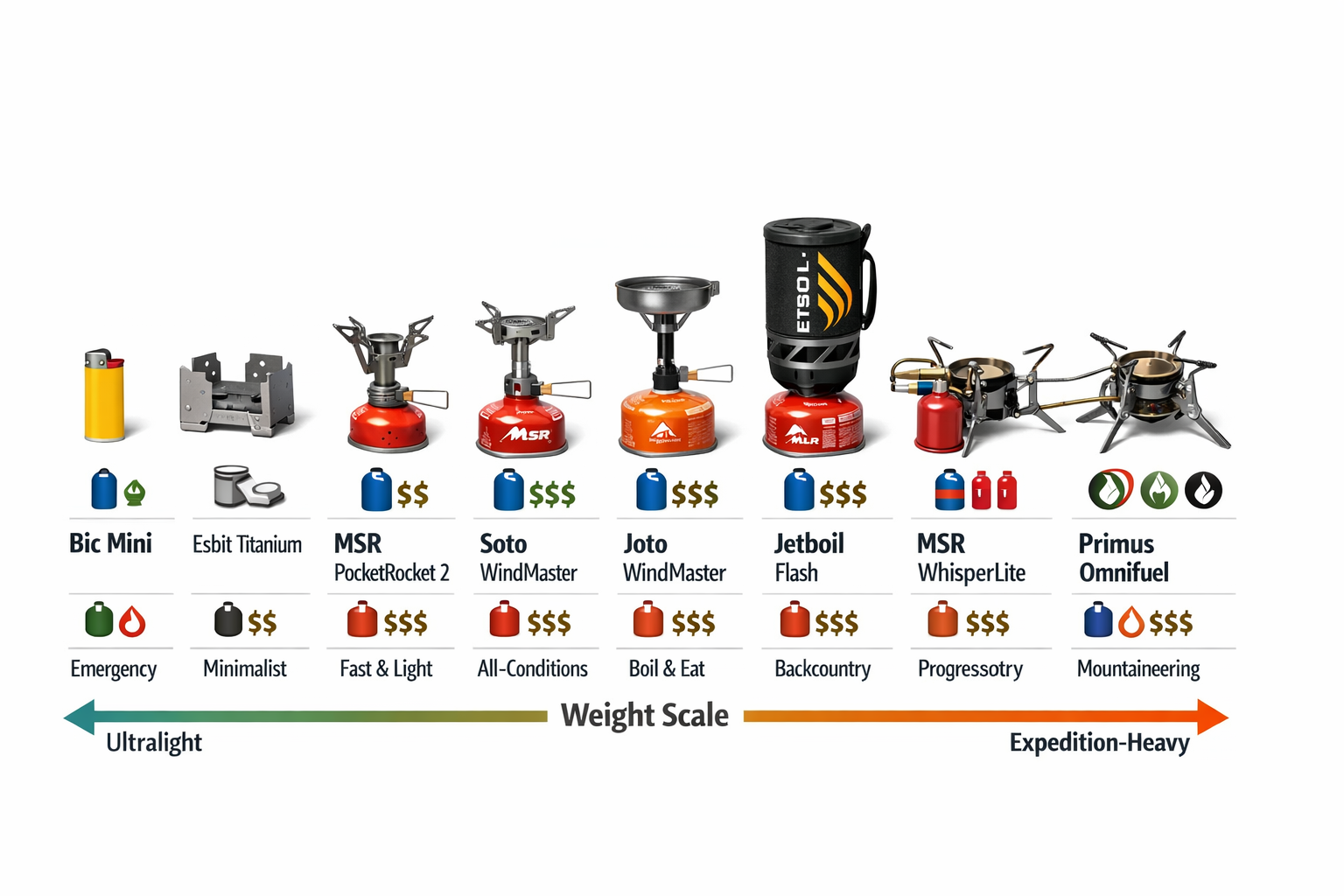
If you’re choosing between the MSR Polaris Optifuel and the PocketRocket line, the decision comes down to where you’re going and what fuel you can get.
The Polaris Optifuel burns canister gas, white gas, kerosene, diesel, and jet fuel through a single jet, making it the stove you want when traveling internationally or venturing into remote areas where isobutane canisters don’t exist.
The PocketRocket 2 weighs a fraction of the Polaris, costs a quarter of the price, and is perfectly adequate for weekend trips and three-season thru-hikes in regions with reliable canister fuel supply.
Most backpackers in North America and Western Europe will be better served by a canister stove; most expedition-goers and global travelers need a multi-fuel option.
Quick Comparison Table
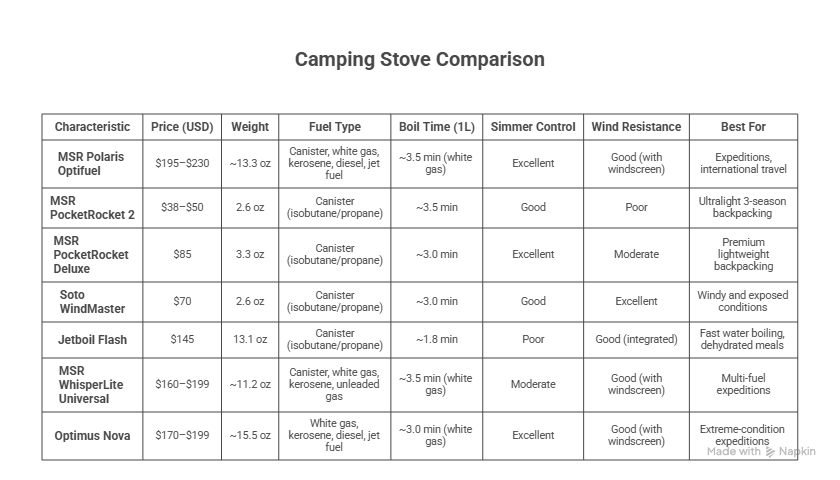
Note: Boil times are approximate and vary by altitude, ambient temperature, and wind. Weights do not include fuel bottles or canisters unless noted.
Check Latest Prices
MSR Polaris Optifuel: The Global Expedition Workhorse
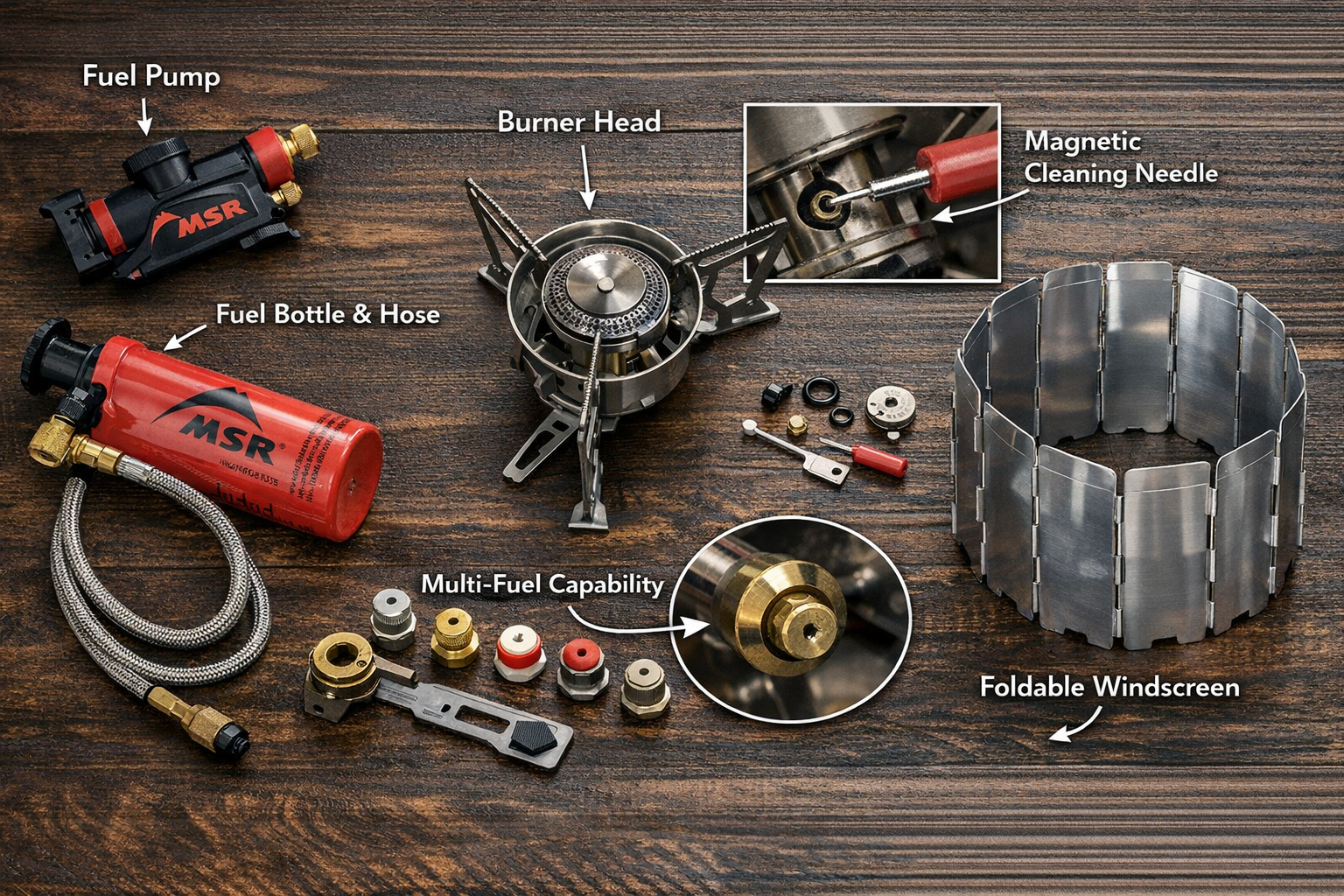
The Polaris Optifuel is MSR’s answer to a simple problem: you don’t always know what fuel you’ll find. It burns five fuel types through a single jet — no swapping parts in the field — and delivers precise flame control across all of them.
Key Features
- Single-jet multi-fuel design: Switches between canister gas, white gas, kerosene, diesel, and jet fuel without changing jets. This is a genuine advantage over older multi-fuel stoves that required a toolkit and patience.
- Self-purging pump: Pressurizes fuel bottles efficiently and purges air from the fuel line, which speeds up priming.
- Magnetic cleaning needle: Built into the stove for clearing carbon buildup without disassembly. Useful when burning dirtier fuels like kerosene or diesel.
- Precise flame control: A wide adjustment range lets you simmer sauces or run at full boil — something many multi-fuel stoves struggle with.
✅ Pros
- Burns five fuel types with zero jet changes
- Excellent simmer-to-boil flame range
- Durable construction rated for expedition abuse
- Quick priming process saves fuel and time
- Integrated magnetic cleaning needle simplifies field maintenance
- Works reliably in sub-freezing temperatures
❌ Cons
- Weighs roughly 13.3 oz (stove and pump), plus fuel bottle weight
- Requires learning the priming process (straightforward but not instant)
- $160–$195 price tag is steep for occasional campers
- Bulkier packed size than any canister stove here
Who Should Buy the Polaris Optifuel
Choose the Polaris Optifuel if you travel internationally to regions where isobutane canisters are unavailable or unreliable, think Central Asia, parts of Africa, or South America.
It’s also the right call for winter expeditions where liquid fuel outperforms pressurized canisters in cold temperatures, and for group trips where you need sustained high heat output. If your trips are mostly weekend backpacking in well-supplied areas, this stove is more capability than you need.
MSR PocketRocket 2: The Ultralight Standard
The PocketRocket 2 is probably the most popular standalone canister stove on the market, and for good reason: it weighs 2.6 ounces, screws onto a canister in seconds, and boils a liter of water in about 3.5 minutes. There’s almost nothing to break.
Key Features
- Folding pot supports: Three arms fold flat against the burner head, giving it a packed size roughly the diameter of a golf ball.
- WindClip windscreen: A small integrated clip helps shield the flame, though it won’t handle strong gusts.
- Simple brass construction: No electronics, no moving parts beyond the valve. Reliability through simplicity.
✅ Pros
- 2.6 oz — among the lightest stoves available
- Packs inside most mugs or cookpots
- $38–$50 price makes it accessible to beginners
- Decent simmer control for a stove this simple
- Proven durability over years of widespread use
❌ Cons
- No built-in igniter; you need a lighter or matches
- Performance drops significantly in wind and cold (below ~25°F / -4°C)
- Three pot supports feel tippy with pots wider than about 7 inches
- Canister fuel only — no liquid fuel option
Who Should Buy the PocketRocket 2
This is the stove for gram-counters on three-season trails. If you’re hiking the AT, PCT, or JMT in summer, the PocketRocket 2 does everything you need at a weight and price that’s hard to argue with.
It’s also a solid first stove for people new to backpacking who want something simple and affordable. Skip it if you regularly camp in exposed alpine terrain or shoulder-season cold.
MSR PocketRocket Deluxe: The Upgraded Middle Ground
Check Latest Prices
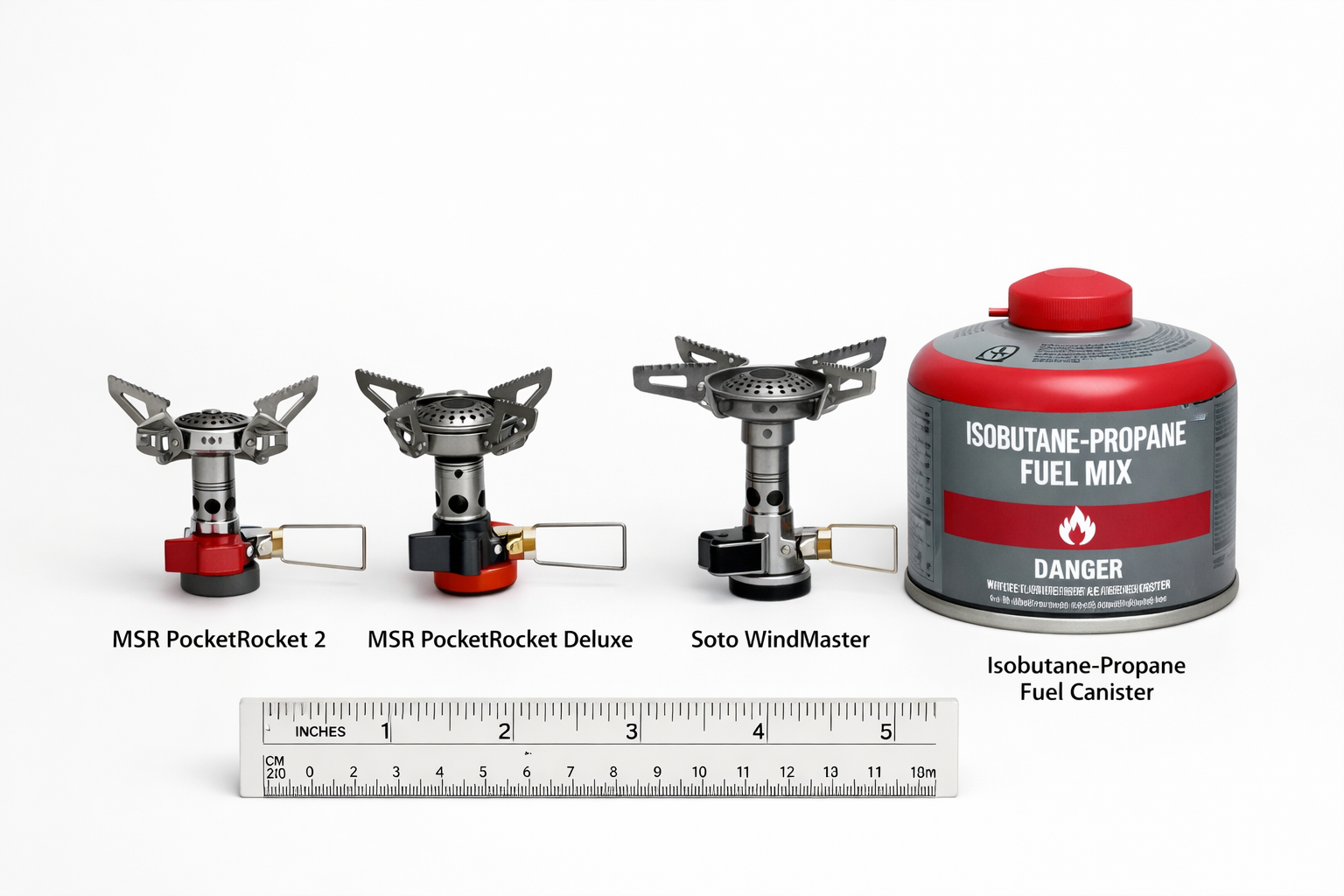
The Deluxe takes the PocketRocket formula and adds three features that matter: a pressure regulator, a wider burner head, and a piezo igniter. The result is a stove that performs more consistently across a wider range of conditions while adding less than an ounce.
Key Features
- Pressure regulator: Maintains consistent flame output as the canister empties or temperatures drop. This is the single biggest functional upgrade over the PocketRocket 2.
- Broader burner head: Distributes heat more evenly and resists wind better than the narrow flame of the PocketRocket 2.
- Push-start piezo igniter: Convenient one-handed lighting, though you should always carry a backup lighter.
✅ Pros
- Faster boil times than the PocketRocket 2 (roughly 3.0 min per liter)
- Excellent simmer control — genuinely usable for cooking, not just boiling
- Pressure regulator improves cold-weather and low-canister performance
- Better wind resistance than the PocketRocket 2
- Still compact enough to nest inside a cookpot
❌ Cons
- 3.3 oz and $85 — heavier and more than double the price of the PocketRocket 2
- Piezo igniters can fail after extended use or at high altitude
- Still not as wind-resistant as the Soto WindMaster or an integrated system
- Canister fuel only
Who Should Buy the PocketRocket Deluxe
Choose the Deluxe if you want PocketRocket simplicity but need more consistent performance. It’s particularly worth the upgrade if you cook actual meals (not just boil water for freeze-dried packets), camp into shoulder season, or regularly use canisters down to near-empty.
The $85 price positions it between the budget PocketRocket 2 and the wind-focused Soto WindMaster — and for many backpackers, it’s the best balance of the three.
Soto WindMaster: Best Canister Stove for Exposed Conditions
The WindMaster earns its name. Its recessed, concave burner head shields the flame from crosswinds better than any other standalone canister stove tested by major outdoor publications. Combined with a micro-regulator for consistent output, it’s the canister stove to pick when you camp above treeline or in coastal environments.
Key Features
- Concave recessed burner: The flame sits inside a dish-shaped burner head, naturally shielded from wind on all sides.
- Micro-regulator technology: Maintains consistent gas pressure and flame output in cold temperatures and as the canister depletes.
- Reliable piezo igniter: Soto’s igniter design has a reputation for lasting longer than many competitors.
- Detachable pot supports: The WindMaster ships with a 3-flex pot support; a 4-flex support (sold separately) adds stability for larger pots.
✅ Pros
- Best wind resistance of any standalone canister stove in this guide
- Consistent output in cold weather thanks to the micro-regulator
- Lightweight at 2.6 oz (without pot support)
- Reliable integrated igniter
- Good simmer control
❌ Cons
- Detachable pot supports are small and easy to misplace; attaching them requires a bit of fiddling
- Pots sit very close to the burner, which can cause flame wrap on narrow-bottomed cookware
- Slightly less fuel-efficient than integrated systems like the Jetboil Flash
- The 3-flex pot support feels less stable than the 4-flex (sold separately for ~$15)
Who Should Buy the Soto WindMaster
If you frequently hike in exposed, windy terrain — think Scottish Highlands, Patagonia, the Colorado 14ers, or any coastal trail — the WindMaster is the canister stove to get.
It handles conditions that would make the PocketRocket 2 nearly useless. The micro-regulator also makes it a strong choice for shoulder-season trips where temperatures dip into the 20s°F. Budget the extra $15 for the 4-flex pot support; it makes a noticeable difference in stability.
Jetboil Flash: Fastest Water Boiling, Period
The Jetboil Flash is an integrated stove system, not a standalone burner. The burner, FluxRing cooking cup, insulating cozy, and lid all nest together as one unit. It boils a liter of water in roughly 100 seconds — faster than anything else here by a wide margin.
Key Features
- FluxRing heat exchanger: Corrugated fins on the bottom of the cooking cup capture heat that would otherwise escape, dramatically improving efficiency.
- Color-changing heat indicator: A thermochromic strip on the cozy changes color as water approaches boiling. It’s a small touch, but genuinely useful.
- Integrated auto-igniter: Push-button start built into the burner base.
- 1.0L cooking cup: Enough for one to two servings of a dehydrated meal or two mugs of coffee.
✅ Pros
- Boils 0.5L of water in about 100 seconds — the fastest on this list
- Highly fuel-efficient for boiling tasks
- All-in-one system packs neatly with canister inside the cup
- Good wind performance due to the enclosed design
- Easy to use with minimal learning curve
❌ Cons
- 13.1 oz system weight — heavier than a PocketRocket 2 plus a separate pot
- Poor simmer control; cooking anything beyond boiling water is difficult
- Limited to the proprietary cooking cup (accessories exist but add cost and weight)
- $145 price for what is essentially a dedicated water boiler
- The tall, narrow form factor is less stable on uneven ground
Who Should Buy the Jetboil Flash
The Flash makes sense if your backcountry cooking routine is: boil water, pour into freeze-dried meal bag, eat. It’s ideal for solo hikers or pairs who prioritize speed and convenience over culinary flexibility.
It’s also a good choice for mountaineering where you need to melt snow quickly. Don’t buy it if you want to cook real meals — the simmer control is too poor and the proprietary cup limits your options.
MSR WhisperLite Universal: The Multi-Fuel Veteran
The WhisperLite Universal bridges canister and liquid fuel worlds, burning isobutane/propane canisters and three liquid fuels (white gas, kerosene, unleaded gasoline). It’s been a staple of expedition cooking for years, and its field-maintainability is a genuine advantage in remote settings.
Key Features
- Dual-fuel compatibility: Accepts both canister and liquid fuel, with a simple adapter swap.
- Shaker jet cleaning: A built-in cleaning needle clears blockages with a shake — no tools needed.
- Collapsible pot supports and windscreen: The wide base provides excellent stability for large pots.
- Field-maintainable: Every component can be serviced with the included maintenance kit.
✅ Pros
- Burns canister gas, white gas, kerosene, and unleaded gasoline
- Extremely durable; proven track record in harsh conditions
- Wide, stable base supports large group cookpots
- Field-serviceable with basic tools
- Good simmer control on canister fuel
❌ Cons
- ~11.2 oz (stove + pump) before adding fuel bottle weight
- Priming liquid fuel has a learning curve and produces a brief flare-up
- Simmer control on liquid fuel is less precise than the Polaris Optifuel
- More parts to manage: pump, fuel line, windscreen, heat reflector
- Does not burn diesel or jet fuel (unlike the Polaris Optifuel)
Who Should Buy the WhisperLite Universal
The WhisperLite Universal is a strong choice for international travelers who want the convenience of canister fuel when it’s available but need liquid fuel as a backup.
It’s lighter than the Polaris Optifuel by a couple of ounces and slightly less expensive. However, it doesn’t burn diesel or jet fuel, so if you’re headed to truly remote regions where those might be the only fuels available, the Polaris Optifuel has the edge.
For winter camping in North America where white gas is the standard, the WhisperLite Universal is a proven performer.
Optimus Nova: Built for Extreme Conditions
Check Latest Prices
The Optimus Nova is a liquid-fuel-only stove built like a tank. It burns white gas, kerosene, diesel, and jet fuel without jet changes, and its low-profile design creates an exceptionally stable cooking platform. It’s the stove you’ll find in base camps on serious mountaineering expeditions.
Key Features
- No-jet-change multi-fuel: Like the Polaris Optifuel, it handles multiple liquid fuels through a single jet.
- Wide, low burner: Creates a stable platform that handles large pots confidently.
- Precise flame control: The regulator allows fine-tuned simmering — uncommon for a liquid fuel stove.
- Quick-connect fuel line: Attaches to the fuel bottle without threading.
✅ Pros
- Extremely durable construction built for expedition abuse
- Multi-fuel versatility with no jet swaps
- Excellent flame control from simmer to full boil
- Very stable base for large pots and group cooking
- Quick priming process
❌ Cons
- ~15.5 oz (stove + pump) — the heaviest option in this guide
- Liquid fuel only; no canister option (unlike the Polaris Optifuel or WhisperLite Universal)
- Windscreen not always included depending on version
- Learning curve for those unfamiliar with liquid fuel stoves
- $150–$185 price range
Who Should Buy the Optimus Nova
The Nova is for dedicated expedition users who know they’ll be using liquid fuel and want the most durable, stable stove available. It’s a better choice than the Polaris Optifuel if you never plan to use canister fuel and want a slightly wider, more stable cooking platform. It’s overkill for weekend backpacking and unnecessary if canister fuel is readily available where you hike.
Buying Guide: How to Choose the Right Backpacking Stove
Fuel Type Is the First Decision
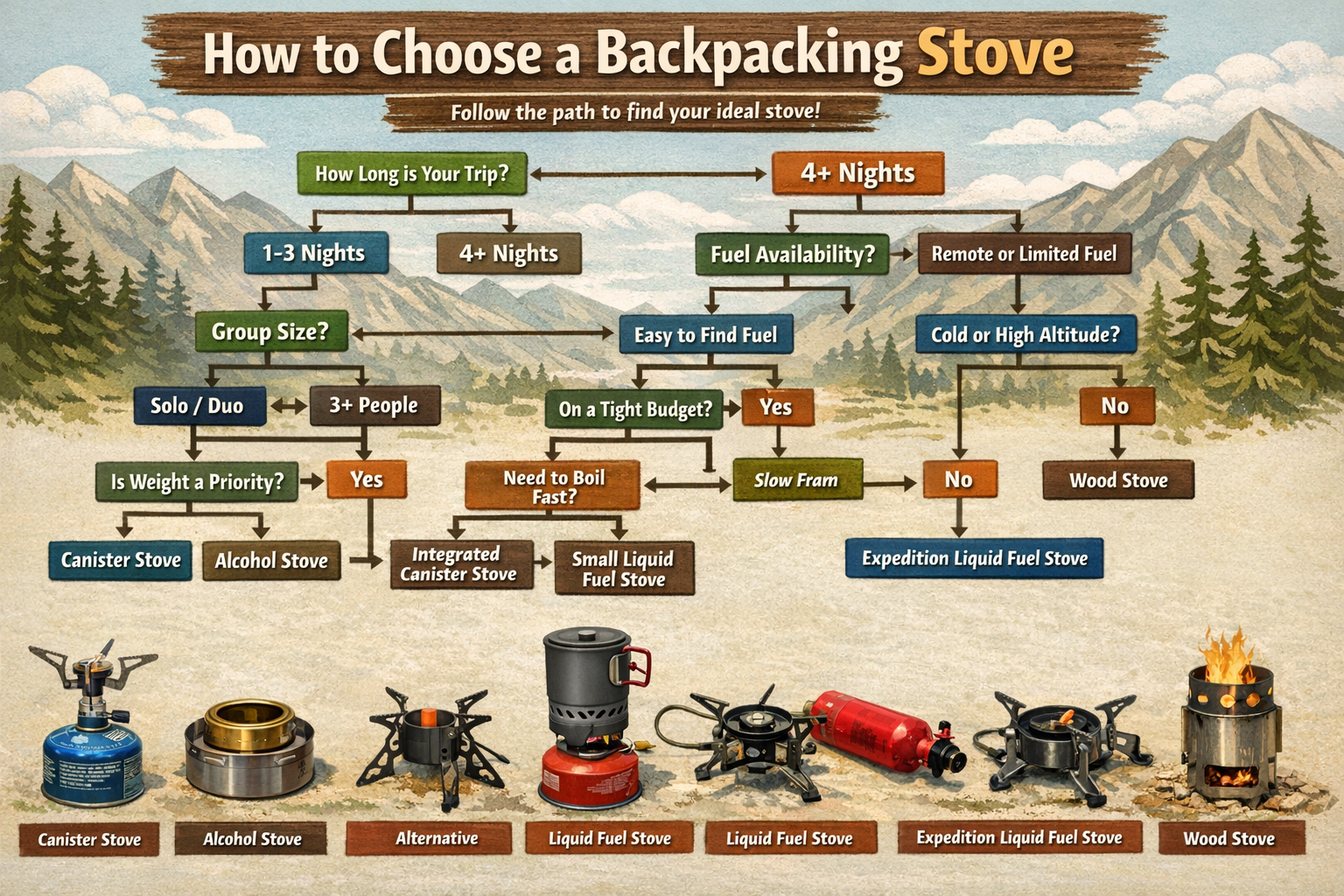
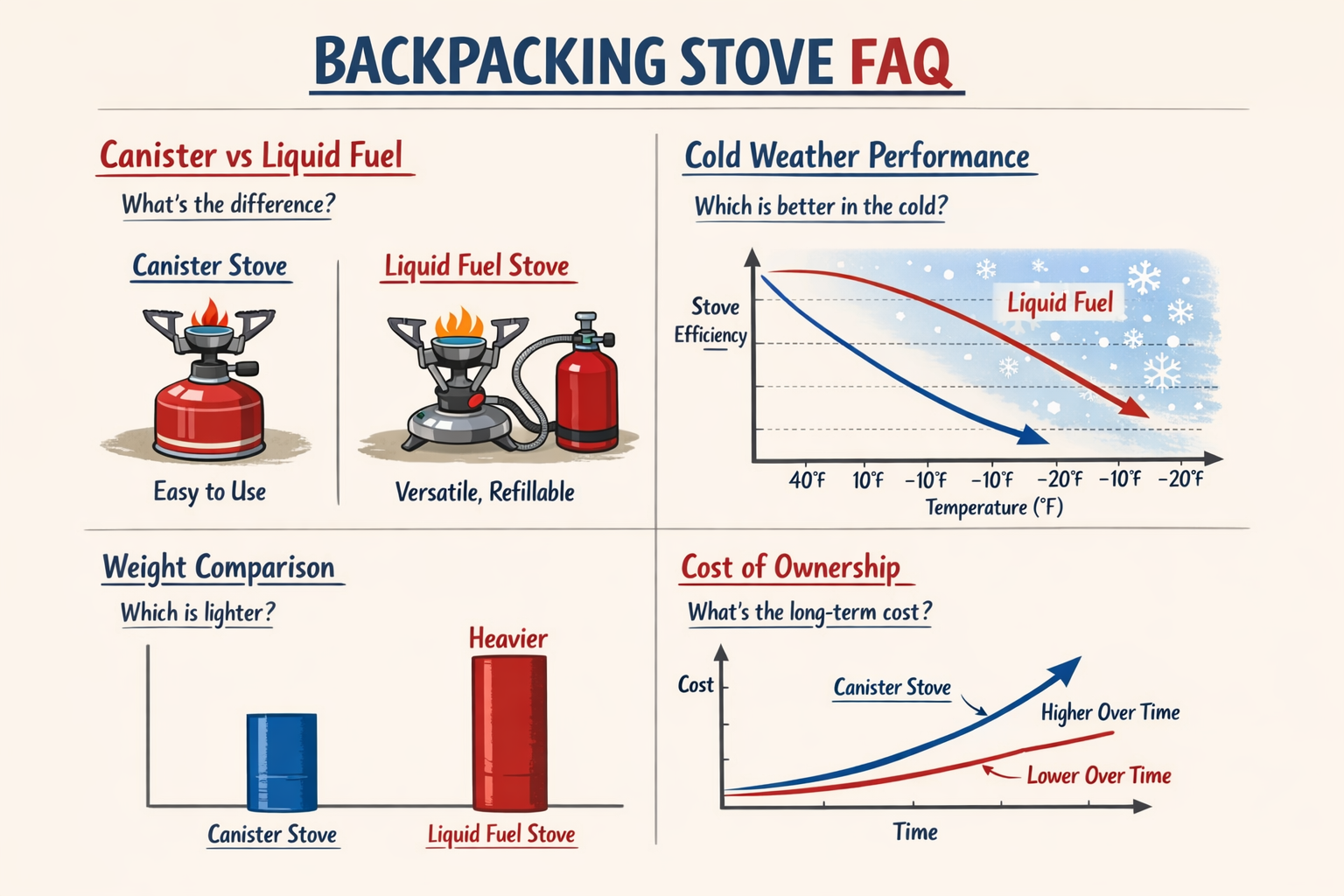
This is the fork in the road. Canister stoves (PocketRocket 2, PocketRocket Deluxe, WindMaster, Jetboil Flash) are lighter, simpler, and easier to use. Liquid fuel and multi-fuel stoves (Polaris Optifuel, WhisperLite Universal, Optimus Nova) are heavier and more complex but work in cold weather and in regions where canisters aren’t sold.
Choose canister if: You hike in North America, Western Europe, Japan, or other regions with reliable outdoor retail. Your trips are primarily three-season. You value simplicity and low weight.
Choose multi-fuel if: You travel internationally to developing regions. You camp in winter below 20°F (-7°C). You need to cook for groups over extended periods. Fuel availability is uncertain.
Weight vs. Capability
The lightest stove here (PocketRocket 2 at 2.6 oz) and the heaviest (Optimus Nova at ~15.5 oz) differ by about 13 ounces. That’s meaningful in a backpack, but weight alone shouldn’t drive the decision. A stove that can’t function in your conditions is dead weight regardless of how light it is.
Wind Performance
Wind is the most underestimated factor in stove selection. A stove that boils water in 3.5 minutes in your kitchen may take 8+ minutes on an exposed ridge. If you camp above treeline or in coastal environments, prioritize wind resistance: the Soto WindMaster for canister stoves, or any multi-fuel stove with a proper windscreen.
Simmer Control
If you cook real meals — pasta, rice, sauces — simmer control matters. The PocketRocket Deluxe, Polaris Optifuel, and Optimus Nova offer the best simmering in their respective categories. The Jetboil Flash is the worst for simmering; it’s essentially a binary boil-or-off device.
Budget Considerations
The PocketRocket 2 at $38–$50 is the clear budget pick. But factor in ongoing fuel costs: canister fuel typically costs $5–$8 per 8 oz canister, while white gas runs about $10–$15 per liter (which lasts longer). Over many trips, liquid fuel can be cheaper per meal, especially for group cooking.
Group Size
Solo hikers and pairs can get by with any stove here. Groups of three or more should lean toward the multi-fuel stoves (Polaris Optifuel, WhisperLite Universal, Optimus Nova), which support larger pots and deliver sustained high heat output without the declining performance that plagues canister stoves during extended cooking sessions.
Frequently Asked Questions
Can I use the MSR PocketRocket 2 in winter?
It works in mild winter conditions above about 25°F (-4°C) if you keep the canister warm (sleep with it in your sleeping bag). Below that, canister pressure drops and performance suffers significantly. For serious winter camping, use a liquid fuel stove or the PocketRocket Deluxe or WindMaster with a canister warmer, though even those have limits.
Is the MSR Polaris Optifuel worth the price over the WhisperLite Universal?
Yes, if you need diesel or jet fuel compatibility. The Polaris Optifuel burns five fuel types through a single jet; the WhisperLite Universal burns four (no diesel, no jet fuel). The Polaris also offers slightly better simmer control on liquid fuels. If you’ll only use white gas and canister fuel, the WhisperLite Universal saves you $10–$35 and shaves a couple of ounces.
How does the Soto WindMaster compare to the MSR PocketRocket Deluxe?
Both have pressure regulators and good simmer control. The WindMaster has better wind resistance due to its recessed burner design. The PocketRocket Deluxe has a broader burner that distributes heat more evenly across the pot bottom. In calm conditions, they perform similarly. In wind, the WindMaster pulls ahead. The WindMaster is $15 cheaper but its detachable pot supports are less convenient than the Deluxe’s integrated folding arms.
Is the Jetboil Flash worth it if I only boil water?
Yes, it’s the most efficient and fastest option for dedicated water boiling. You’ll use less fuel per boil than any standalone stove, and the integrated design resists wind well. The trade-off is weight (13.1 oz for the system), lack of cooking versatility, and the $145 price. If you eat exclusively dehydrated meals and drink hot beverages, the Flash pays for itself in fuel savings and time over a long thru-hike.
Do I really need a multi-fuel stove for international travel?
It depends on where you’re going. In Western Europe, Japan, South Korea, Australia, and New Zealand, canister fuel is widely available. In Central Asia, much of Africa, rural South America, and parts of Southeast Asia, canisters are scarce or nonexistent. Research fuel availability for your specific destination. When in doubt, a multi-fuel stove eliminates the risk.
How long does a piezo igniter typically last?
Most piezo igniters on stoves like the PocketRocket Deluxe and WindMaster last for several hundred to a few thousand clicks under normal conditions. Moisture, altitude, and mechanical wear degrade them over time. Always carry a mini BIC lighter or waterproof matches as backup — this is non-negotiable regardless of which stove you use.
Final Verdict: Which Stove Should You Buy?
Best overall for most backpackers: MSR PocketRocket Deluxe ($85). It balances weight, performance, features, and price better than anything else here. The pressure regulator and improved burner make it meaningfully better than the PocketRocket 2 in real-world conditions, and the sub-$100 price keeps it accessible.
Best budget pick: MSR PocketRocket 2 ($38–$50). If you’re starting out, hiking in fair weather, or counting every gram and dollar, the PocketRocket 2 does the job. It’s simple, proven, and cheap enough to replace if something goes wrong.
Best for wind: Soto WindMaster ($70). Nothing in the canister stove category matches its wind resistance. If you camp in exposed terrain regularly, this is the one.
Best for expeditions and international travel: MSR Polaris Optifuel ($160–$195). Five fuel types, one jet, excellent flame control. It’s the most versatile stove here and the right choice when you can’t predict what fuel you’ll find.
Best for fast boiling only: Jetboil Flash ($145). Unmatched speed and efficiency for boiling water. Accept its limitations and it’s a fantastic tool for the right user.
Best multi-fuel alternative: MSR WhisperLite Universal ($150–$160). Lighter and slightly cheaper than the Polaris Optifuel, with canister compatibility. Choose it over the Polaris if you don’t need diesel or jet fuel.
Best for extreme expeditions: Optimus Nova ($150–$185). The most durable and stable liquid fuel stove here. Choose it for base camp cooking and extended trips where reliability in harsh conditions is the top priority.
The right stove isn’t the lightest, the cheapest, or the most versatile in isolation — it’s the one that matches your specific trips, conditions, and cooking style. Start with where you’re going and what fuel you can get, then narrow from there.
Check Latest Prices
Key Takeaways
- Fuel type (canister vs. liquid vs. multi-fuel) should be your first decision, driven by where you travel and in what conditions.
- The MSR PocketRocket 2 remains the best value canister stove for three-season, fair-weather backpacking.
- The PocketRocket Deluxe’s pressure regulator is worth the $35–$47 premium for anyone who camps into shoulder season or wants better simmer control.
- The Soto WindMaster is the best standalone canister stove for windy and exposed conditions.
- The MSR Polaris Optifuel’s five-fuel, single-jet design makes it the most versatile multi-fuel stove available for global travel.
- The Jetboil Flash is a specialist tool — the fastest water boiler here, but poor at anything else.
- Always carry a backup lighter, even with stoves that have built-in igniters.
- Wind resistance is the most commonly underestimated factor in stove performance.
- For groups of three or more, multi-fuel stoves with large pot support are more practical than canister stoves.
- Research fuel availability at your destination before committing to a stove type.