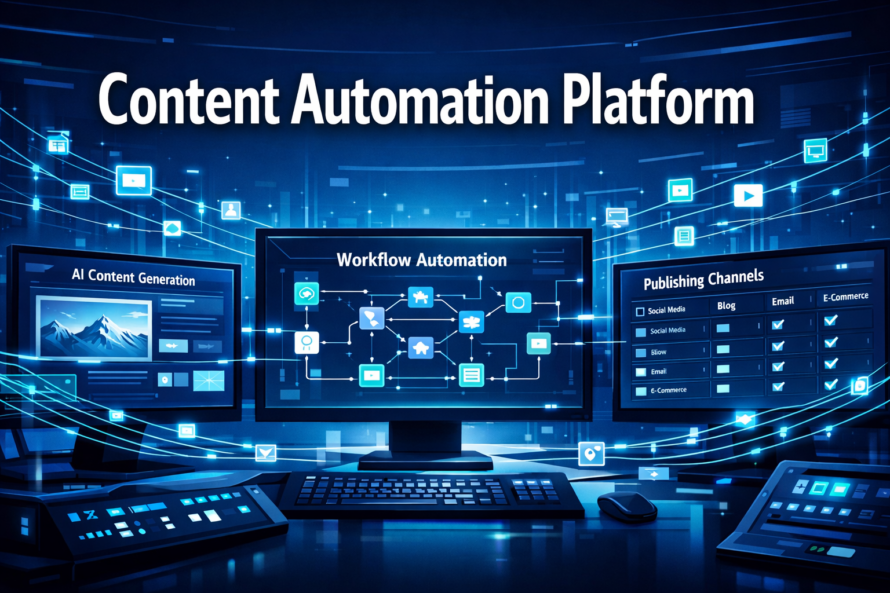
Content Automation Platform
Last updated: April 4, 2026
Quick Answer: A Content Automation Platform is software that uses AI and rule-based workflows to plan, create, schedule, publish, and analyze content across multiple channels — without requiring manual effort at every step.
In 2026, the global AI marketing market is valued at $47.32 billion, and these platforms sit at the center of that growth.
The right platform can cut content production time significantly while maintaining brand consistency at scale.
Key Takeaways
- A Content Automation Platform handles the full content lifecycle: creation, scheduling, publishing, and performance analysis.
- AI content generation has advanced to drafting long-form articles, personalized video scripts, and entire multichannel campaign flows with real-time brand voice management [3].
- Top platforms in 2026 include HubSpot, Hootsuite, Jasper AI, Buffer, Sprout Social, and WordPress with AI plugin integrations.
- Pricing ranges from free tiers (Buffer) to enterprise contracts exceeding $1,200/month (HubSpot Marketing Hub).
- Integration depth — with CRMs, ad platforms, and analytics tools — is the most commonly overlooked buying criterion.2
- Meta is integrating Manus AI directly into Ads Manager and creator tools, making platform-native automation more powerful than ever [1].
- Hyper-personalization through real-time intent matching is the defining competitive differentiator for platforms in 2026 [2].
- ROI from content automation is measurable: track time saved per content asset, cost per published piece, and engagement lift post-automation.
What Is a Content Automation Platform?
A Content Automation Platform is a software system that automates repetitive tasks in the content production and distribution process.
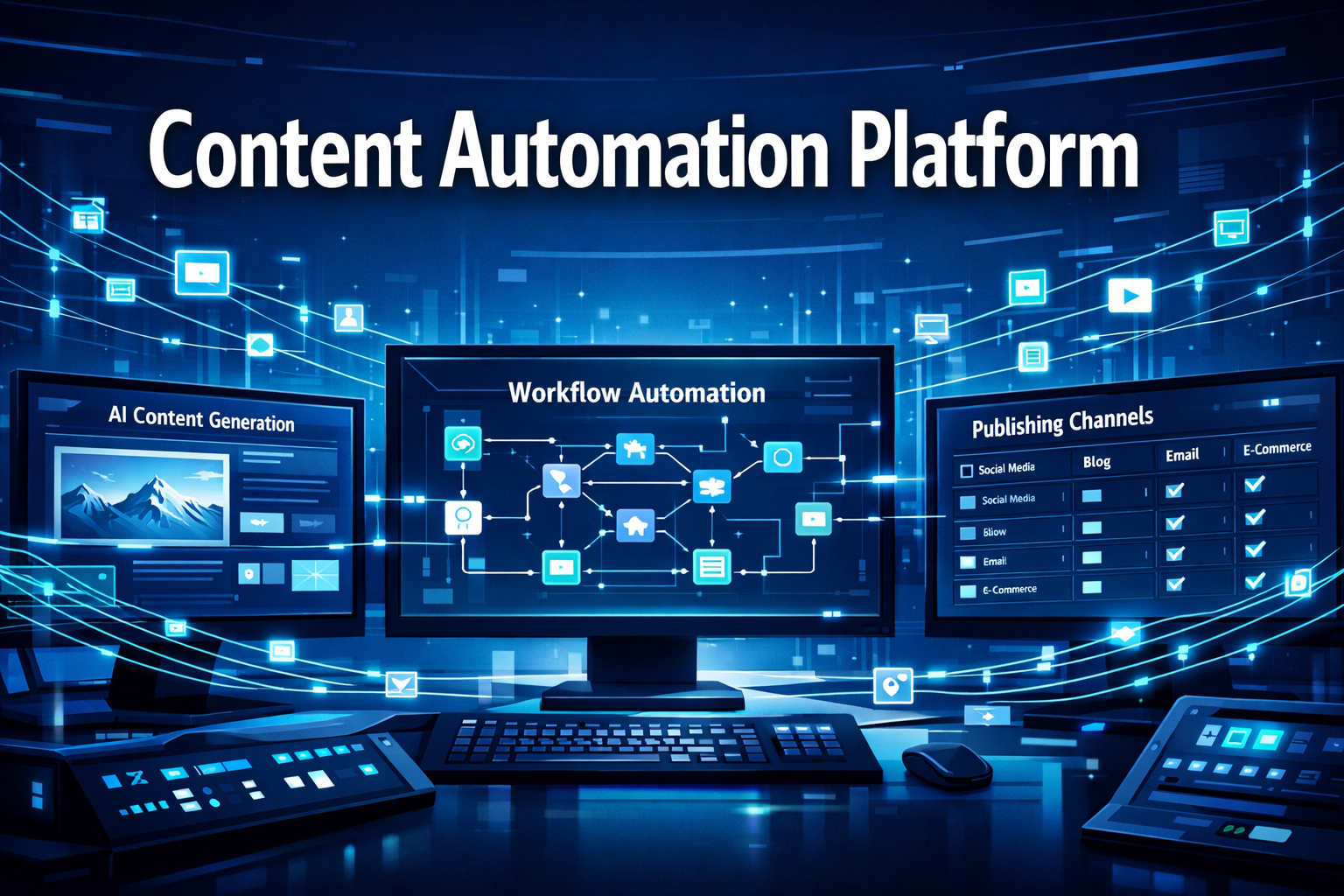
This includes AI-assisted writing, automated scheduling, multichannel publishing, performance tracking, and workflow management — all from a centralized interface.
These platforms differ from basic scheduling tools in one key way: they connect the entire content supply chain.
Instead of moving between a writing tool, a scheduler, an analytics dashboard, and a CRM, a content automation platform ties those functions together so data flows between them automatically.
Who it’s for: Marketing teams producing content at volume — agencies, enterprise brands, SaaS companies, media publishers, and e-commerce businesses. It’s less suited to solo creators publishing once a week who don’t need workflow orchestration.
How Do Social Media Automation Tools Fit Into the Broader Platform?
Social media automation tools are a subset of the larger content automation platform category. They handle scheduling, posting, and engagement tracking across platforms like Instagram, LinkedIn, X (Twitter), and Facebook.
In 2026, the distinction between a “social scheduler” and a full content automation platform has nearly disappeared.
Tools like Hootsuite and Sprout Social now include AI content generation, competitor benchmarking, and CRM integrations that were previously only available in enterprise marketing suites.
Key social automation capabilities to look for:
- Bulk scheduling with AI-suggested optimal posting times
- Cross-platform content adaptation (auto-resize images, reformat captions)
- Engagement monitoring and automated response triggers
- Hashtag and keyword performance tracking
- LinkedIn AI visibility optimization, which is increasingly important as LinkedIn content is highly cited in AI search results [1]
Top Content Automation Platforms in 2026: Compared
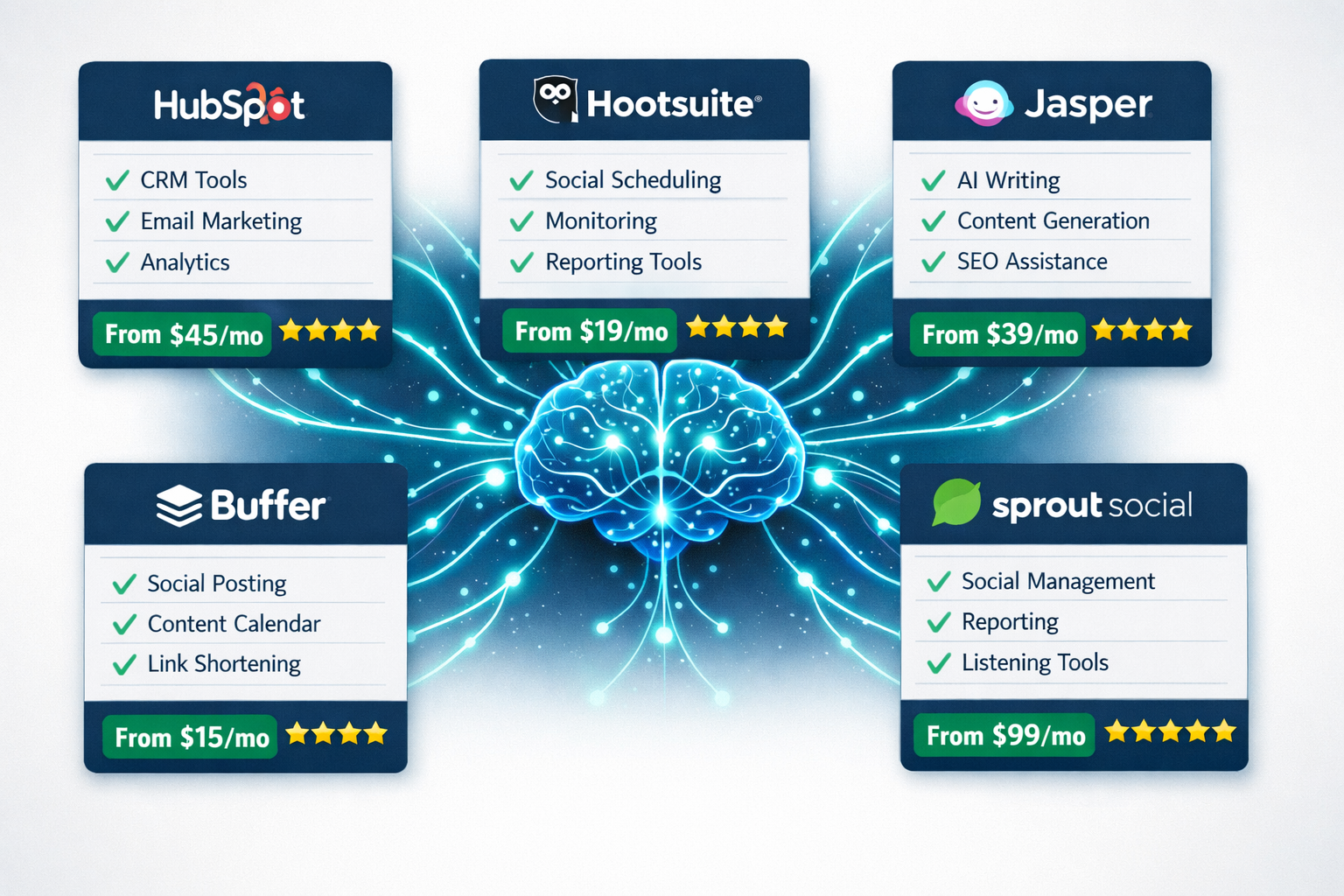
Here is a direct comparison of the leading platforms based on features, pricing, and best-fit use cases.
| Platform | Best For | Starting Price | AI Writing | CRM Integration | Social Scheduling |
|---|---|---|---|---|---|
| HubSpot Marketing Hub | Enterprise teams | $800/mo | ✅ | ✅ Native | ✅ |
| Hootsuite | Social-first teams | $99/mo | ✅ | ✅ Via integration | ✅ |
| Jasper AI | Content-heavy brands | $49/mo | ✅ Native | ❌ Limited | ❌ |
| Buffer | SMBs and startups | Free / $6/mo | ✅ Basic | ❌ | ✅ |
| Sprout Social | Agencies | $249/mo | ✅ | ✅ | ✅ |
| WordPress + AI Plugins | Web-first publishers | Free + plugin costs | ✅ (OpenAI, Gemini, Claude) | ✅ Via plugins | ❌ |
Notes on each:
- HubSpot is the most complete content automation platform for teams that need CRM, email, blog, and social in one place. The price reflects that breadth.
- Hootsuite added AI content generation and now competes directly with more expensive enterprise tools for social-focused teams.
- Jasper AI excels at long-form content and brand voice consistency but requires pairing with a separate scheduler.
- Buffer is the best entry point for small teams. Its AI features are basic but the scheduling and analytics are solid.
- Sprout Social is strong for agencies managing multiple client accounts with detailed reporting needs.
- WordPress with AI plugins (now integrating OpenAI, Gemini, and Claude directly) gives web publishers flexible, customizable automation without a monthly SaaS fee [1].
Choose HubSpot if you need a single platform to run email campaigns, blog publishing, lead nurturing, and social from one dashboard. Choose Jasper + Buffer if you want best-in-class AI writing at a lower combined cost and don’t need deep CRM features.
How AI Is Transforming Content Workflows in 2026
AI has moved from “helpful assistant” to active workflow participant. In 2026, AI content generation tools can draft long-form articles, structure interactive media, generate personalized video scripts, and create entire multichannel campaign flows — with real-time brand voice management and language localization built in [3].
Three concrete shifts happening right now:
- Automated campaign creation: Marketing teams are deploying intelligent platforms that create, schedule, and adapt content for every channel within a centralized environment, with automatic tracking across all assets [3].
- Spreadsheet and document automation: Google’s Gemini AI in Workspace now synthesizes information from emails, files, chats, and calendar data to auto-generate fully formatted documents — achieving a 70.48% success rate on the SpreadsheetBench dataset, a new benchmark for AI-driven automation [4].
- Hyper-personalization at scale: Content management platforms are connecting intent data, behavioral signals, and content libraries in real time to anticipate customer needs before they are expressed [2]. This is no longer a premium feature — it’s becoming table stakes.
“The platforms that win in 2026 are the ones that don’t just automate publishing — they automate relevance.” — Observed trend across enterprise CMS deployments [2]
Common mistake: Teams often automate distribution before they automate creation. The bigger time savings come from AI-assisted drafting, not just scheduling.
What Are the Key Features of an Enterprise Content Automation Platform?
An enterprise Content Automation Platform needs more than scheduling and AI writing. The features that separate enterprise-grade tools from SMB tools are depth of integration, governance controls, and performance intelligence.
Must-have features for enterprise buyers:
- Brand voice management: AI that learns and enforces your brand’s tone, terminology, and style across all outputs
- Multi-user workflows: Role-based permissions, approval chains, and editorial calendars for teams of 10+
- CRM and ad platform integration: Native connections to Salesforce, HubSpot CRM, Meta Ads Manager, and Google Ads
- Real-time content optimization: Suggestions based on current performance data, not last month’s averages
- Multichannel distribution: Publish to blog, email, social, and paid channels from a single workflow
- Compliance and audit trails: Version history, content approval logs, and brand safety filters
- AI moderation support: Meta is shifting toward AI handling content moderation decisions at scale, and enterprise platforms are following suit [1]
Edge case to watch: If your team operates across multiple regions or languages, check whether the platform supports localization workflows natively or requires third-party tools.
Many platforms advertise “multilingual support” but only offer basic translation, not localized brand voice management.
How to Calculate ROI From a Content Automation Platform
ROI from a content automation platform is measurable if you track the right inputs before and after implementation.
Step-by-step ROI calculation:
- Measure current content production cost: Hours per asset × hourly rate × monthly volume
- Measure post-automation production cost: Same formula after implementation
- Calculate time savings: (Pre-automation hours − Post-automation hours) × hourly rate
- Add engagement lift value: Increased traffic, leads, or conversions attributed to higher content volume or better targeting
- Subtract platform cost: Monthly subscription + onboarding + training time
- Net ROI = (Time savings + Engagement lift) − Platform cost
Example estimate (assumptions: 5-person content team, 40 assets/month, $75/hr blended rate):
- Pre-automation: 4 hrs/asset × 40 assets × $75 = $12,000/month in labor
- Post-automation (estimate: 50% time reduction): $6,000/month in labor
- Monthly savings: $6,000
- Platform cost (mid-tier): $500/month
- Estimated net monthly ROI: $5,500
This is an illustrative estimate. Actual results depend on team size, content complexity, and platform fit.
What Are the Ethical Considerations in Content Automation?

Content automation raises real ethical questions that most platform vendors don’t address directly. Buyers should factor these into their evaluation.
Key ethical considerations:
- Transparency with audiences: Should AI-generated content be labeled? Some platforms include disclosure features; most don’t enforce them.
- Misinformation risk: Automated content at scale can amplify errors quickly. Human review checkpoints are not optional — they’re a risk management requirement.
- Job displacement: Automation changes team structures. Content teams are shifting from production roles to editorial oversight and strategy roles. Plan for this transition.
- Data privacy in personalization: Hyper-personalization requires behavioral data. Ensure your platform’s data handling complies with GDPR, CCPA, and any regional regulations relevant to your audience.
- Brand safety in AI outputs: AI writing tools occasionally produce off-brand or factually incorrect content. Brand voice guardrails and approval workflows are essential, not optional.
Decision rule: If a platform vendor can’t explain how their AI handles factual accuracy and brand safety, treat that as a red flag — not a minor gap.
Industry-Specific Automation Strategies
Different industries get different value from a content automation platform. Here’s where the ROI concentrates by sector:
- E-commerce: Automated product description generation, dynamic email campaigns triggered by browsing behavior, and social proof content (reviews, UGC curation)
- SaaS/Tech: Thought leadership content pipelines, automated onboarding email sequences, and developer documentation updates
- Healthcare: Compliant content workflows with approval gates, patient education content localized by region
- Financial services: Regulatory-compliant content templates, automated market commentary, and personalized client communications
- Agencies: Multi-client content calendars, white-label reporting, and AI-assisted creative briefs
CRM-integrated automation is especially powerful in financial services and SaaS, where intelligent platforms now manage real-time customer interactions, capture behavioral data, and instantly update customer profiles through AI chatbots [6].
Conclusion: How to Choose and Implement the Right Platform
The Content Automation Platform market in 2026 is mature enough that there’s a credible option for every team size and budget. The global AI marketing market at $47.32 billion [7] reflects real adoption — not hype.
Your next steps:
- Audit your current workflow before buying anything. Identify where time is actually lost: creation, approval, scheduling, or reporting.
- Shortlist based on integration needs first. A platform that doesn’t connect to your CRM or ad accounts will create new silos, not eliminate them.
- Run a paid pilot on 2-3 platforms using a real content campaign. Free trials rarely reveal workflow friction.
- Build your ROI baseline before go-live so you can measure actual impact at 30, 60, and 90 days.
- Plan your team structure change. Automation works best when someone owns the editorial strategy layer that AI cannot replace.
The platforms that deliver the most value are the ones that fit your existing stack, match your team’s technical comfort level, and have a clear roadmap for AI feature development.
Start with your workflow gaps, not the feature list.
Frequently Asked Questions
Q: What is the difference between a content automation platform and a social media scheduler?
A social media scheduler handles posting and timing. A content automation platform covers the full lifecycle: AI-assisted creation, approval workflows, multichannel publishing, CRM integration, and performance analytics. Schedulers are a feature inside broader platforms.
Q: Is a content automation platform worth it for small businesses?
Yes, if you’re publishing more than 10-15 pieces of content per month across multiple channels. Tools like Buffer (free tier) and WordPress with AI plugins make entry-level automation accessible without significant cost [1].
Q: How does AI content generation maintain brand voice?
Enterprise platforms use brand voice profiles — trained on your existing content — to guide AI outputs. You define tone, vocabulary preferences, and off-limits language. The AI generates within those constraints. Human review remains necessary for accuracy.
Q: Can content automation platforms handle video content?
Increasingly yes. In 2026, AI tools can generate personalized video scripts and structure video content briefs [3]. Full video production automation (editing, rendering) is still emerging and typically requires separate tools.
Q: What integrations should I prioritize when evaluating platforms?
CRM (Salesforce, HubSpot), ad platforms (Meta Ads Manager, Google Ads), analytics (GA4, Looker), and your CMS (WordPress, Webflow). If a platform can’t connect to at least three of these natively, factor in integration costs.
Content Automation Platform: FAQs
Q: How long does it take to implement a content automation platform?
Basic setup (scheduling, social accounts connected) takes 1-2 days. Full workflow automation with CRM integration, brand voice training, and team onboarding typically takes 4-8 weeks for mid-size teams.
Q: Are there risks to automating content at scale?
Yes. The main risks are content quality drift, factual errors amplified at volume, and brand safety issues. Mitigation requires human editorial oversight, approval workflows, and regular audits of AI outputs.
Q: What is hyper-personalization in content automation?
Hyper-personalization connects real-time intent data, behavioral signals, and content libraries to deliver the right content to the right person at the right moment — anticipating needs before they’re expressed [2]. It goes beyond segmentation into individual-level content adaptation.
References
[1] April 2026 Digital News Updates – https://bootcampdigital.com/blog/april-2026-digital-news-updates/
[2] Key Trends For 2026 Whats Ahead For Content Management Cx And Ai With Coremedias Sren Stamer – https://cmscritic.com/key-trends-for-2026-whats-ahead-for-content-management-cx-and-ai-with-coremedias-sren-stamer
[3] Ai Content Generation In 2026 Brand Voice Strategy And Scaling – https://www.roboticmarketer.com/ai-content-generation-in-2026-brand-voice-strategy-and-scaling/
[4] Latest Ai News And Updates – https://www.crescendo.ai/news/latest-ai-news-and-updates
[6] Crm Automation Trends That Will Dominate 2026 – https://thetechclouds.com/crm-automation-trends-that-will-dominate-2026/
[7] Ai Powered Marketing Automation – https://almcorp.com/blog/ai-powered-marketing-automation/