AEO and GEO in Digital Marketing
Last updated: April 27, 2026
Quick Answer: AEO (Answer Engine Optimization) and GEO (Generative Engine Optimization) are two emerging search strategies that go beyond traditional SEO. AEO focuses on getting your content selected as the direct answer in search engines and voice assistants. GEO focuses on getting your brand cited or referenced inside AI-generated responses from tools like ChatGPT, Gemini, and Perplexity. Both are now essential parts of a complete digital marketing strategy in 2026.
Key Takeaways
- AEO targets featured snippets, voice search answers, and “People Also Ask” boxes — any place where a search engine answers a question directly.
- GEO targets generative AI platforms that compose original responses, aiming to get your brand, content, or data cited within those responses.
- Traditional SEO still matters, but it no longer covers the full search landscape on its own.
- Structured data (schema markup) is a core tactic for both AEO and GEO.
- Content written in a clear, question-and-answer format performs better across all three disciplines.
- GEO is harder to measure than AEO because AI citation tracking tools are still maturing.
- Brands that build genuine topical authority tend to win in both AEO and GEO.
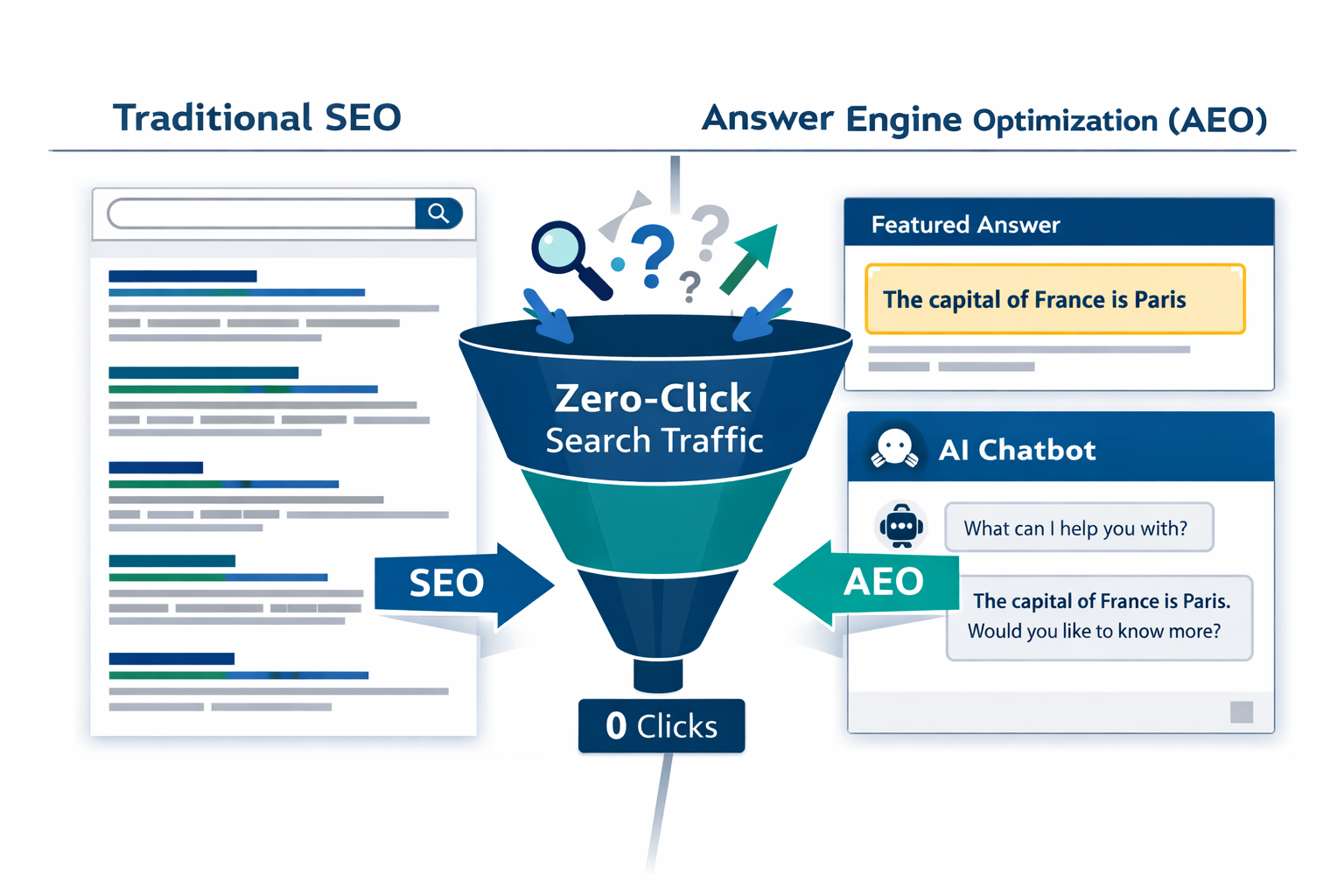
- Zero-click searches — where users get answers without visiting a website — are growing, making AEO and GEO critical for brand visibility even when traffic doesn’t follow.
What Are AEO and GEO in Digital Marketing?
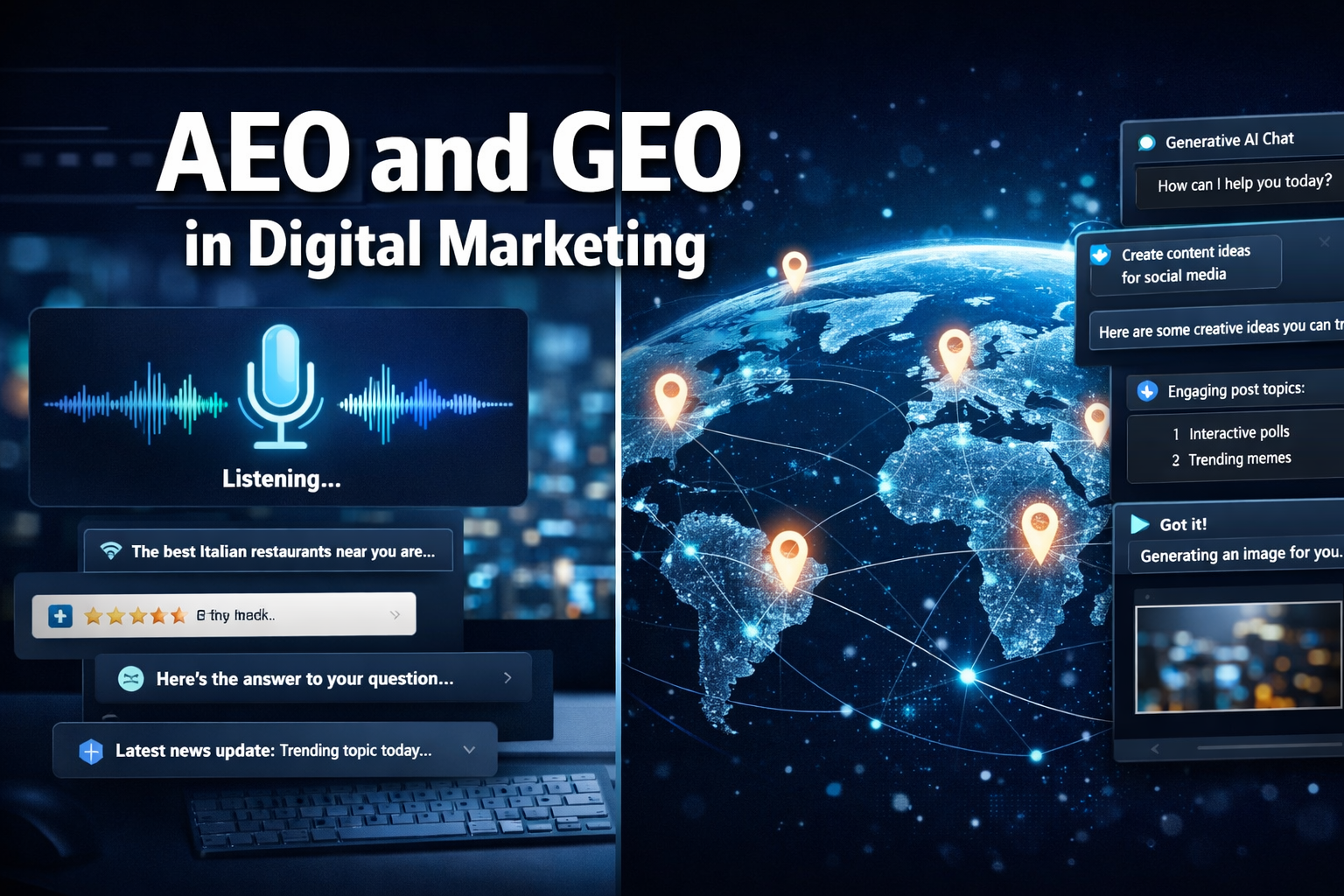
AEO stands for Answer Engine Optimization. GEO stands for Generative Engine Optimization. Together, AEO and GEO in Digital Marketing represent the next evolution of search strategy, designed for a world where users increasingly get answers without ever clicking a link.
Here’s the simplest way to think about them:
- AEO = optimizing for search engines that select an existing answer (Google’s featured snippets, Siri, Alexa).
- GEO = optimizing for AI systems that generate a new answer by synthesizing multiple sources (ChatGPT, Perplexity, Google’s AI Overviews, Microsoft Copilot).
Both disciplines share a common goal: make your content the most credible, citable source in your niche. But the tactics, platforms, and measurement methods differ in important ways.
Ready to try it yourself?
Start generating SEO-optimized articles today and let BlogSEO handle the rest.
Start Free Trial
Free 3-day trial • Cancel anytime
How Did AEO and GEO Emerge as Distinct Strategies?
AEO and GEO didn’t appear overnight, they evolved as user behavior and search technology changed.
AEO became relevant around 2015–2017, when Google began prominently featuring “Position Zero” snippets and voice search through Google Home and Amazon Alexa started growing fast.
Marketers realized that ranking #1 in traditional results wasn’t enough if a competitor’s content was being read aloud as the answer.
GEO is newer. It became a recognized discipline in 2023–2024 as large language models (LLMs) became mainstream search tools. A landmark academic paper by Aggarwal et al.
(2023) formally defined GEO and demonstrated that specific content strategies, adding statistics, citing authoritative sources, and using fluent, quotable language, increased the likelihood of content being cited in AI-generated responses.
The key shift driving both: users now expect answers, not just links. According to SparkToro and Datos research published in 2024, more than half of Google searches in the U.S. ended without a click to any website. That number has only grown since.
AEO vs. GEO vs. Traditional SEO: What’s the Difference?
These three strategies overlap but serve different purposes. Choosing the right mix depends on your goals and audience.
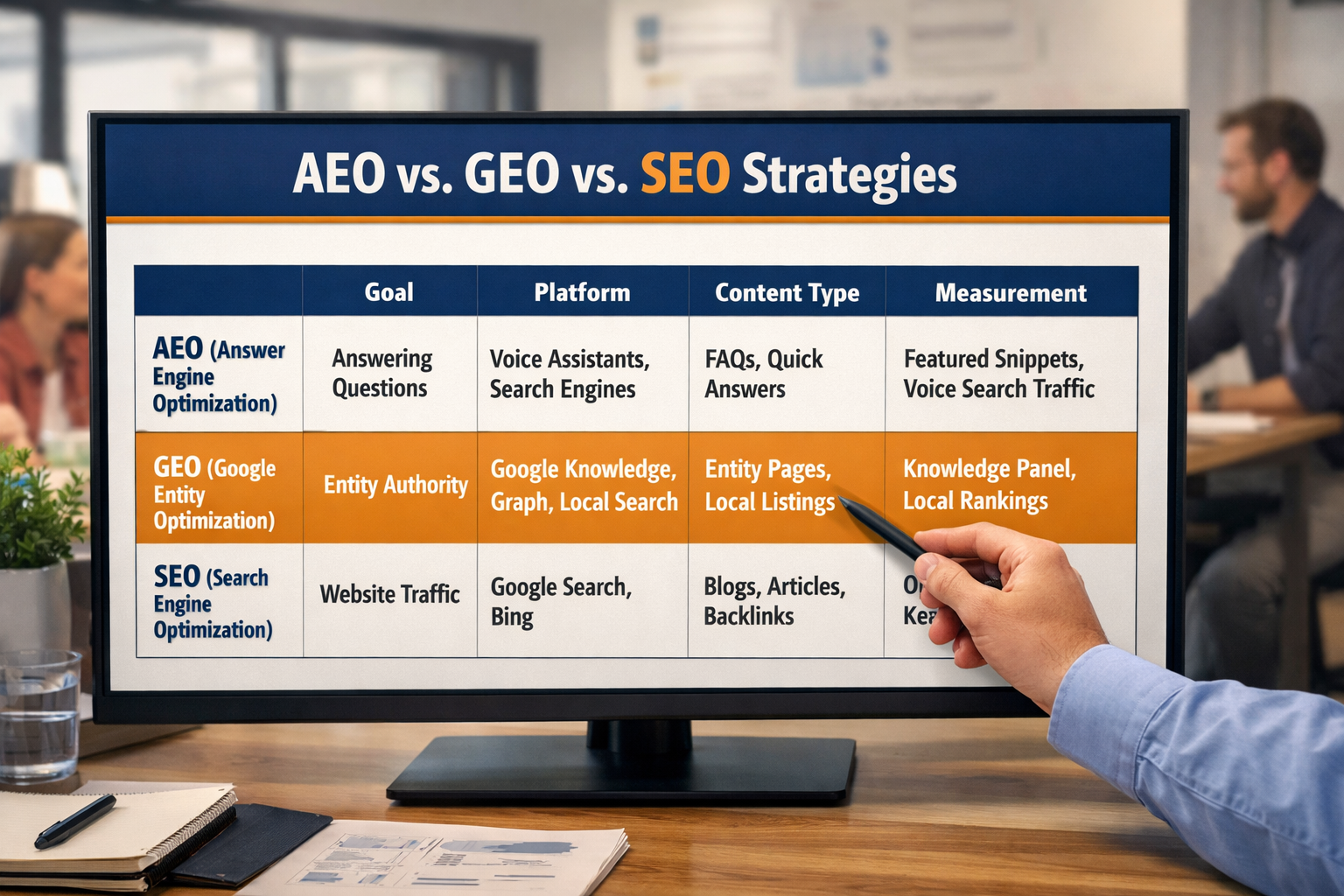
| Strategy | Primary Target | Content Goal | Key Platforms | Measurement |
|---|---|---|---|---|
| Traditional SEO | Search engine rankings | Drive clicks to website | Google, Bing | Rankings, organic traffic |
| AEO | Direct answer boxes | Be selected as the answer | Google, Siri, Alexa, Cortana | Featured snippet rate, voice search visibility |
| GEO | AI-generated responses | Be cited or referenced | ChatGPT, Perplexity, Gemini, Copilot | AI citation frequency, brand mention tracking |
Choose traditional SEO if your primary goal is driving traffic volume to product or service pages.
– AEO if your audience asks specific questions and you want to dominate informational queries, especially on mobile and voice.
– GEO if you want brand authority in AI-assisted research, where users are asking complex questions and trusting synthesized answers.
In practice, most brands need all three working together.
What Tactics Actually Work for AEO and GEO in Digital Marketing?
The good news: many AEO and GEO tactics reinforce each other and align with good content practice.
For AEO
- Write in Q&A format. Structure content so that a clear question is followed immediately by a concise, direct answer (40–60 words works well for featured snippets).
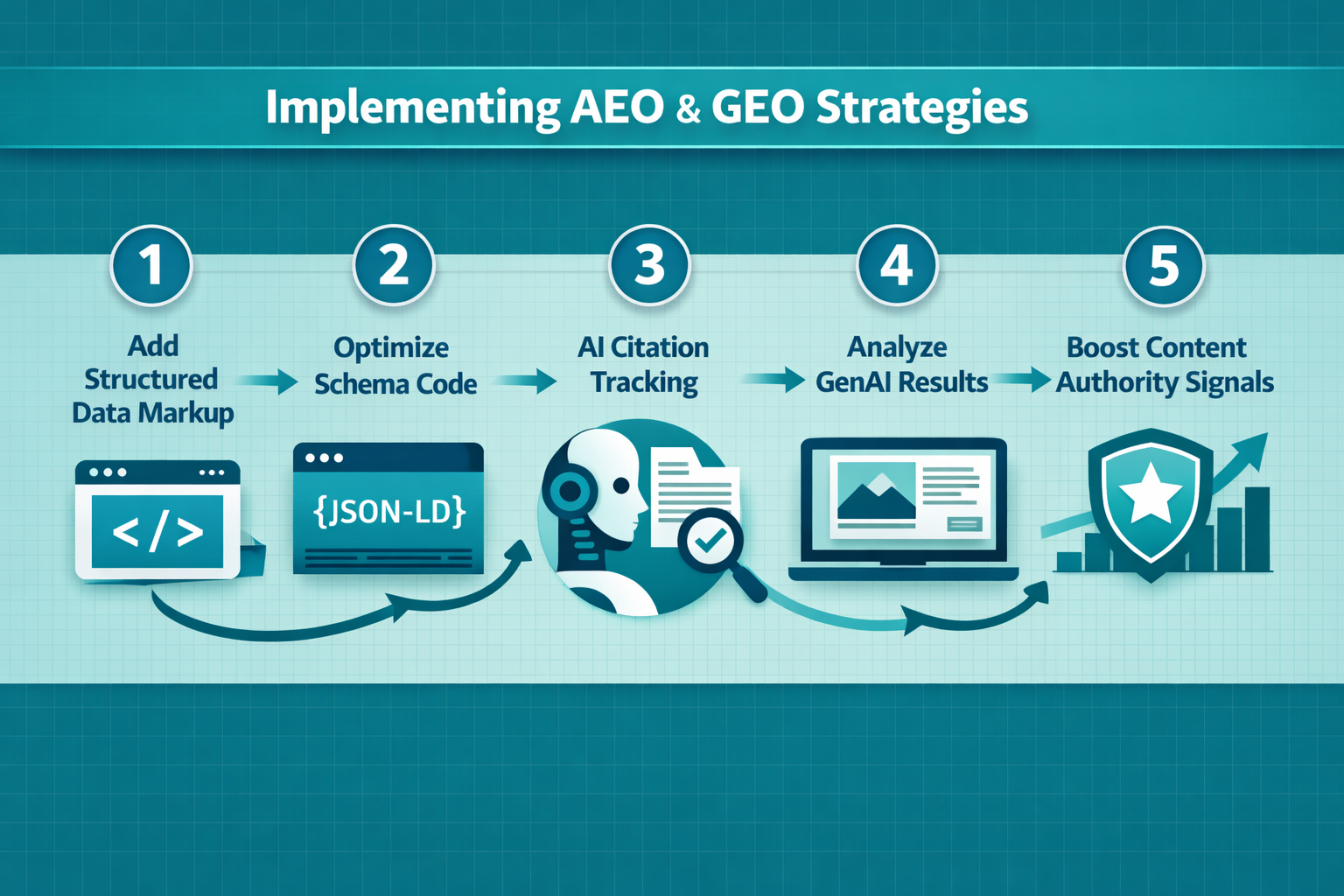
- Use schema markup. FAQ schema, HowTo schema, and Speakable schema all signal to search engines that your content is answer-ready.
- Target long-tail, question-based keywords. Phrases starting with “what is,” “how do I,” “why does,” and “when should” are AEO goldmines.
- Keep answers tight. Google’s featured snippets favor answers that are specific and scannable — not long paragraphs.
For GEO
- Build topical authority. AI systems favor sources that consistently cover a topic in depth. A single great article isn’t enough; you need a cluster of credible content.
- Include verifiable data and citations. The Aggarwal et al. (2023) GEO study found that adding statistics and citing authoritative sources measurably increased AI citation rates.
- Write quotable passages. Self-contained paragraphs that answer a specific question — without needing surrounding context — are more likely to be pulled into AI responses.
- Earn mentions on authoritative sites. AI systems learn from the broader web. If reputable publications reference your brand, your authority signal grows.
- Use structured data broadly. Schema markup helps AI crawlers understand your content’s context and entities.
Common mistake: Treating GEO as purely a content task. Distribution matters too. Content that nobody links to or references rarely gets cited by AI systems, no matter how well it’s written.
How Do You Measure AEO and GEO Performance?
Measuring AEO is more straightforward than measuring GEO, but neither is as simple as tracking keyword rankings.
AEO measurement tools and signals:
- Google Search Console: track impressions and clicks for question-based queries
- Third-party tools like SEMrush or Ahrefs: monitor featured snippet ownership
- Voice search testing: manually query your target questions on Google Assistant or Alexa
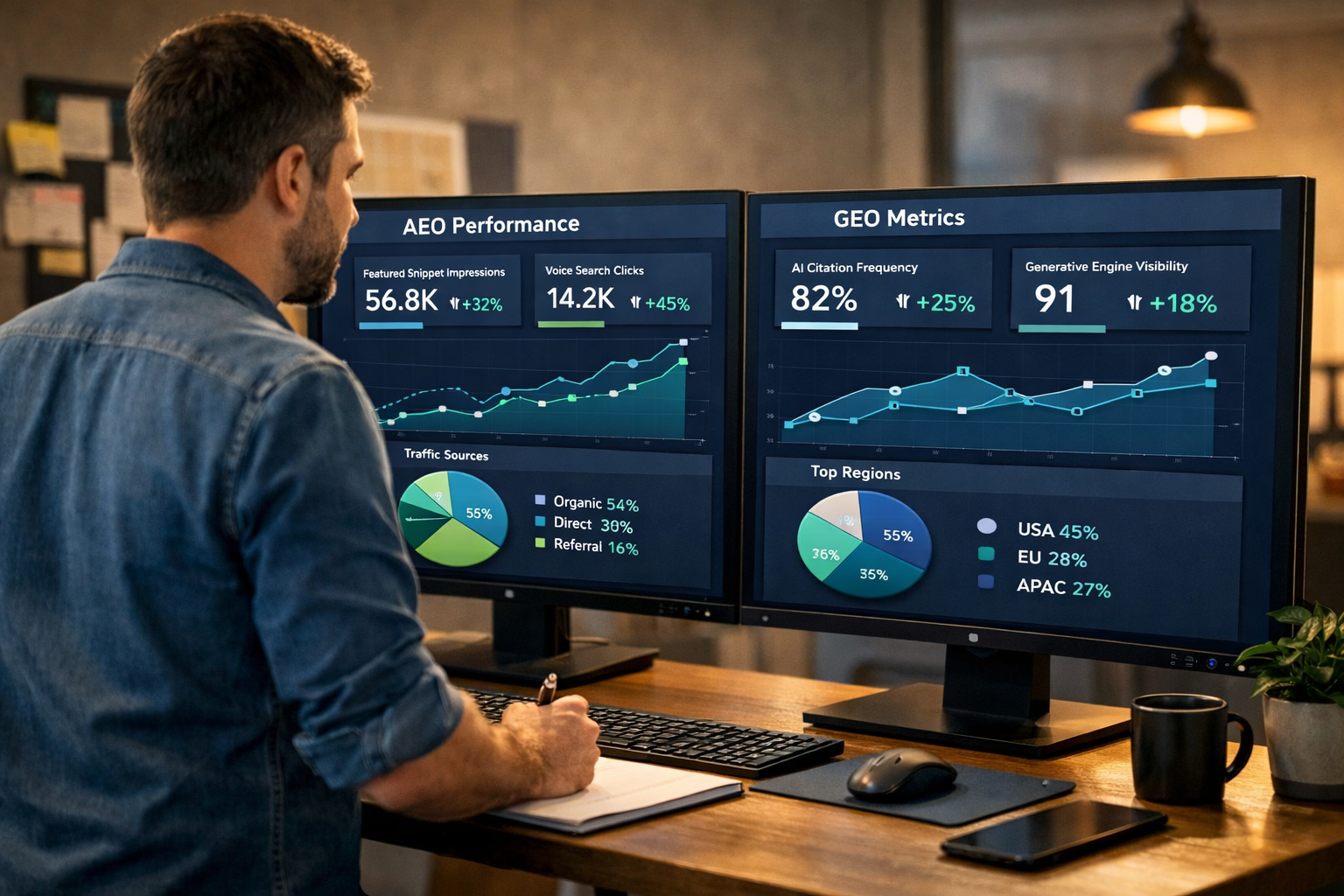
GEO measurement is still developing. As of 2026, the main approaches include:
- Manual testing: Ask your target questions in ChatGPT, Perplexity, Gemini, and Copilot. Note whether your brand or content appears.
- Brand monitoring tools: Platforms like Brandwatch or Mention can catch when your brand name appears in AI-generated content shared publicly.
- Emerging GEO analytics tools: Several startups (including Profound and Otterly.AI) now offer dashboards specifically for tracking AI citation visibility, though the space is still maturing.
Edge case to watch: AI systems update their underlying models periodically. A GEO win today, your content being cited regularly, can shift after a model update. Regular testing is essential.
Ready to try it yourself?
Start generating SEO-optimized articles today and let BlogSEO handle the rest.
Start Free Trial
Free 3-day trial • Cancel anytime
Who Should Prioritize AEO and GEO in Digital Marketing?
Not every business needs to invest equally in both strategies. Here’s a practical guide:
AEO is especially valuable for:
- Healthcare, legal, and financial brands answering specific consumer questions
- E-commerce businesses targeting “best X for Y” or “how to use X” queries
- Local businesses optimizing for voice search (“nearest,” “open now,” “how do I”)
GEO is especially valuable for:
- B2B companies whose buyers research complex decisions using AI tools
- SaaS brands competing in crowded categories where AI tools summarize options
- Publishers, agencies, and consultants who want to be cited as industry authorities
- Any brand whose target audience uses Perplexity or ChatGPT for research
AEO and GEO are less urgent if your business runs primarily on paid search, referrals, or direct traffic — though building organic authority is still a long-term asset.
What Are the Biggest Mistakes Marketers Make with AEO and GEO?
Even experienced teams get these wrong.
- Ignoring structured data. Schema markup is table stakes for both AEO and GEO. Skipping it leaves easy wins on the table.
- Writing for clicks, not answers. Content that teases rather than answers directly will lose to content that answers first and elaborates second.
- Treating GEO as a one-time project. AI citation visibility requires ongoing content production, link building, and monitoring.
- Measuring GEO with traditional traffic metrics. If AI systems cite you but users don’t click through, your traffic reports won’t capture that brand exposure. Use brand awareness metrics alongside traffic data.
- Neglecting E-E-A-T signals. Google’s framework of Experience, Expertise, Authoritativeness, and Trustworthiness applies to AI citation decisions too. Author credentials, about pages, and editorial standards all matter.
FAQ: AEO and GEO in Digital Marketing
Q: Is GEO the same as SEO?
No. Traditional SEO focuses on ranking pages in search results. GEO focuses on getting content cited inside AI-generated answers, which is a different mechanism entirely.
Q: Can small businesses compete in AEO and GEO?
Yes — especially in AEO. A well-structured FAQ page with schema markup can win featured snippets even against larger competitors. GEO is harder for small brands but still achievable through niche topical authority.
Q: Does AEO hurt my website traffic?
It can reduce clicks if users get their answer in a featured snippet without visiting your site. But it increases brand visibility and can drive higher-intent traffic when users want more detail.
Q: How long does it take to see AEO results?
Featured snippet gains can appear within weeks of publishing well-structured content, though competitive queries take longer. There’s no guaranteed timeline.
Q: How long does GEO take to show results?
GEO is slower. Building the topical authority and external references that AI systems recognize typically takes months of consistent effort.
AEO and GEO in Digital Marketing: FAQs
Q: Do I need to write differently for AEO vs. GEO?
Mostly no. Clear, direct, well-cited content works for both. The main GEO-specific addition is writing self-contained passages and including verifiable data points.
Q: What schema types matter most for AEO?
FAQ schema, HowTo schema, Article schema, and Speakable schema are the highest-priority types for AEO.
Q: Is voice search still relevant in 2026?
Yes. Smart speakers and voice assistants remain widely used, particularly for local queries and quick factual questions. AEO directly supports voice search performance.
Q: Can I track when AI tools cite my content?
Partially. Manual testing and emerging tools like Profound and Otterly.AI offer some visibility, but comprehensive AI citation tracking is still an evolving capability.
Q: Should I hire a specialist for AEO and GEO?
If search visibility is a core business driver, yes. Both disciplines require specific technical knowledge (schema markup, AI behavior, content architecture) that general marketers may not have.
Conclusion: Where to Start with AEO and GEO
The shift toward answer-first and AI-generated search is not a future trend, it’s the current reality in 2026. Brands that adapt their content strategy now will build durable visibility that traditional SEO alone can’t provide.
Actionable next steps:
- Audit your existing content for question-based queries you already rank for. These are your fastest AEO opportunities.
- Add schema markup to your top informational pages, starting with FAQ and HowTo schema.
- Rewrite key passages in a direct Q&A format with concise, self-contained answers.
- Test your brand’s AI visibility by manually querying your core topics in ChatGPT, Perplexity, and Gemini.
- Build a content cluster around your most important topic area to establish topical authority for GEO.
- Set up brand monitoring to track AI mentions alongside traditional traffic metrics.
AEO and GEO in Digital Marketing aren’t replacements for good SEO, they’re extensions of it. The brands winning in 2026 are those that treat every piece of content as a potential answer, not just a page to rank.
Ready to try it yourself?
Start generating SEO-optimized articles today and let BlogSEO handle the rest.
Start Free Trial
Free 3-day trial • Cancel anytime
References
- Aggarwal, A., Memon, A., & others. (2023). GEO: Generative Engine Optimization. arXiv preprint. https://arxiv.org/abs/2311.09735
- SparkToro & Datos. (2024). Zero-Click Search Study. https://sparktoro.com/blog/2024-zero-click-search-study/
- Google Search Central. (2024). Structured Data Documentation. https://developers.google.com/search/docs/appearance/structured-data/intro-structured-data
3 Day Free Trial – Well Worth a Look—> BlogSEO.io
Pingback: SEO and Content Strategy: The Complete 2026 Guide