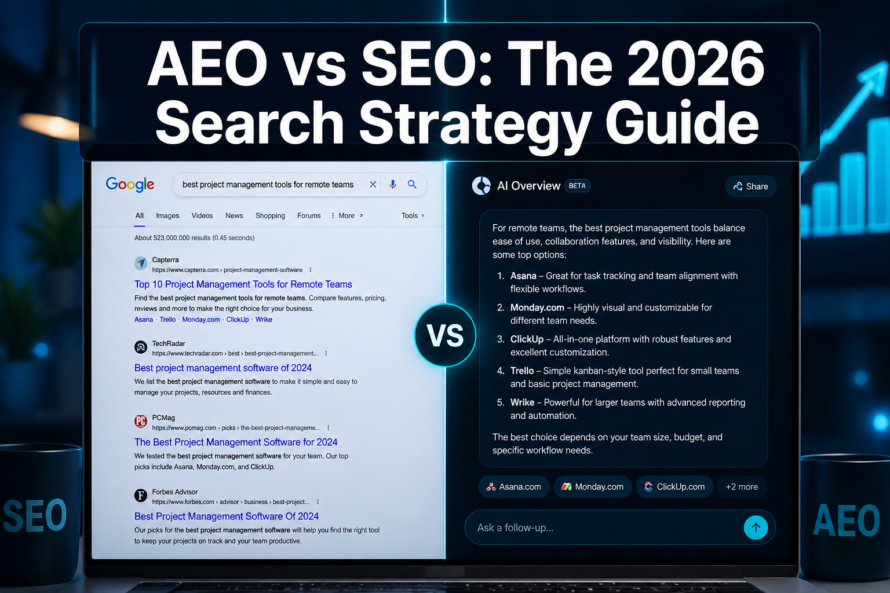
AEO and SEO
Last updated: May 03, 2026
Quick Answer
AEO (Answer Engine Optimization) and SEO (Search Engine Optimization) are complementary strategies for getting found online.
SEO focuses on ranking web pages in traditional search results, while AEO focuses on getting your content selected as the direct answer in AI-generated responses, featured snippets, and voice search.
In 2026, brands that treat AEO and SEO as a unified strategy consistently outperform those that pursue only one.
Key Takeaways
- SEO targets keyword rankings and organic traffic through on-page content, backlinks, and technical signals.
- AEO targets direct answer placements in AI overviews, featured snippets, voice search, and chatbot responses.
- Both strategies share the same foundation: high-quality, well-structured content.
- AEO requires additional tactics: FAQ schema, structured data markup, and conversational question-and-answer formatting.
- You don’t have to choose between AEO and SEO, they reinforce each other when planned together.
- Content that answers specific questions clearly tends to rank well in both traditional search and AI-generated answers.
- Measuring AEO success requires tracking different metrics than SEO, including answer appearance rate and zero-click visibility.
- Voice search and AI assistants now influence a significant share of informational queries, making AEO increasingly relevant for brands targeting those touchpoints.
Ready to try it yourself?
Start generating SEO-optimized articles today and let BlogSEO handle the rest.
Start Free Trial
Free 3-day trial • Cancel anytime
What Are AEO and SEO, and Why Do Both Matter?
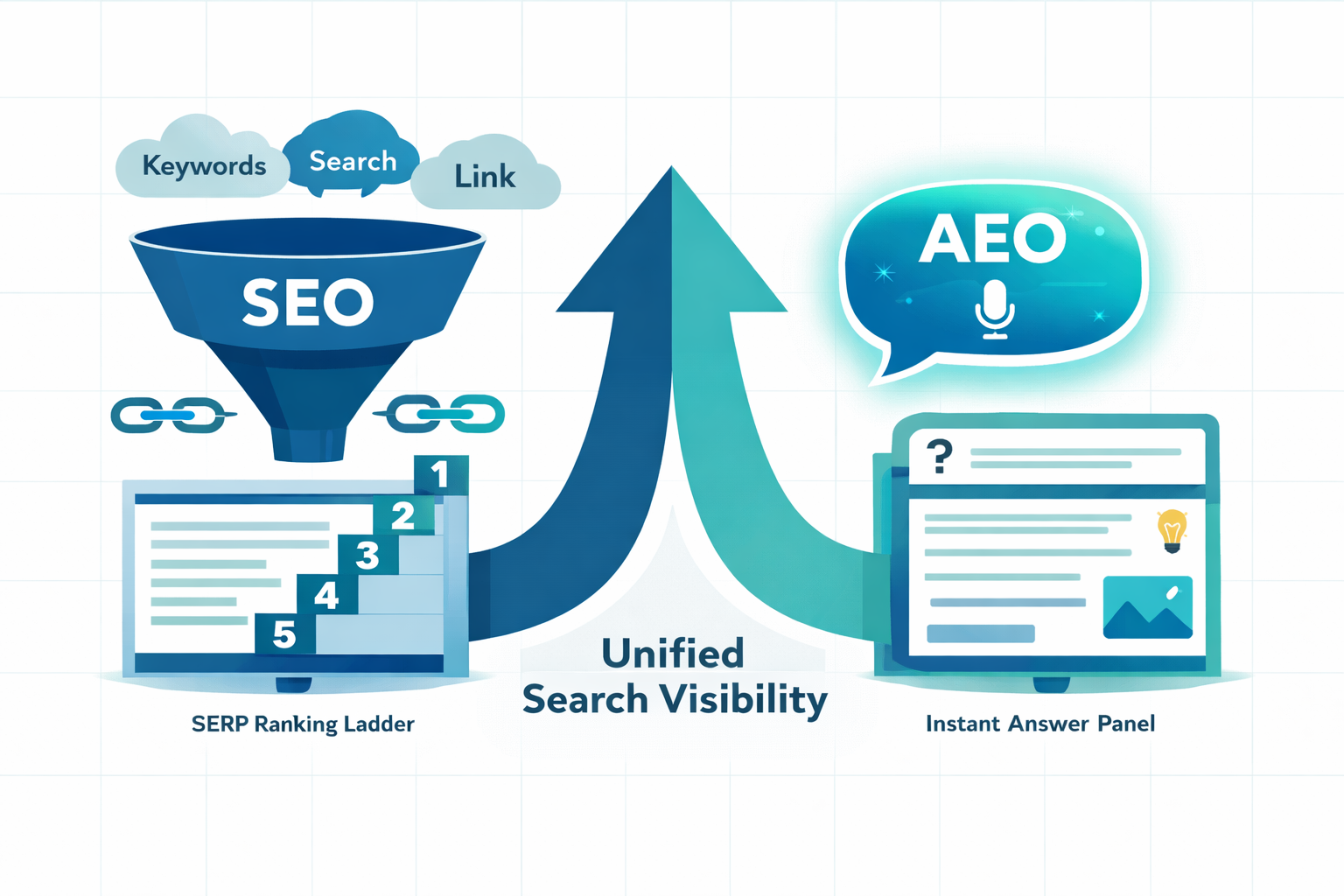
AEO (Answer Engine Optimization) is the practice of structuring content so that search engines and AI systems select it as a direct answer.
SEO (Search Engine Optimization) is the broader discipline of improving a website’s visibility in organic search results. Together, AEO and SEO cover the full spectrum of how users discover content in 2026.
Here’s why the distinction matters: a user searching “what is the capital of France” doesn’t click a link. They read the answer box. If your content strategy only optimizes for clicks, you’re invisible in that moment. AEO closes that gap.
Who needs to care about this?
- Content marketers and SEO managers at brands targeting informational queries
- E-commerce sites where voice search drives product discovery
- Publishers and media companies whose revenue depends on search traffic
- Any business investing in AI-assisted content or chatbot integrations
“The search experience has split into two lanes: one where users click, and one where they just read the answer. A smart strategy covers both.” common framing among search strategists in 2026
How Are AEO and SEO Different?
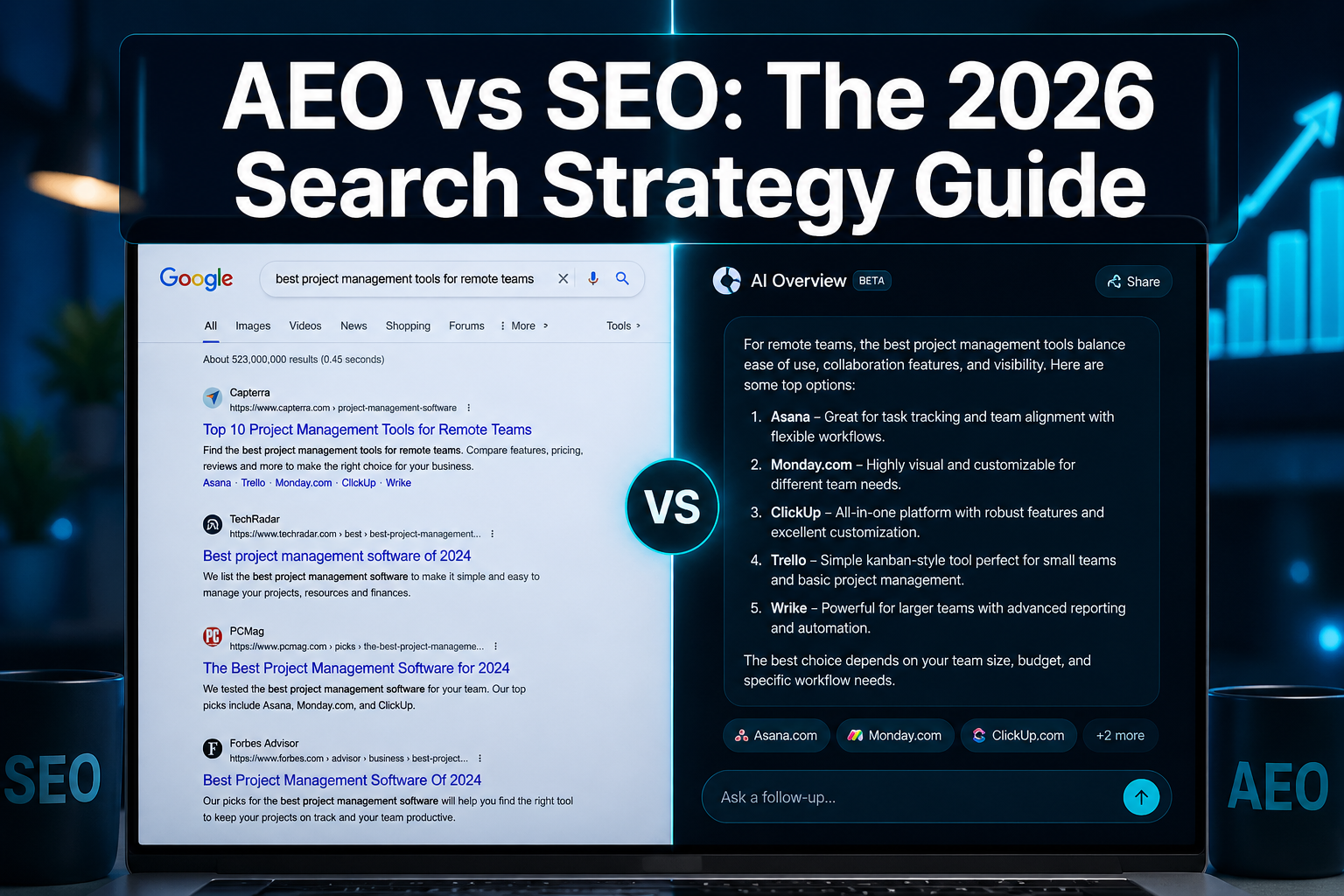
The core difference is the goal. SEO aims to rank a page so users click through to your site. AEO aims to have your content quoted or surfaced directly, often without a click.
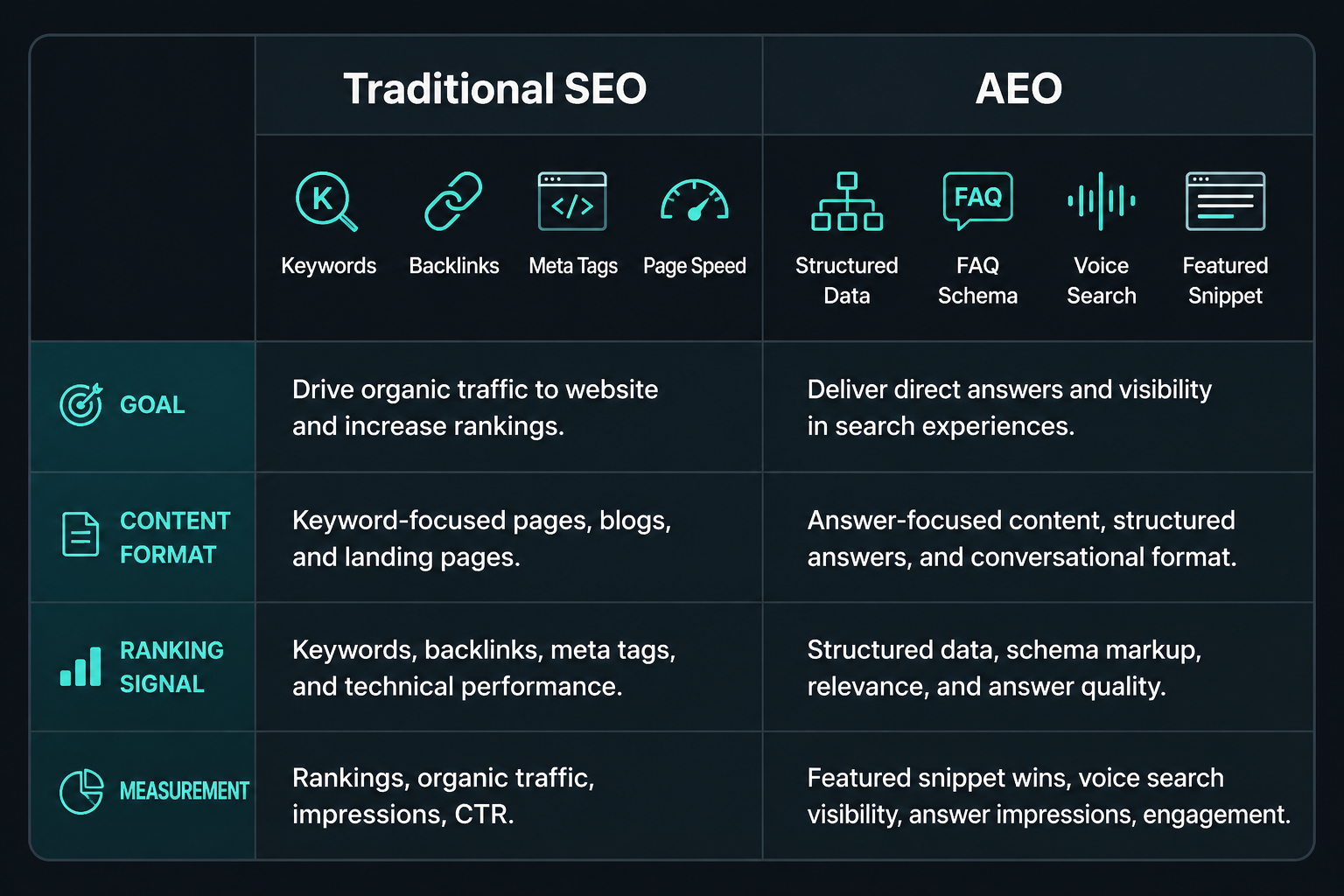
| Factor | SEO | AEO |
|---|---|---|
| Primary goal | Drive organic clicks to a page | Appear as the direct answer |
| Content format | Long-form, keyword-rich pages | Concise Q&A, structured data |
| Key signals | Backlinks, on-page optimization, page speed | Schema markup, clarity, authority |
| Measurement | Rankings, organic sessions, CTR | Answer appearances, voice impressions |
| User behavior | Click-through to website | Zero-click or voice read-aloud |
| Best for | Transactional and navigational queries | Informational and conversational queries |
Common mistake: Treating AEO as a replacement for SEO. It’s not. A page that doesn’t rank can’t be selected as an answer. Strong SEO authority is still the foundation that makes AEO possible.
What Does AEO Actually Require in Practice?
AEO requires three things: clear question-and-answer content structure, schema markup, and topical authority. Without all three, even well-written content rarely gets selected as a direct answer.
Here’s what that looks like in practice:
- Write for questions, not just keywords. Instead of optimizing a page for “best running shoes,” also create a section that directly answers “What are the best running shoes for flat feet?” Answer in the first sentence, then add supporting detail.
- Add FAQ schema markup. Use JSON-LD structured data to mark up question-and-answer pairs on your page. This signals to Google and AI systems that your content is structured as answers.
- Use concise answer paragraphs. The ideal featured snippet answer is roughly 40–60 words. Write a tight, direct paragraph before expanding into detail.
- Build topical authority. AI systems and search engines favor sources that cover a topic comprehensively. A single optimized page rarely wins if the rest of your site ignores the topic.
- Optimize for voice search phrasing. Voice queries tend to be longer and more conversational (“How do I fix a leaky faucet?”) compared to typed queries (“fix leaky faucet”). Include natural language variations.
Edge case: For highly competitive informational queries, even perfect AEO execution may not win the answer box if a high-authority competitor already owns it. In those cases, focus on related long-tail questions where competition is lower.
How Do AEO and SEO Work Together?
Ready to try it yourself?
Start generating SEO-optimized articles today and let BlogSEO handle the rest.
Start Free Trial
Free 3-day trial • Cancel anytime
AEO and SEO share the same content quality requirements, which means improvements to one almost always benefit the other.
A page that clearly answers questions, loads fast, earns backlinks, and uses structured data performs well in both traditional rankings and answer selections.
Think of it this way: SEO gets your page into the consideration set. AEO gets your content selected from that set as the best answer.
Where they reinforce each other:
- Structured data improves both rich snippet appearance (SEO benefit) and answer engine selection (AEO benefit).
- Clear headings and subheadings help Google understand page structure for rankings and help AI systems extract specific answers.
- E-E-A-T signals (Experience, Expertise, Authoritativeness, Trustworthiness) matter for both organic rankings and AI answer selection.
- Page speed and Core Web Vitals affect rankings and also influence whether AI crawlers can efficiently process your content.
Choose a unified approach if: Your content covers informational topics where users might ask questions in both a search bar and a voice assistant. That’s most content marketing, most FAQ pages, and most how-to guides.
What’s the Step-by-Step Process for Optimizing for AEO and SEO?
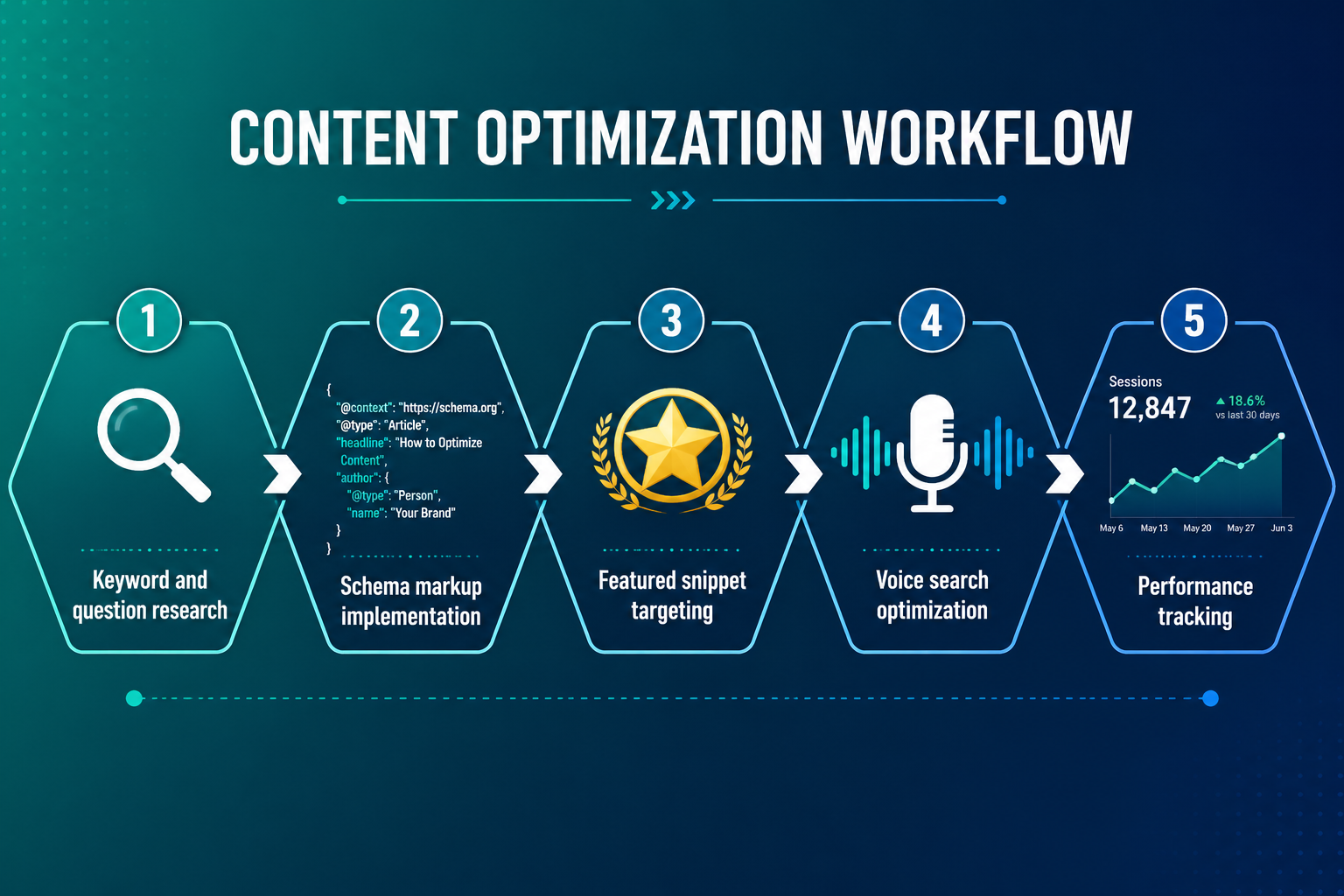
Start with keyword and question research, then layer AEO tactics on top of your existing SEO foundation. Don’t rebuild your content strategy from scratch — extend it.
Step-by-step process:
- Audit existing content for pages that already rank on page one but don’t appear in featured snippets or AI overviews. These are your highest-priority AEO opportunities.
- Identify question-based queries your target audience uses. Tools like Google’s “People Also Ask” boxes, keyword research platforms, and AI search interfaces reveal the exact phrasing users expect answers to.
- Restructure content to lead with direct answers. Add a concise summary paragraph at the top of each major section before expanding.
- Implement structured data. Add FAQ schema, HowTo schema, or Article schema depending on content type. Validate using Google’s Rich Results Test.
- Target featured snippets deliberately. For each target question, write a 40–60 word answer paragraph that directly addresses it. Use the exact question phrasing as a subheading.
- Track AEO-specific metrics. Monitor featured snippet appearances in Google Search Console, track AI overview mentions if your analytics tools support it, and measure zero-click impressions alongside traditional click metrics.
- Iterate based on data. If a page ranks in positions 1–5 but doesn’t appear in the answer box, rewrite the answer paragraph to be more direct and concise.
How Do You Measure AEO Performance Separately from SEO?
Measuring AEO requires looking beyond traditional click-through rates because many AEO wins are zero-click interactions. Standard SEO metrics like organic sessions will undercount the value AEO delivers.
Key AEO metrics to track:
- Featured snippet appearances: Visible in Google Search Console under “Search type: Web” filtered by queries where your page appears in position zero.
- Impression share for informational queries: High impressions with low CTR can indicate answer box appearances where users got what they needed without clicking.
- Voice search traffic: Difficult to isolate directly, but tools like SEMrush and Ahrefs track some voice-related query patterns.
- Brand mentions in AI responses: Manual testing and emerging tools track whether your brand or content appears in ChatGPT, Gemini, Perplexity, and similar platforms.
Important constraint: Zero-click visibility still has brand value even without a direct session. Factor this into how you report AEO ROI to stakeholders.
Common Mistakes When Combining AEO and SEO Strategies
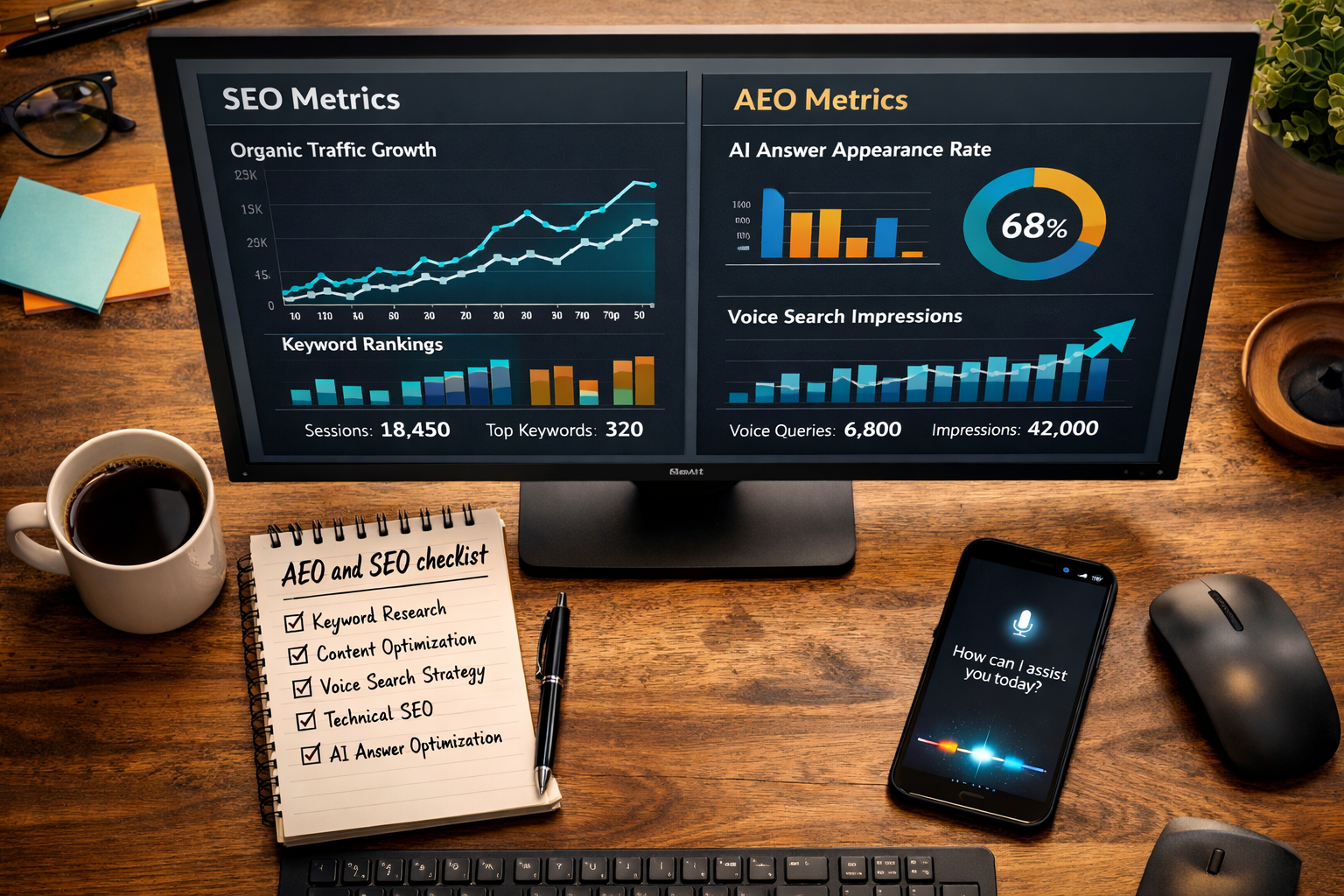
The most common mistake is treating AEO as a separate content silo instead of integrating it into existing SEO workflows. This leads to duplicated effort and inconsistent content quality.
Other frequent errors:
- Over-optimizing for answer boxes at the expense of depth. Pages that only contain short Q&A pairs often lack the authority signals needed to rank in the first place.
- Ignoring schema validation. Adding structured data incorrectly can prevent rich results from appearing. Always validate with Google’s testing tools.
- Targeting only high-volume questions. High-volume informational queries are often dominated by major publishers. Long-tail, specific questions frequently offer faster AEO wins.
- Neglecting mobile and voice formatting. AEO content that reads awkwardly when spoken aloud performs poorly in voice search contexts.
- Skipping content updates. AI systems and search engines favor fresh, accurate content. Outdated answers get replaced quickly.
FAQ: AEO and SEO
Q: Is AEO replacing SEO? No. AEO extends SEO rather than replacing it. Traditional organic rankings are still the foundation that makes answer engine selection possible.
Q: Do I need a separate content strategy for AEO? Not entirely. You need to add question-focused formatting, structured data, and concise answer paragraphs to your existing SEO content strategy.
Q: What types of content benefit most from AEO? Informational content, how-to guides, FAQ pages, and definitional content benefit most. Transactional pages (product listings, pricing pages) benefit less from AEO tactics.
Q: Does schema markup guarantee a featured snippet? No. Schema markup signals eligibility, but Google and AI systems make the final selection based on relevance, authority, and content quality.
Q: How long does AEO take to show results? For pages already ranking on page one, AEO improvements can show results within a few weeks. For new pages, the SEO foundation must be established first, which typically takes several months.
Q: Is voice search the same as AEO? Voice search optimization is a subset of AEO. AEO also covers featured snippets, AI overviews, and chatbot answer sourcing, which go beyond voice search alone.
Q: Can small websites compete with large publishers in AEO? Yes, particularly for niche or long-tail questions where large publishers haven’t invested in detailed answers. Specificity and accuracy often matter more than domain authority for these queries.
Q: What tools help with AEO optimization? Google Search Console (featured snippet tracking), SEMrush and Ahrefs (question keyword research), Google’s Rich Results Test (schema validation), and Surfer SEO or similar tools for content structure analysis.
Ready to try it yourself?
Start generating SEO-optimized articles today and let BlogSEO handle the rest.
Start Free Trial
Free 3-day trial • Cancel anytime
Conclusion: Your Next Steps for AEO and SEO in 2026
AEO and SEO are not competing priorities. They’re two layers of the same search visibility strategy.
SEO builds the authority and rankings that get your content into consideration. AEO structures that content so it gets selected as the answer.
Actionable next steps:
- Pull your top 20 ranking pages from Google Search Console and identify which ones target informational queries but don’t appear in featured snippets.
- Rewrite the opening paragraph of each target section to directly answer the primary question in 40–60 words.
- Add FAQ schema markup to at least five high-priority pages this month.
- Set up a simple tracking sheet to monitor featured snippet appearances and zero-click impressions alongside your standard SEO metrics.
- Review your content calendar and flag every informational piece for question-based formatting before publication.
The brands winning in search right now aren’t choosing between AEO and SEO. They’re doing both, systematically, starting with the pages they already have.
References
- Google Search Central. (2023). Structured data markup: FAQ schema documentation. https://developers.google.com/search/docs/appearance/structured-data/faqpage
- Google Search Central. (2024). How Google Search works: Featured snippets and your website. https://developers.google.com/search/docs/appearance/featured-snippets
- Fishkin, R. (2019). SparkToro: Zero-click searches study. https://sparktoro.com/blog/less-than-half-of-google-searches-now-result-in-a-click/
- Search Engine Journal. (2024). E-E-A-T and its role in Google’s ranking systems. https://www.searchenginejournal.com/google-eat/what-is-it/
Pingback: SEO Tools: Best For Website Growth 2026 - A1Publishing
Pingback: Best Enterprise SEO Tools: Manage Content Performance - A1Publishing
Pingback: SEO Tools AI Checker: Best Reliable AI Visibility Checks - A1Publishing
Pingback: What is Content Strategy: A Complete Guide for 2026 - A1Publishing
Pingback: SEO Tools Reviews and Comparisons: Best Picks for 2026 Tool Stacks - A1Publishing