AI Tools For Product Managers
Last updated: May 07, 2026
Quick Answer: AI Tools For Product Managers help automate repetitive tasks like roadmap prioritization, user research synthesis, and sprint planning, so PMs can spend more time on strategy and customer conversations.
The best tools in 2026 include Notion AI, Productboard, Aha!, Amplitude, and ChatGPT-based workflows.
Choosing the right one depends on your team size, tech stack, and where you lose the most time today.
Key Takeaways
- AI tools for product managers can cut research synthesis time by several hours per week by automatically clustering feedback and surfacing themes.
- The most useful categories are: roadmap planning, user research, data analysis, writing assistance, and sprint management.
- No single tool does everything well — most PMs use two to three tools in combination.
- Free tiers exist for most tools, but meaningful AI features usually sit behind paid plans ($15–$99/month per seat).
- The biggest mistake PMs make is adopting AI tools without a clear workflow problem to solve first.
- AI tools work best when they augment judgment, not replace it — especially for prioritization decisions.
- Integration with your existing stack (Jira, Confluence, Slack, Figma) matters more than raw feature count.
- Security and data privacy policies vary significantly — always check before feeding in customer data.
What Are AI Tools for Product Managers, and Why Do They Matter?

AI tools for product managers are software products that use machine learning, large language models, or predictive analytics to automate or accelerate core PM tasks.
These include drafting PRDs, analyzing user feedback, forecasting feature impact, and generating roadmap options.
They matter because the average PM juggles an enormous number of inputs, customer interviews, support tickets, stakeholder requests, analytics dashboards, and engineering constraints, all at once. AI tools help process that volume faster and with fewer blind spots.
Who benefits most:
- Solo PMs at startups with no dedicated research or data teams
- PMs at mid-size companies managing multiple product lines
- Senior PMs who want to spend less time on documentation and more on strategy
Who may see limited benefit:
- PMs whose primary bottleneck is organizational politics, not information overload
- Teams with highly regulated data environments where feeding data into third-party AI tools is restricted
Which AI Tools for Product Managers Are Worth Using in 2026?
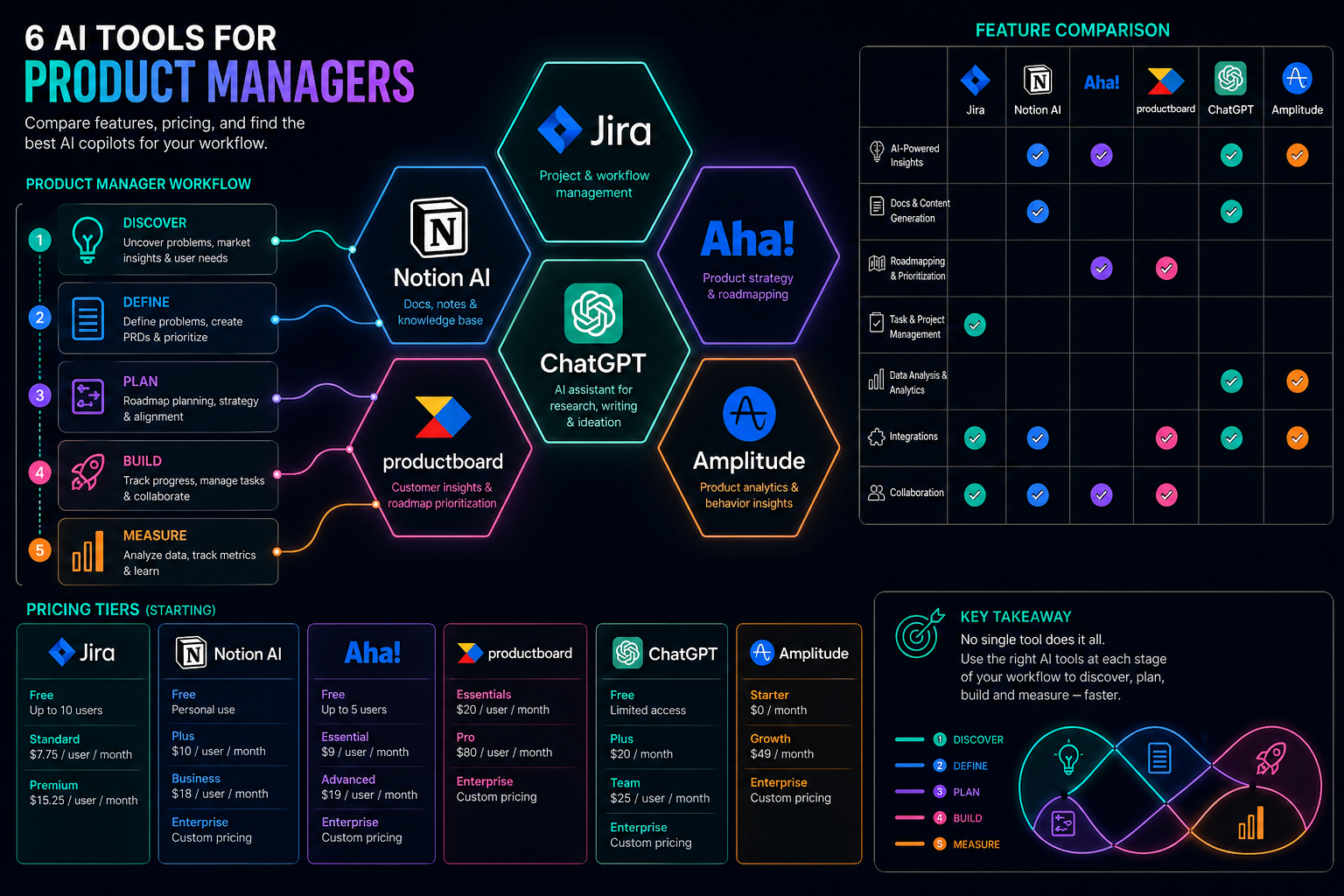
The short answer: it depends on your biggest pain point. Below is a breakdown by category with specific tool recommendations.
| Category | Top Tools | Best For |
|---|---|---|
| Roadmap & Planning | Aha!, Productboard, Linear AI | Prioritization, stakeholder alignment |
| Writing & Documentation | Notion AI, ChatGPT, Confluence AI | PRDs, release notes, specs |
| User Research | Dovetail, Marvin, Grain | Interview synthesis, tagging |
| Analytics & Insights | Amplitude AI, Mixpanel, Heap | Behavioral analysis, funnel review |
| Sprint & Backlog | Jira AI, Height, ClickUp AI | Ticket writing, effort estimation |
Choose Productboard if you need a single source of truth that connects customer feedback directly to your roadmap. Its AI feature-scoring model is genuinely useful for large backlogs.
Choose Dovetail if your team runs frequent user interviews and spends hours tagging and summarizing — Dovetail’s AI clustering saves real time here.
Choose Amplitude AI if you already use Amplitude for analytics and want natural language querying without writing SQL.
“The best AI tool for a product manager is the one that removes friction from the task they dread most.” — A useful rule of thumb before committing to any subscription.
How Do AI Tools Help With Roadmap Prioritization?
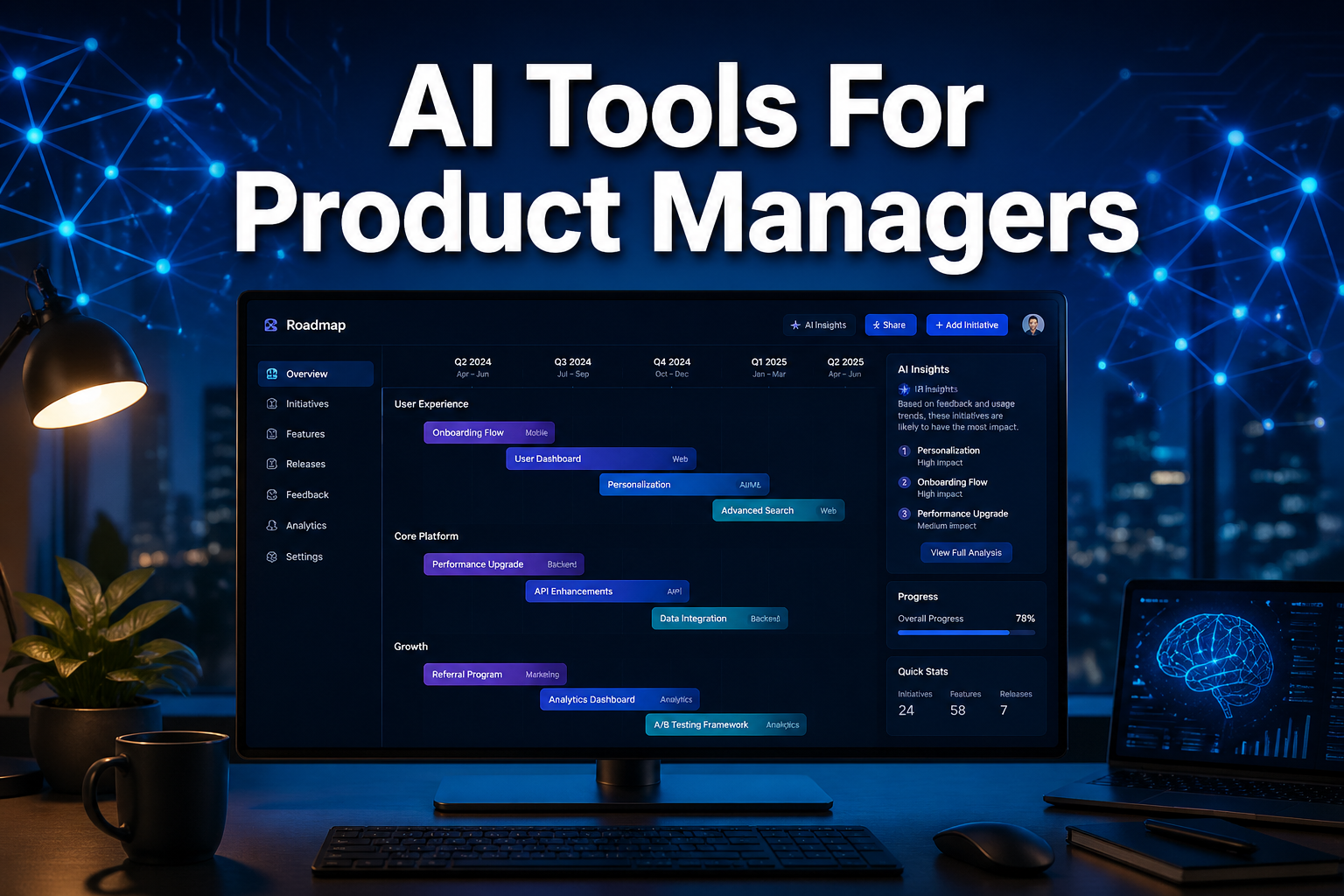
AI tools assist with roadmap prioritization by scoring features against weighted criteria (revenue impact, customer demand, engineering effort) and surfacing patterns in feedback data that humans might miss.
Practical ways AI supports prioritization:
- Feedback aggregation — Tools like Productboard and Dovetail pull in tickets, NLP-tagged reviews, and interview notes, then cluster them by theme automatically.
- Impact scoring — Some tools let you define scoring frameworks (RICE, MoSCoW, ICE) and apply them at scale across hundreds of backlog items.
- Stakeholder input collection — AI-assisted forms and surveys can gather weighted input from sales, support, and executives, then synthesize it into a ranked list.
- Scenario modeling — A handful of tools (Aha! Roadmaps, for example) let you model “what if we delay Feature X by one quarter” and see downstream effects.
Common mistake: Treating AI priority scores as final decisions. These tools work with the data you feed them. If your feedback dataset skews toward vocal enterprise customers, the AI will too. Always sanity-check outputs against your own customer knowledge.
Can AI Tools for Product Managers Replace User Research?
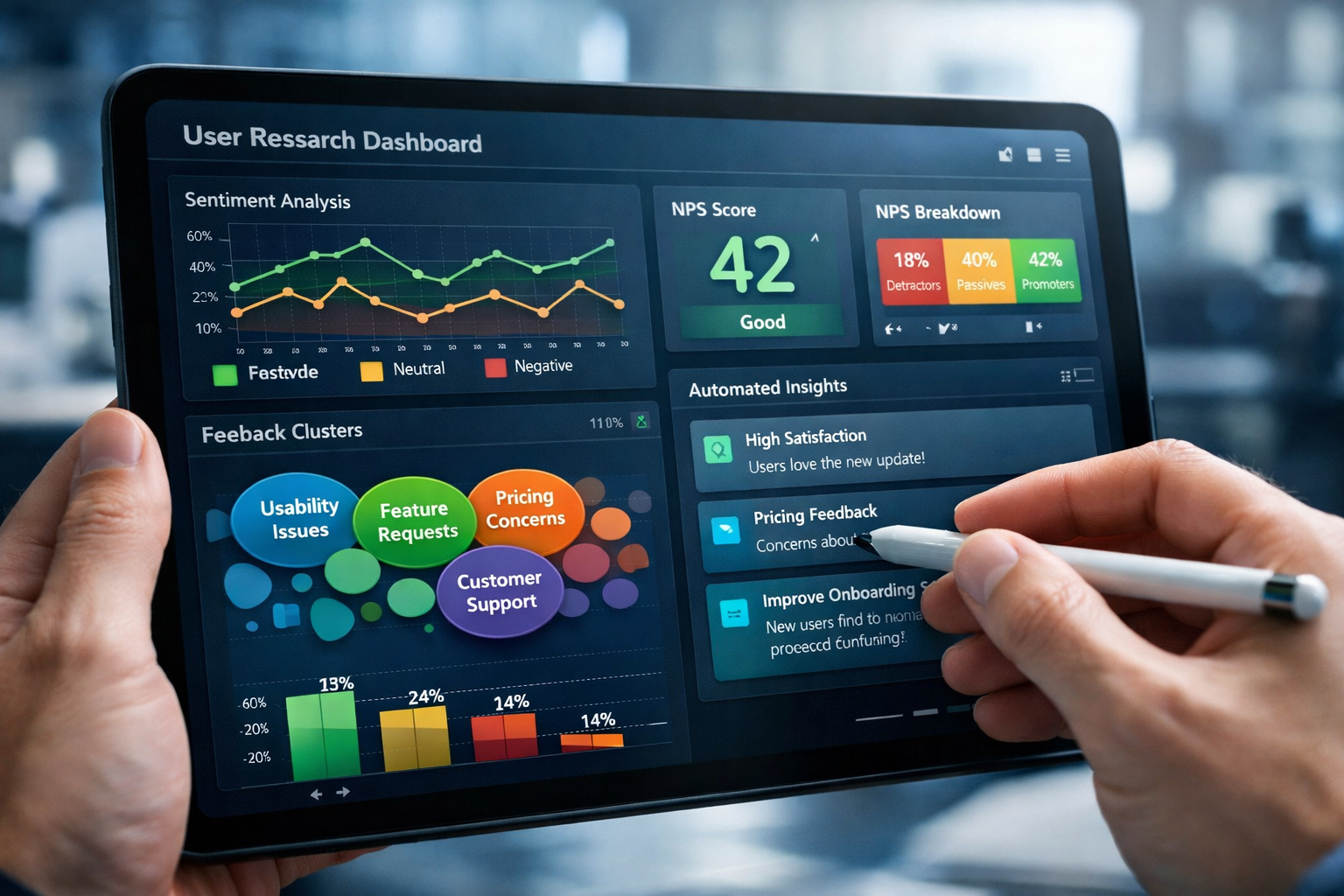
No — and any tool that claims otherwise is overselling. AI tools can dramatically speed up research synthesis, but they cannot replace the judgment formed during a live customer conversation.
What AI does well in research:
- Transcribing and summarizing interview recordings (Grain, Otter.ai, Marvin)
- Auto-tagging quotes by theme or persona
- Identifying sentiment shifts across a large corpus of reviews or support tickets
- Generating draft discussion guides based on your research objectives
What AI does poorly:
- Noticing non-verbal cues or hesitation during interviews
- Asking follow-up questions that pivot based on an unexpected answer
- Distinguishing between what customers say they want and what they actually need
Edge case to watch: AI transcription tools sometimes struggle with heavy accents, technical jargon, or poor audio quality. Always review auto-generated transcripts before treating them as ground truth.
What Does It Cost to Use AI Tools as a Product Manager?
Costs vary widely. Most tools offer a free tier with limited AI features, a mid-tier plan for individual PMs, and a team or enterprise plan with full AI access.
Rough cost ranges (2026):
- Free: Notion AI (limited), ChatGPT free tier, basic Amplitude
- $15–$30/month per seat: Notion AI add-on, Dovetail Starter, Grain Basic
- $50–$99/month per seat: Productboard Essentials, Aha! Roadmaps, Marvin
- $100+/month per seat: Enterprise tiers with SSO, advanced security, and dedicated support
Budget tip: Before buying, map out which tasks consume the most PM hours each week. A $49/month tool that saves you four hours of interview tagging pays for itself quickly. A $99/month tool that duplicates what Jira already does does not.
How to Evaluate and Adopt AI Tools for Product Managers
Start with the problem, not the tool. The most common reason AI tool adoption fails is that PMs pick a tool based on a demo and then try to retrofit it onto their workflow.
A simple five-step evaluation process:
- Identify your top three time drains — Track your time for one week. Where do you lose the most hours to low-value work?
- Shortlist tools by category — Match your pain points to the tool categories in the table above.
- Run a two-week trial with real work — Don’t use dummy data. Use an actual PRD, a real batch of customer interviews, or a live backlog.
- Measure time saved, not features used — Did the tool actually reduce the time spent on that task? By how much?
- Check integration and security — Does it connect to Jira, Slack, or Figma? What is the data retention policy? Who owns your data?
Decision rule: If a tool doesn’t save you at least 30 minutes per week during the trial, it’s probably not the right fit for your specific workflow, regardless of how impressive the feature list looks.
What Are the Risks of Using AI Tools in Product Management?

The main risks are data privacy, over-reliance on AI outputs, and bias in training data. Each is manageable if you know what to watch for.
Key risks and how to handle them:
- Data privacy: Many AI tools send your data to third-party LLMs for processing. Before uploading customer interview transcripts or internal strategy documents, review the tool’s data processing agreement. Some enterprise plans offer private deployment options.
- Output bias: AI tools trained on public datasets may reflect biases that don’t match your specific market or customer base. Always validate AI-generated insights against your own primary research.
- Over-automation: Relying on AI to write every PRD or generate every user story can erode your own writing and analytical skills over time. Use AI as a first draft, not a final product.
- Stakeholder trust: Some executives and engineers are skeptical of AI-generated roadmaps or priorities. Be transparent about where AI assisted your process and where human judgment drove the decision.
FAQ: AI Tools for Product Managers
Q: What is the single best AI tool for product managers in 2026?
There’s no universal answer. Notion AI is the best starting point for most PMs because it handles documentation, brainstorming, and summarization in one place at a reasonable cost.
Q: Can ChatGPT replace dedicated PM tools like Productboard?
No. ChatGPT is excellent for writing, brainstorming, and summarizing text you paste in. Productboard connects directly to your feedback sources, roadmap, and team workflows — that integration is what justifies the cost.
Q: How do AI tools help with writing PRDs?
They generate structured first drafts based on a brief you provide, suggest edge cases you may have missed, and help rewrite sections for clarity. You still need to validate every requirement.
Q: Are AI tools safe for confidential product strategy documents?
It depends on the tool and plan. Enterprise plans with private data processing are generally safer. Never paste confidential IP into a free consumer AI tool.
AI Tools For Product Managers: FAQs
Q: Do I need technical skills to use AI tools as a PM?
No. Most modern AI PM tools are designed for non-technical users. Natural language querying (asking questions in plain English) is now standard across analytics tools like Amplitude and Mixpanel.
Q: How long does it take to see ROI from an AI tool?
Most PMs report noticeable time savings within two to four weeks of consistent use, assuming the tool addresses a real workflow bottleneck.
Q: What’s the difference between AI-assisted tools and AI-native tools?
AI-assisted tools (like Jira with AI add-ons) layer AI features onto an existing platform. AI-native tools (like Marvin or Dovetail) are built from the ground up around AI workflows. AI-native tools tend to be more powerful for their specific use case but less flexible overall.
Q: Can AI tools help with stakeholder communication?
Yes. Tools like Notion AI and ChatGPT are particularly useful for drafting executive summaries, translating technical specs into plain language, and preparing presentation outlines.
Conclusion: Where to Start
The best way to get value from AI Tools For Product Managers is to solve one specific problem first. Don’t overhaul your entire workflow at once.
Actionable next steps:
- This week: Track where you spend your PM hours. Identify the single most time-consuming low-value task.
- Next week: Pick one tool from the relevant category above and start a free trial using real work, not a demo dataset.
- After 30 days: Measure time saved honestly. If it’s meaningful, expand use. If not, try a different tool or category.
- Ongoing: Revisit your tool stack every quarter — this space is moving fast, and the best option today may not be the best option in six months.
AI tools for product managers are genuinely useful in 2026, but only when matched to real problems. Start small, measure honestly, and build from there.
References
- Dovetail. (2023). How teams use Dovetail for research synthesis. https://dovetail.com
- Productboard. (2024). Product management platform overview. https://www.productboard.com
- Amplitude. (2024). AI analytics features documentation. https://amplitude.com
- Aha! (2024). Roadmapping and prioritization with AI. https://www.aha.io
- Notion. (2024). Notion AI features and pricing. https://www.notion.so/product/ai