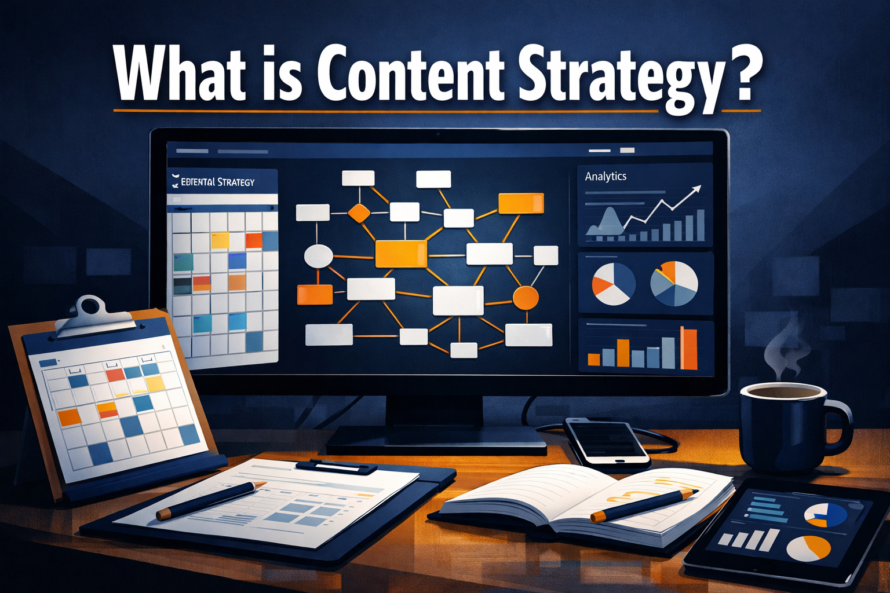
Content Strategy
Last updated: May 02, 2026
Quick Answer: Content Strategy is the deliberate planning, creation, distribution, and management of content to achieve specific business and user goals.
It answers three questions before any content is created: who is it for, what should it accomplish, and how will success be measured?
Unlike a content calendar or editorial plan, a content strategy connects every piece of content to a business outcome and a user need.
Key Takeaways
- Content strategy is a plan, not a schedule. It defines purpose, audience, and goals before production begins.
- Strategy and tactics are different things. Strategy answers “why and what.” Tactics answer “how and when.”
- Effective content strategy aligns business goals with user needs at every stage of the customer journey.
- In 2026, content strategy must account for zero-click search, AI-generated answers, and multi-platform visibility, not just website traffic. [3]
- Measurement is non-negotiable. Without defined KPIs, content strategy becomes content production.
- Content format selection should follow user intent and business value, not content calendar convenience. [2]
- Cross-functional collaboration between marketing, product, sales, and customer success teams produces stronger content ecosystems.
- AI tools are changing content production speed, but strategic thinking remains a human responsibility.
- Structured, machine-readable content gives brands a significant advantage in AI-powered search environments. [1]
- A content strategy without a governance plan degrades over time. Assign ownership, review cycles, and update protocols from the start.
What is Content Strategy, Exactly?
Content strategy is the practice of planning, creating, governing, and managing content so it serves both users and business goals. It’s the layer of thinking that sits above content creation and asks: “Should we make this at all, and if so, why?”
A useful working definition: content strategy determines what content exists, why it exists, who it’s for, and how its performance will be evaluated. Everything else, including blog posts, videos, landing pages, and email sequences, is execution.
The term was formalized in the web design and UX communities in the late 2000s, largely through the work of practitioners like Kristina Halvorson, whose book Content Strategy for the Web helped establish it as a professional discipline.
Since then, it has expanded far beyond website copy to cover the entire content lifecycle across every channel a brand uses.
What content strategy is NOT:
- A content calendar (that’s a scheduling tool)
- A list of blog topics (that’s an editorial plan)
- A social media posting schedule (that’s a distribution tactic)
- A brand voice guide (that’s one component of a larger strategy)
Each of these is useful, but none of them is a strategy on its own.
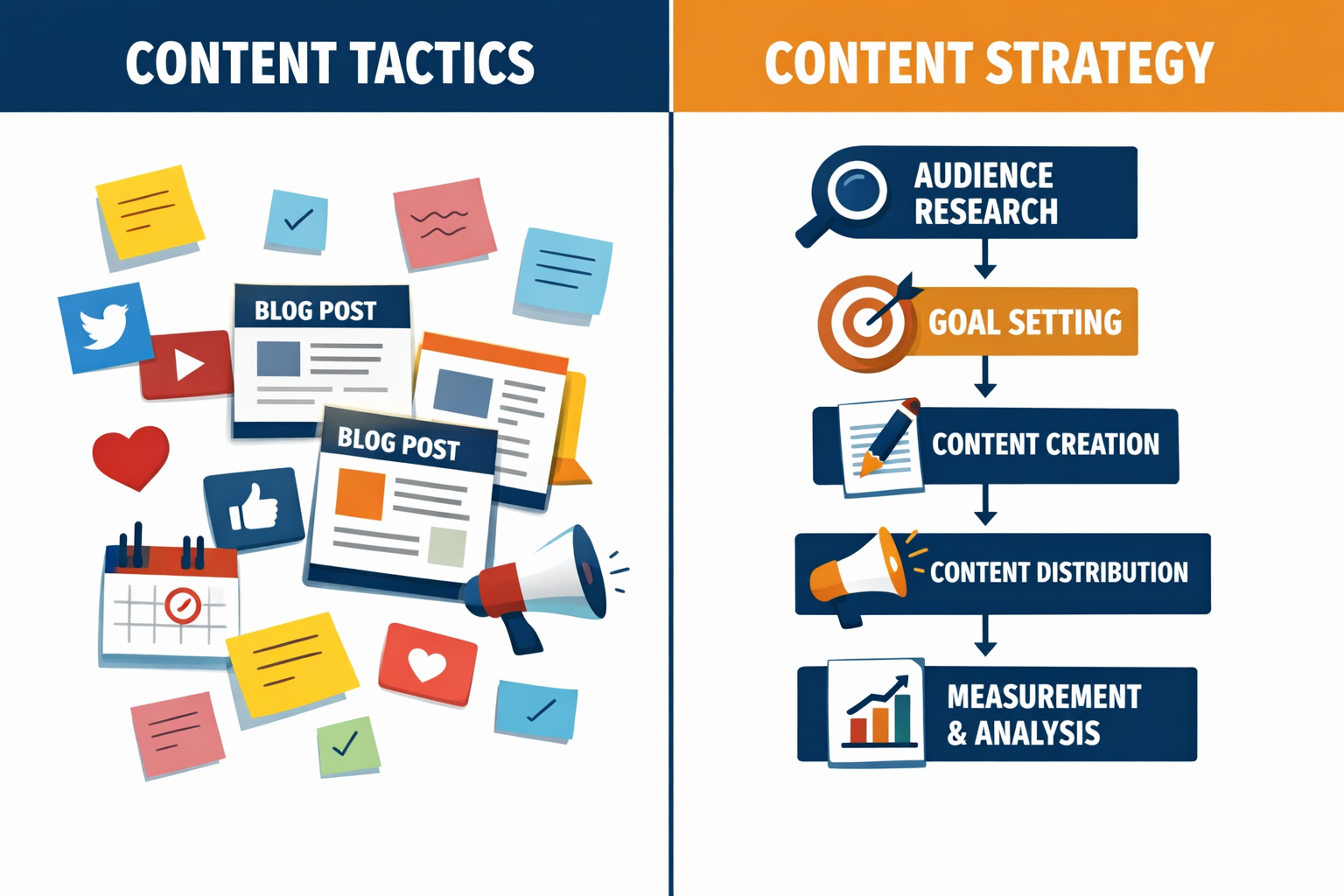
Content Strategy vs. Content Tactics: What’s the Difference?
Your content strategy defines direction. The Content tactics execute it. Confusing the two is one of the most common reasons content programs fail to produce results.
| Content Strategy | Content Tactics | |
|---|---|---|
| Question it answers | Why and what | How and when |
| Time horizon | 6–24 months | Days to weeks |
| Owner | Content strategist, CMO | Content creators, editors |
| Examples | Audience personas, content pillars, KPIs | Blog posts, social captions, email campaigns |
| Changes when | Business goals shift | Campaign or channel changes |
A common mistake: teams jump straight to tactics (writing blog posts, posting on LinkedIn) without a strategy to connect those actions to outcomes.
The result is content that gets created but doesn’t convert, rank, or build authority.
Decision rule: If you can’t explain how a specific piece of content connects to a business goal and a user need, it’s a tactic without a strategy behind it.
Why Does Content Strategy Matter for Businesses?
Content strategy matters because content without direction wastes budget and misses opportunities. Every piece of content costs time, money, and attention, and without a strategy, there’s no way to know whether that investment is working.
Beyond efficiency, content strategy matters because buyer behavior has changed significantly. Search behavior is increasingly conversational and answer-focused, with users asking longer, more specific questions and visiting websites later in their decision process.
This means content must do more work earlier in the funnel, providing direct answers to questions users are asking AI systems and search engines, not just ranking for keywords.
Three business outcomes a strong content strategy drives:
- Demand generation — Content that creates awareness and interest among people who don’t yet know they need your product or service.
- Conversion support — Content that helps prospects evaluate, compare, and decide (pricing pages, case studies, comparison guides).
- Retention and loyalty — Content that keeps existing customers engaged, reduces churn, and drives referrals.
Without a strategy, most organizations over-invest in demand generation content (blog posts, social media) and under-invest in conversion and retention content, which often has higher ROI.
What Are the Key Components of an Effective Content Strategy?
An effective content strategy has six core components. Each one builds on the previous, and skipping any of them creates gaps that show up later as poor performance.
1. Audience Research and Personas
Who is the content for? Not in vague demographic terms, but in specific behavioral and psychographic terms. What questions are they asking? Which problems are they trying to solve? And what formats do they prefer? Good audience research draws on customer interviews, support ticket analysis, search data, and sales team feedback.
2. Business and Content Goals
What should the content accomplish? Goals should be specific and tied to measurable outcomes: increase organic traffic by X%, reduce sales cycle length, improve trial-to-paid conversion rate. Vague goals like “build brand awareness” are only useful if paired with a metric that defines what awareness means in measurable terms.
3. Content Pillars and Topic Clusters
What subjects will the content cover, and how do they relate to each other? Content pillars are the broad themes that reflect both your expertise and your audience’s needs. Topic clusters organize specific pieces of content around those pillars in a way that builds topical authority.
What is Content Stratergy
4. Content Formats and Channels
The right format depends on what users need at each stage of their journey, not what’s easiest to produce. [2] A prospect comparing vendors needs a detailed comparison page or case study, not a social media post. A user troubleshooting a product issue needs a clear support article or short video, not a blog post.
5. Content Governance
Who owns each piece of content? Who approves it? When does it get reviewed and updated? Governance is the operational backbone of a content strategy. Without it, content goes stale, brand voice drifts, and outdated information stays live.
6. Measurement and KPIs
How will you know if the strategy is working? Define KPIs before you start creating. Common content KPIs include organic search rankings, page engagement rate, lead generation, content-assisted conversions, and content ROI.
How Do You Build a Content Strategy? A Step-by-Step Process
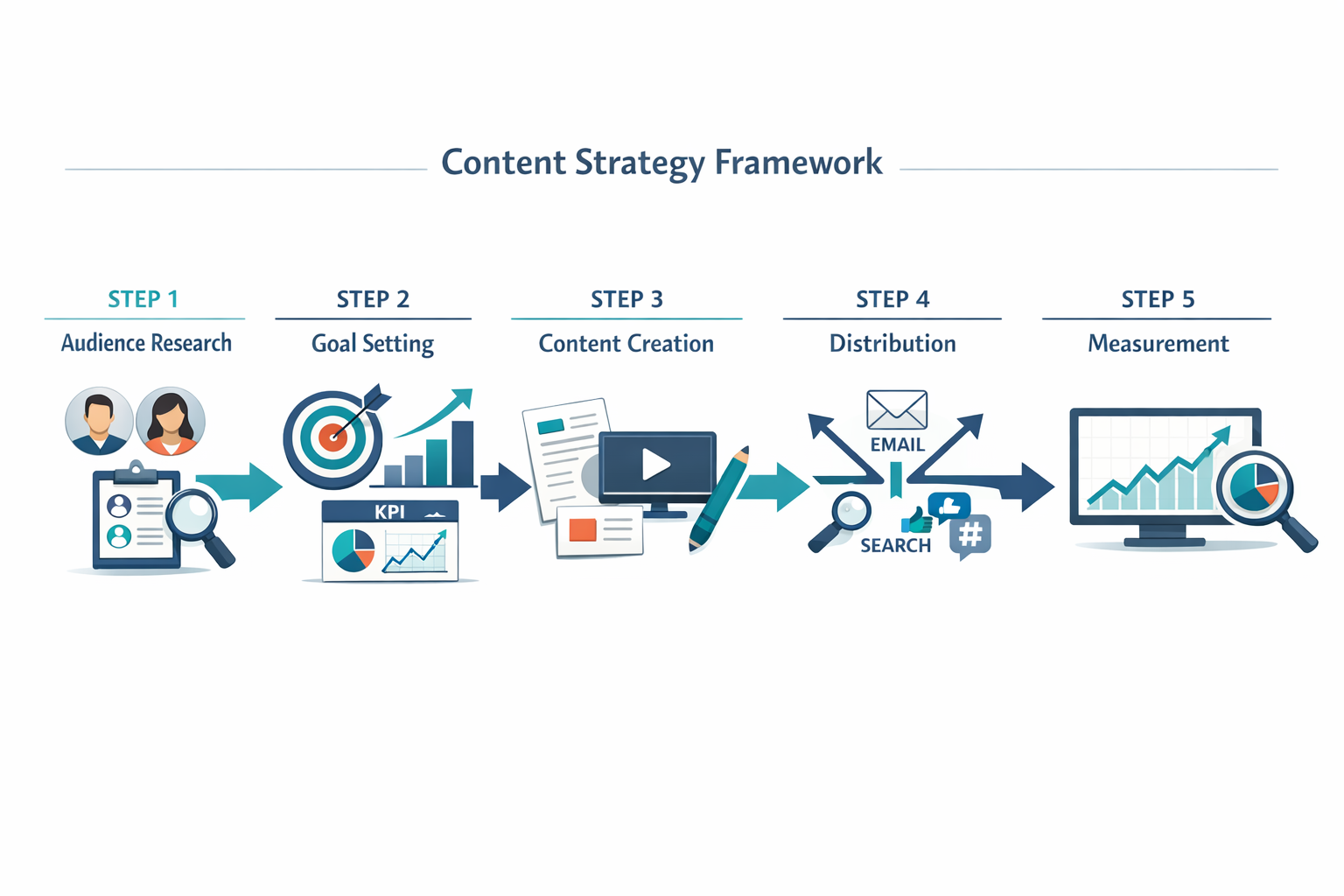
Building a content strategy follows a logical sequence. Here’s a practical framework that works for teams of any size.
Step 1: Conduct a Content Audit
Before creating anything new, assess what already exists. Catalog current content, evaluate its performance, and identify gaps. A content audit reveals what’s working, what’s outdated, and what’s missing entirely.
Step 2: Define Your Audience
Build specific audience personas based on real data. Include the questions they ask at each stage of the buyer journey, the channels they use, and the formats they respond to.
Step 3: Set Clear Goals and KPIs
Align content goals with business objectives. Every content goal should have at least one measurable KPI attached to it.
Step 4: Map Content to the Customer Journey
Identify what content is needed at each stage: awareness, consideration, decision, and retention. This mapping exercise often reveals significant gaps in existing content libraries.
Step 5: Choose Formats and Channels
Select formats based on user intent and business value, not habit or convenience. Prioritize channels where your audience is most active and where content can generate the most impact.
Step 6: Create a Content Production Plan
Assign ownership, set timelines, and establish a realistic production schedule. This is where the content calendar becomes useful, as an execution tool, not a strategy substitute.
Step 7: Publish, Distribute, and Promote
Distribution is as important as creation. In 2026, email and social media are gaining ground as primary distribution channels as search traffic becomes less predictable. [3] Build a distribution plan into every content project.
Step 8: Measure, Learn, and Iterate
Review performance against KPIs on a regular cadence (monthly or quarterly). Use what you learn to adjust topics, formats, and channels. Content strategy is not a one-time document; it’s an ongoing practice.
What Does Content Strategy Look Like in 2026?
Content strategy in 2026 looks fundamentally different from what it looked like five years ago, and the gap between teams that have adapted and those that haven’t is widening.
Zero-visit visibility is now a strategic priority. AI summaries and platform answers are reducing traditional website clicks. [3]
Rand Fishkin has projected that the majority of online journeys won’t result in website clicks, which means content strategy must focus on generating visibility and credibility across AI systems and platforms, not just driving traffic to a website.
This requires content that is structured, direct, and quotable, exactly the kind of content AI systems pull into their answers.
Structured, machine-readable content is a competitive advantage. Brands gaining ground are those with clean data infrastructure and structured content that AI systems can parse and use for recommendations. This means using schema markup, clear heading hierarchies, FAQ sections, and direct answer formats throughout content.
Multi-media content is now a direct ranking factor. Videos, images, interactive content, and properly annotated audio are no longer supplementary. They directly affect visibility across search and social platforms and help AI systems understand and prioritize content.
Integration across channels is replacing isolated strategies. Content strategy in 2026 depends less on winning individual channels and more on connecting the full path from discovery to decision through integration of search, paid media, content, and conversion optimization.
Information gain is the primary content differentiator. Content that simply rephrases what already exists performs poorly. The strategies that win are those that add original research, unique perspectives, proprietary data, or first-hand expertise that can’t be found elsewhere.
Common Mistakes in Content Strategy (and How to Avoid Them)
Even experienced teams make predictable errors. Here are the most common ones and how to sidestep them.
- Skipping the audit: Starting fresh without reviewing existing content leads to duplication and missed opportunities to update high-performing assets.
- Treating strategy as a one-time project: Content strategy needs regular review. Business goals change, audience behavior shifts, and platforms evolve.
- Optimizing for traffic instead of outcomes: High traffic with low conversion is a vanity metric. Tie content goals to business outcomes, not just page views.
- Ignoring governance: Without clear ownership and review cycles, content libraries become outdated and inconsistent.
- Producing content without a distribution plan: Great content that no one sees has no business value. Distribution planning should happen before production, not after.
- Neglecting existing customers: Most content strategies are acquisition-focused. Content that supports retention and expansion often has higher ROI and is consistently underfunded.
FAQ: What is Content Strategy
Q: What is the simplest definition of content strategy?
Content strategy is a plan for creating, managing, and distributing content that serves both user needs and business goals. It defines what content exists, why it exists, and how its success will be measured.
Q: Who needs a content strategy?
Any organization that creates content, which is nearly every business, benefits from a content strategy. It’s especially critical for businesses where content plays a role in attracting, converting, or retaining customers.
Q: How is content strategy different from content marketing?
Content marketing is a specific application of content to attract and retain an audience. Content strategy is the broader planning discipline that governs all content, including content marketing, product content, support content, and internal communications.
Q: How long does it take to build a content strategy?
A basic content strategy for a small business can be developed in two to four weeks. A comprehensive strategy for a larger organization with multiple products, audiences, and channels typically takes two to three months, including research, auditing, and stakeholder alignment.
Q: What tools are used in content strategy?
Common tools include SEO platforms (for keyword and topic research), content management systems, analytics platforms (for performance measurement), project management tools (for production workflows), and AI writing assistants (for drafting and ideation). Tools like Blogify.ai and BlogSEO.io can help automate content production while keeping strategy at the center.
What is Content Stratergy: FAQs
Q: What is content governance?
Content governance is the system of rules, roles, and processes that determine how content is created, approved, published, updated, and retired. It keeps content accurate, on-brand, and strategically aligned over time.
Q: How do you measure content strategy success?
Success is measured against the KPIs defined at the start of the strategy. Common metrics include organic search rankings, engagement rates, lead volume, content-assisted conversions, and content ROI. The right metrics depend on the goals the strategy was built to achieve.
Q: Can a small business have a content strategy?
Yes. A small business content strategy doesn’t need to be complex. It needs to be clear: who the content is for, what it should accomplish, and how performance will be tracked. A focused strategy with limited resources outperforms a sprawling one with no direction.
Q: How does AI affect content strategy in 2026?
AI affects content strategy in two ways. First, AI tools accelerate content production, research, and optimization. Second, AI-powered search and answer systems change how content reaches audiences, requiring strategies that prioritize structured, direct, and authoritative content that AI systems can cite and surface. [3]
Q: What is a content pillar?
A content pillar is a broad topic area that reflects your brand’s expertise and your audience’s core interests. Individual pieces of content are organized around pillars to build topical authority and create a coherent content ecosystem.
Conclusion: Turn Strategy into Action
Content strategy is the difference between content that costs money and content that earns it. Without a strategy, even high-quality content gets lost, misaligned, or forgotten. With one, every piece of content has a purpose, an audience, and a way to prove its value.
Actionable next steps to start today:
- Audit what you have. Before creating anything new, understand what’s already working and what’s not.
- Define your audience specifically. Move beyond demographics to behavioral and intent-based personas.
- Set one measurable goal per content initiative. Vague goals produce vague results.
- Map content to your customer journey. Find the gaps between what you have and what your audience needs at each stage.
- Build a governance plan. Assign ownership and set review cycles before you publish anything new.
- Use tools that support your strategy. Platforms like Blogify.ai can help you scale content production without losing strategic focus, and BlogSEO.io can help ensure your content is optimized for both search and AI visibility.
Content strategy isn’t a one-time document you file away. It’s an ongoing practice that gets sharper the more consistently you apply it. Start with clarity, measure what matters, and adjust as you learn.
Click Here for a Solution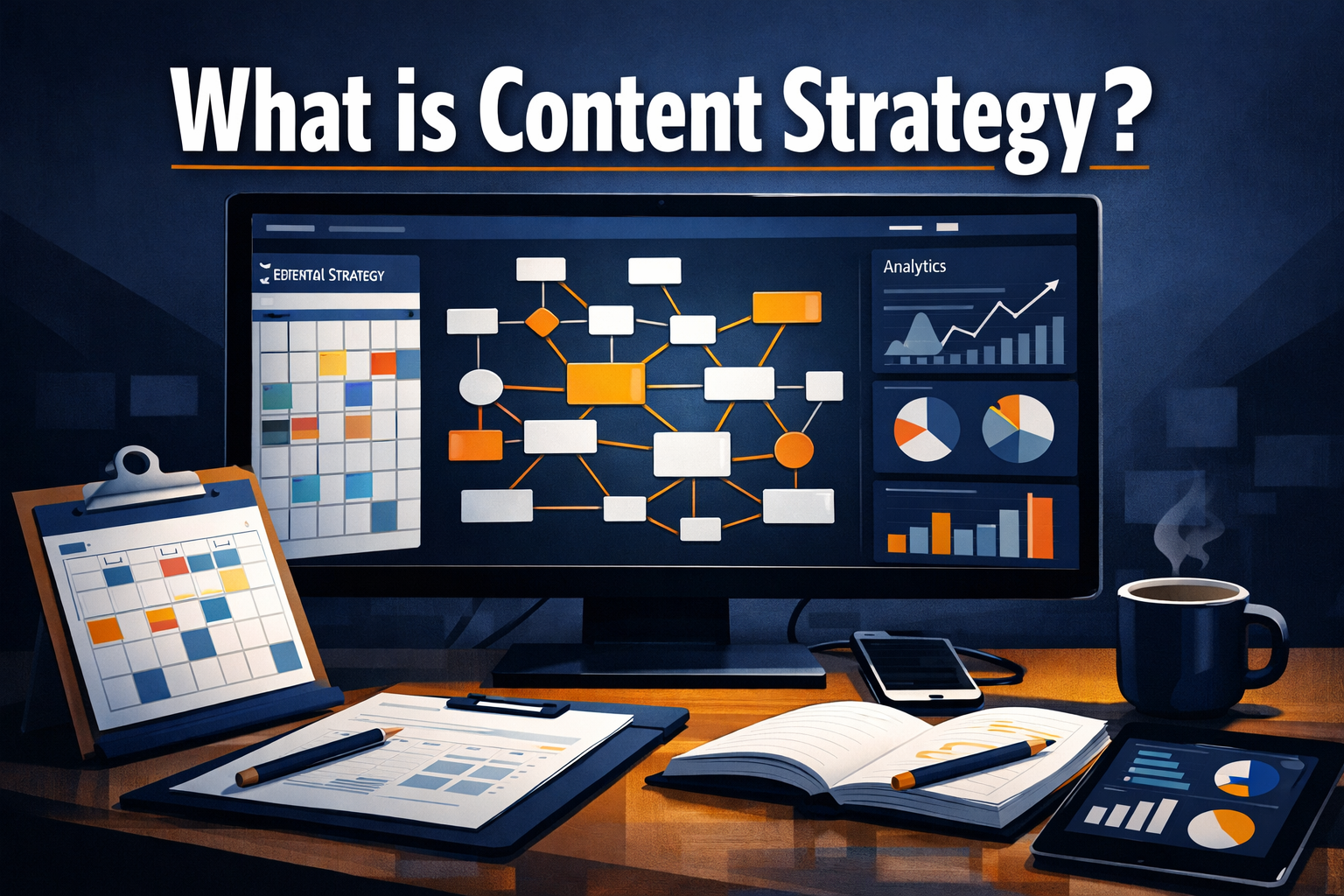
References
[1] April 2026 Marketing News – https://seafoammedia.com/april-2026-marketing-news/
[2] Digital Marketing Trends April 2026 – https://almcorp.com/blog/digital-marketing-trends-april-2026/
[3] 2026 Content Marketing Trends – https://www.wordstream.com/blog/2026-content-marketing-trends
[4] 5 Key Digital Marketing Trends From April 2026 Every Business Must Prepare – https://qortechno.com/5-key-digital-marketing-trends-from-april-2026-every-business-must-prepare/
[5] Content Marketing Ideas 2026 Trends For Engagement Conversions – https://iynixdigital.wordpress.com/2026/04/14/content-marketing-ideas-2026-trends-for-engagement-conversions/
[6] Digital Marketing Updates April 2026 – https://twooctobers.com/blog/digital-marketing-updates-april-2026/
[7] April 2026 Whats Happening In Digital Marketing – https://ny-ave.com/blog/april-2026-whats-happening-in-digital-marketing/
Click Here for a Solution