SaaS Link Building
Lastest update: June 8, 2026
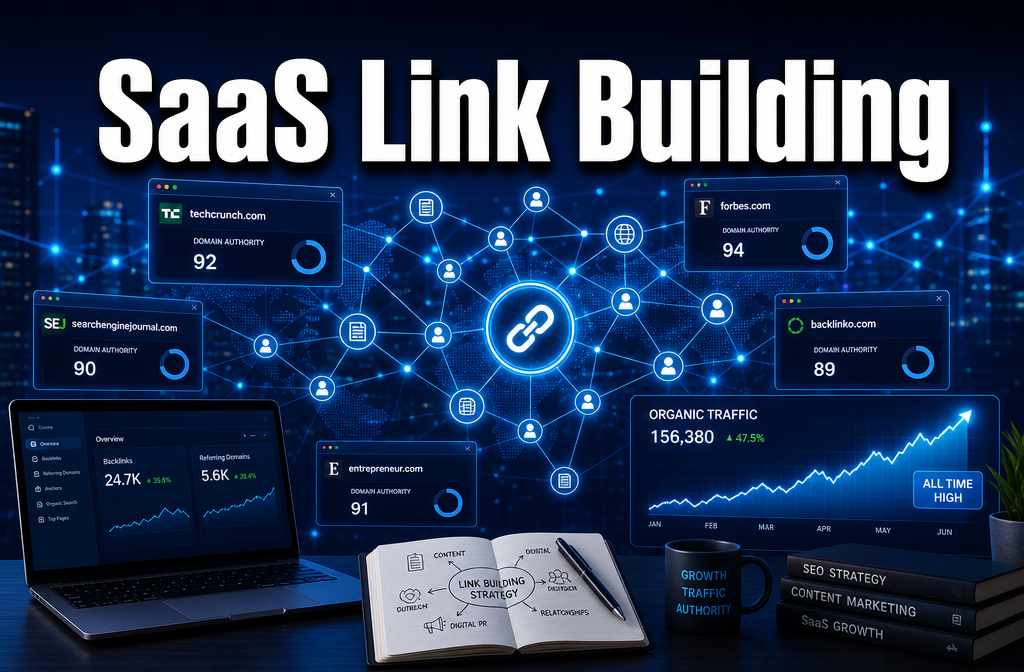
Quick Answer: SaaS Link Building is the process of earning high-quality backlinks from authoritative, relevant websites to improve a SaaS product’s organic search rankings, domain authority, and referral traffic.
It differs from generic link building because SaaS companies must target industry-specific publishers, integration partners, and comparison platforms while competing against well-funded incumbents.
Done correctly, it compounds over time and becomes one of the most cost-efficient customer acquisition channels a SaaS business can own.
Key Takeaways
- SaaS link building focuses on earning editorial, contextual backlinks from relevant technology, business, and industry publications rather than generic directories.
- Competitor backlink gap analysis using tools like Ahrefs or Semrush is now the standard starting point for identifying high-value, replicable link opportunities [1][2].
- Original data studies, benchmark reports, and proprietary research are among the highest-leverage link assets a SaaS company can produce [1][2][5].
- Unlinked brand mention reclamation is considered baseline hygiene and often delivers fast wins with minimal effort [1][2][4].
- Integration partner links and co-created content are a SaaS-specific channel that most competitors overlook [1][5].
- Listicle placements and Reddit thread visibility are now critical for AI search citation, not just traditional organic rankings [5][1].
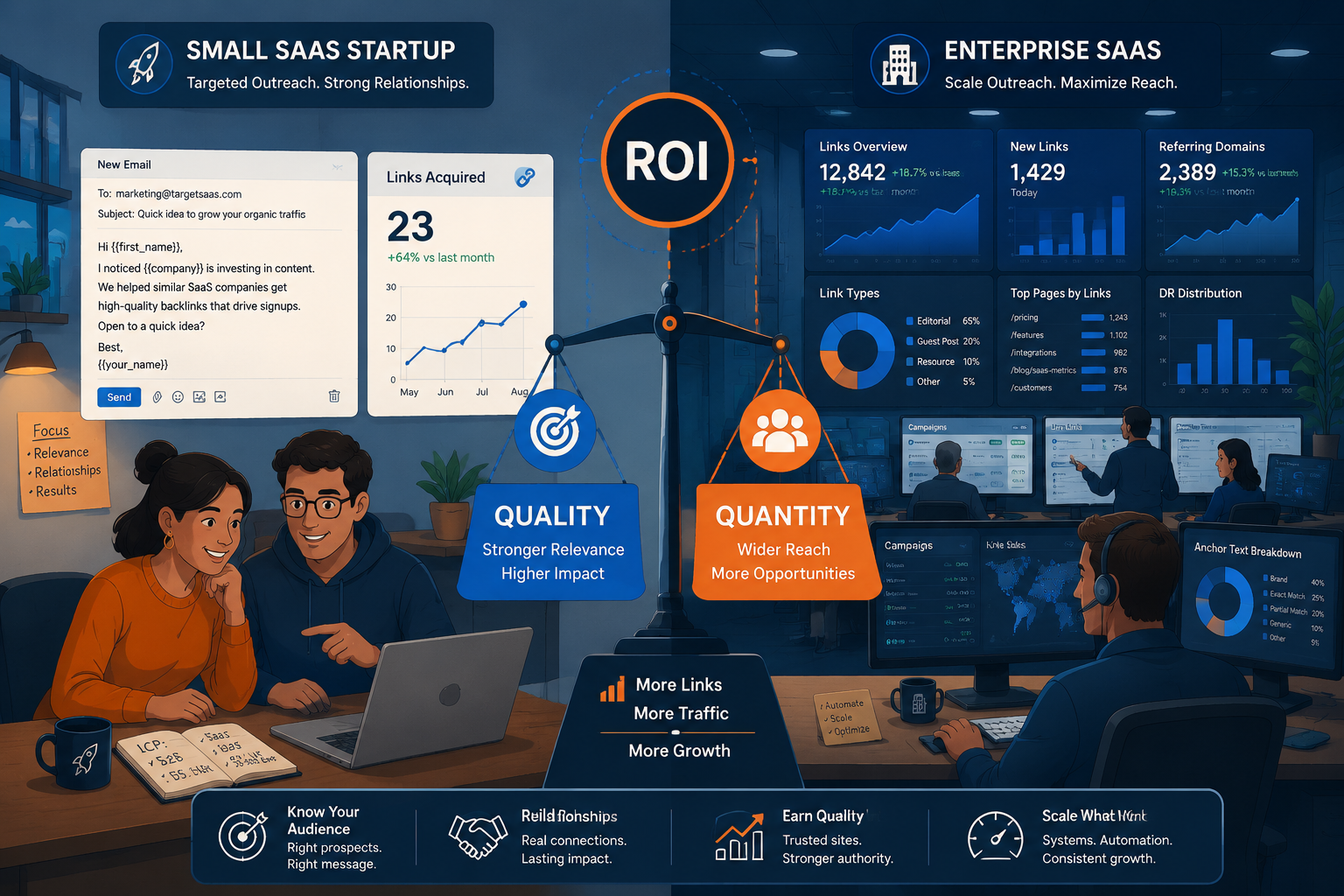
- Small SaaS startups can compete with larger brands by focusing on niche relevance and link quality over volume.
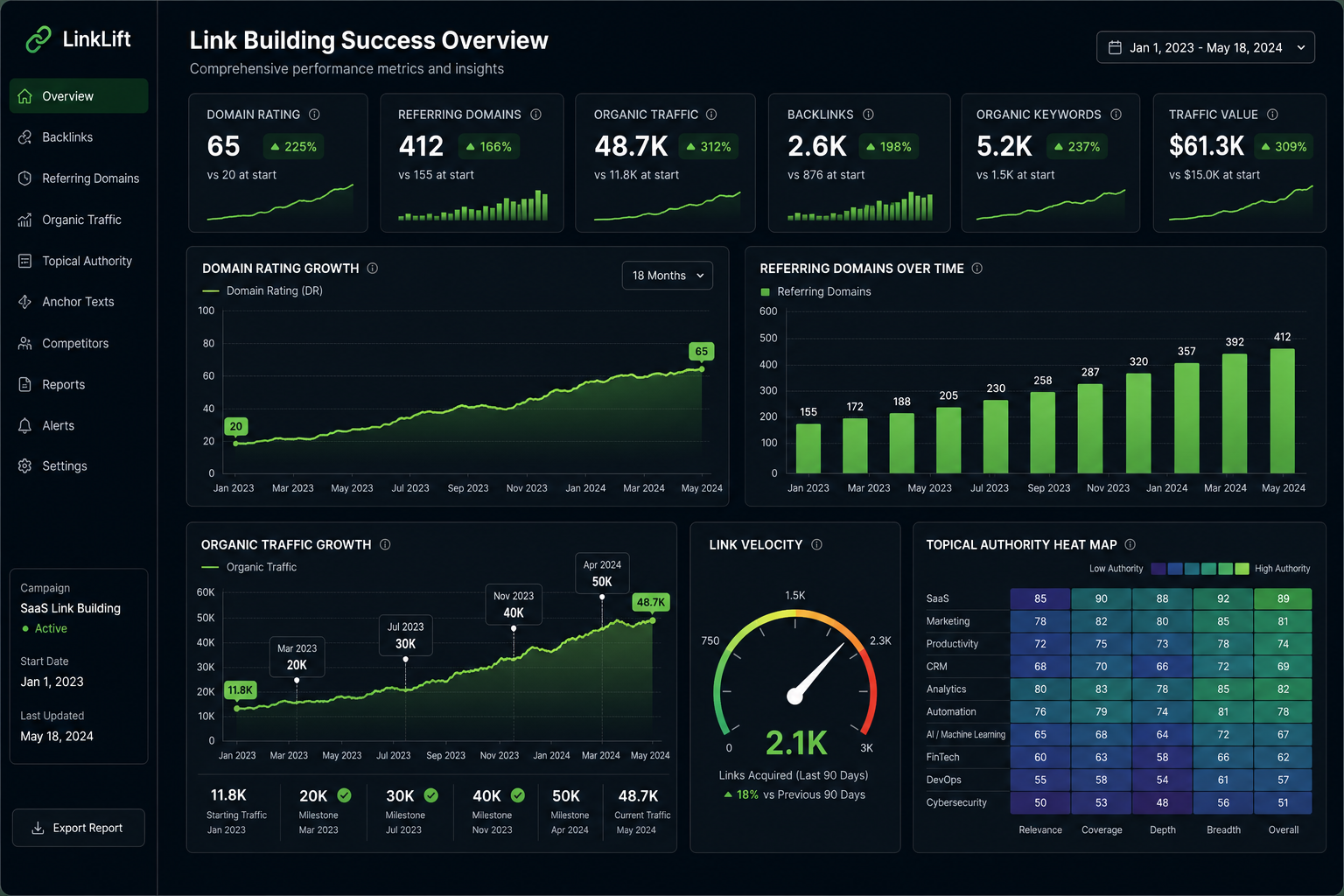
- Tracking referring domains growth, domain rating trajectory, and organic traffic alongside link acquisition is essential for proving ROI.
- Professional SaaS link building services typically cost between $2,000 and $15,000 per month depending on scope and deliverable quality [10].
- Results from a sustained link building program typically appear in search rankings within 3 to 6 months, with compounding gains over 12 to 18 months.
What Exactly Is SaaS Link Building and How Does It Work
SaaS link building is the practice of acquiring hyperlinks from external websites that point back to a SaaS company’s domain, product pages, or content assets.
Search engines treat these backlinks as votes of confidence, and a higher volume of quality links from authoritative, relevant sources correlates strongly with improved organic search rankings.
The mechanics work like this: when a respected industry publication, integration partner, or niche blog links to your SaaS product’s pricing page, a feature guide, or a data study you published, search engines register that signal and gradually improve your domain’s authority. Over time, that authority lifts rankings across your entire site, not just the linked page.
What separates SaaS link building from generic link building is context and specificity. A SaaS company selling project management software needs links from productivity blogs, software review platforms, developer communities, and business operations publications, not from unrelated lifestyle or local business sites. Relevance is the multiplier that turns a backlink into a ranking asset.
Why Are Backlinks Important for SaaS Marketing
Backlinks remain one of Google’s most heavily weighted ranking signals, and for SaaS companies operating in competitive keyword spaces, they are often the deciding factor between page one and page two. A SaaS product that ranks on page one for a high-intent query like “best CRM for small business” can generate thousands of trial signups monthly from organic traffic alone.
Beyond rankings, backlinks from relevant industry sites drive direct referral traffic from readers who are already in your target market. A single mention in a widely-read SaaS newsletter or a “best tools” roundup can send hundreds of qualified visitors to a trial page in a single day.
There is also a compounding effect that makes early investment in SaaS link building particularly valuable. Links earned today continue to pass authority for months and years, unlike paid ads that stop delivering the moment a budget runs out.
How Is Link Building for SaaS Different from Other Industries
SaaS link building operates under a distinct set of conditions that make it both more competitive and more opportunity-rich than link building for, say, a local service business or an e-commerce store.
Key differences include:
- Product-led content opportunities: SaaS companies can publish original usage data, benchmark studies, and API documentation that naturally attract citations from developers, journalists, and researchers.
- Integration ecosystem links: SaaS products that integrate with other platforms can earn links from partner directories, co-marketing pages, and “works with” listings that simply don’t exist for other business types.
- Comparison and review platform dominance: Sites like G2, Capterra, and Product Hunt are high-authority link sources specific to SaaS. Ranking well on these platforms also feeds AI search recommendations.
- Longer sales cycles mean more content touchpoints: Because SaaS buyers research extensively before purchasing, there are more opportunities to earn links from educational content at every stage of the funnel.
- Competitive keyword economics: SaaS keywords often have high commercial intent and correspondingly high competition, which means the bar for ranking, and therefore the link volume required, is higher than in most other industries.
What Are the Best Link Building Strategies for SaaS Companies
The most effective SaaS link building strategies in 2026 combine content-driven link earning with systematic outreach. Here are the approaches with the strongest track records [1][2][5]:
1. Competitor Backlink Gap Analysis
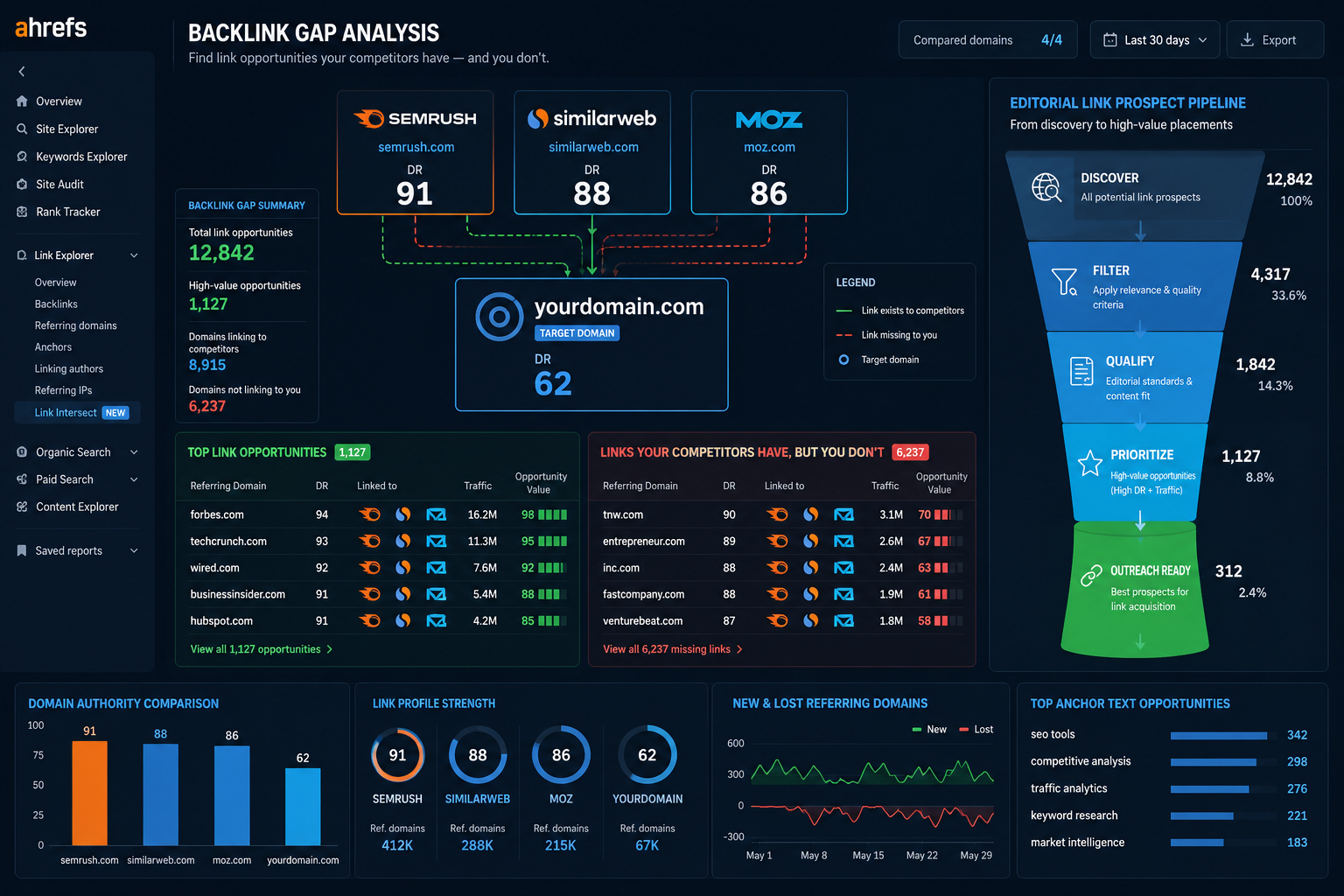
Pull your top 3 to 5 keyword competitors into Ahrefs or Semrush and run a backlink gap report. Prioritize prospects where only one or two competitors have links, as these represent editorial placements you can realistically replicate rather than paid or low-quality directories [1][2].
2. Original Data Studies and Benchmark Reports
Turn your product’s usage data, customer survey results, or industry benchmarks into a standalone research page. Journalists, bloggers, and AI models actively cite original data, making this one of the highest-leverage link assets a SaaS company can produce [1][2][5].
3. Unlinked Brand Mention Reclamation
Set up Google Alerts, Brand24, or Ahrefs Content Explorer to monitor mentions of your brand and product name. Filter results to unlinked domains and send short, direct emails requesting a link be added. A 5 to 7 day follow-up window is recommended for best conversion rates [1][2][4].
4. Integration Partner Co-Marketing
Work with your integration partners to co-create tutorials, joint case studies, or “how X works with Y” guides. Secure links from their integration directories, testimonial pages, and ecosystem listings. These links are both high-authority and highly relevant [1][5].
SaaS Link Building: FAQs
5. Targeted Guest Posting
Use search operators like “write for us” combined with your niche keywords to find relevant publications. Prioritize guest posts that link directly to trial, demo, or feature pages rather than just blog posts, and avoid generic guest post farms that risk future devaluation [2][1][6].
6. Listicle and Comparison Page Placement
Systematically identify “best [category] software” pages ranking on page one and reach out to be included. These placements are now a primary surface from which AI assistants pull product recommendations [5][1].
7. Reddit and Forum Visibility
Contribute genuinely helpful answers in relevant subreddits and niche forums. Reddit threads appearing on page one for high-intent queries are increasingly cited by AI search systems, making this a dual-channel opportunity [5].
How Do I Build High-Quality Links for My SaaS Product: A Step-by-Step Process
Building high-quality links requires a repeatable system, not one-off tactics. Here is a practical framework:
- Audit your current backlink profile using Ahrefs or Semrush to understand your baseline domain rating, referring domains count, and any toxic links to disavow.
- Run a competitor gap analysis to identify link prospects your rivals have earned that you have not yet targeted [1][2].
- Create a link-worthy asset such as a data study, free tool, or comprehensive guide that gives publishers a reason to link.
- Build a prospect list of 50 to 100 relevant sites per month, segmented by type: publications, partner directories, review platforms, and forums.
- Personalize outreach emails with a specific reason why your content is relevant to their audience. Generic templates get ignored.
- Follow up once after 5 to 7 days if you receive no response, then move on.
- Track placements in a simple spreadsheet or CRM, noting the referring domain, page linked, date, and estimated domain authority.
- Repeat monthly with a consistent volume target, adjusting tactics based on what converts.
Can Small SaaS Startups Compete with Big Brands in Link Acquisition
Yes, but the strategy must be different. Early-stage SaaS startups cannot out-spend established competitors on link volume, but they can out-maneuver them on niche relevance and speed.
Concrete approaches for budget-conscious startups:
- Focus on micro-niche publications where competition for links is lower and relevance is higher. A link from a small but tightly focused newsletter read by your exact target customer often outperforms a generic high-DA placement.
- Leverage founder expertise by writing bylined articles for industry publications. Founders often have unique insights that editors value, and this costs time rather than budget.
- Partner with complementary tools at a similar stage. Early-stage SaaS companies are often willing to co-create content and exchange integration links because they face the same growth challenges.
- Prioritize unlinked mention reclamation as a zero-cost starting point. If people are already writing about your product without linking, converting those mentions requires only a short email [1][2][4].
A startup with a monthly link building budget of $500 to $1,500 can still build meaningful domain authority within 12 months by concentrating on quality over quantity.
How Much Does Professional SaaS Link Building Cost
Professional SaaS link building services typically range from $2,000 to $15,000 per month, depending on the agency’s track record, the quality of placements, and the volume of links delivered [10]. Some agencies charge per link, with individual placements on high-authority sites ranging from $300 to $2,000 each.
What drives the cost variation:
- Domain authority of target sites: Links from DR 70+ publications cost significantly more than DR 30 to 50 placements.
- Editorial versus sponsored placement: True editorial links earned through content quality command a premium over disclosed sponsored placements.
- Niche specificity: SaaS-focused agencies with existing publisher relationships in technology and B2B verticals charge more than generalist link builders.
- Deliverable scope: Some services include content creation, outreach, and reporting; others deliver links only.
Before hiring a service, request a sample of recent placements and verify them independently in Ahrefs. Reputable agencies will share this information without hesitation [8][9][10].
What Metrics Should I Track for SaaS Link Building Success
Tracking the right metrics prevents you from optimizing for vanity numbers. The metrics that actually indicate link building ROI for SaaS companies are:
| Metric | What It Tells You | Review Frequency |
|---|---|---|
| Referring domains growth | Rate of new unique sites linking to you | Monthly |
| Domain Rating (DR) trajectory | Overall authority trend | Quarterly |
| Organic keyword rankings | Impact on target keyword positions | Monthly |
| Organic traffic from search | Actual visitor growth from SEO | Monthly |
| Link velocity | Consistency of acquisition pace | Monthly |
| Topical authority score | Relevance of linking sites to your niche | Quarterly |
| Trial/demo page referral traffic | Direct revenue attribution from links | Monthly |
One metric to treat with caution: raw domain authority scores from any single tool. These are proprietary estimates, not Google signals. Use them as directional indicators rather than absolute benchmarks.
Common Mistakes to Avoid in SaaS Link Building
The most costly mistakes in SaaS link building are not always obvious, and some can result in Google manual penalties that take months to recover from.
- Buying links from link farms or private blog networks: Google’s spam detection has become sophisticated enough to identify unnatural link patterns. The short-term ranking boost rarely justifies the long-term risk.
- Ignoring link relevance in favor of domain authority: A DR 80 link from a cooking blog adds little value to a B2B SaaS product. Relevance and authority together create ranking impact.
- Targeting only homepage links: Distributing links to product feature pages, pricing pages, and landing pages distributes authority more effectively and supports conversion-focused rankings.
- No follow-up system: Most link placements require at least one follow-up email. Teams that send one outreach email and move on leave a significant percentage of potential links unclaimed.
- Neglecting existing partnerships: Integration partners, investors, and existing customers are often willing to link and rarely asked [1][5].
How Long Does It Take to See Results from SaaS Link Building
Realistic timelines matter because unrealistic expectations cause teams to abandon link building before it compounds. In practice, the timeline looks like this:
- Months 1 to 2: Backlinks are indexed, domain authority begins a slow upward trend. No visible ranking changes yet.
- Months 3 to 4: Target pages begin moving from page 3 to 4 up to page 2 for mid-competition keywords. Referral traffic from placements becomes measurable.
- Months 6 to 9: Meaningful ranking improvements for target keywords become visible. Organic traffic growth accelerates.
- Months 12 to 18: Compounding effect becomes clear. Rankings stabilize in top 5 positions for priority keywords, and organic traffic growth becomes a predictable channel.
HubSpot’s growth from 500,000 to over 7,000,000 monthly organic visitors over four years is a well-documented example of what sustained, compounding SEO and link building investment produces at scale. The trajectory was not linear; it accelerated significantly after the 12 to 18 month mark as domain authority reached a threshold that made new rankings easier to achieve.
What Types of Websites Should I Target for SaaS Backlinks
Not all websites are worth pursuing. The highest-value link sources for SaaS companies, ranked by typical impact, are:
- Industry publications and trade media covering your software category (e.g., TechCrunch, G2 Learning Hub, SaaStr for B2B SaaS)
- Integration partner directories and ecosystem pages from platforms your product connects with
- Software review and comparison sites such as G2, Capterra, GetApp, and Software Advice
- Niche newsletters and community sites with engaged audiences in your target vertical
- University and research institution sites that cite original data studies you have published
- High-authority business and marketing blogs where your target buyers consume content
- Podcast show notes and video descriptions from interviews featuring your founders or subject matter experts
- Reddit and niche forum threads ranking on page one for high-intent queries [5]
Avoid: link directories with no editorial standards, irrelevant foreign-language sites, sites with no real traffic, and any site that sells links openly without disclosure.
Are Paid Link Building Services Worth It for SaaS
Paid link building services can deliver strong ROI for SaaS companies when the agency has genuine publisher relationships and a track record of editorial placements in relevant verticals. The key is distinguishing between agencies that earn links through content and outreach versus those that simply sell placements on low-quality networks [8][9][10].
Choose a paid service if:
- You lack internal bandwidth for consistent outreach at scale
- You need to accelerate authority building in a competitive keyword space
- The agency can demonstrate verified placements on sites your target audience actually reads
Build links in-house if:
- You have a content team capable of producing link-worthy assets
- Your founders or subject matter experts can contribute bylined content to industry publications
- You are in an early stage where budget is the primary constraint
A hybrid approach works well for many SaaS companies: handle data-driven content creation and partner link acquisition internally while outsourcing outreach-heavy tactics to a specialist agency [9][10].
The Future of SaaS Link Building: AI Search and What Changes Next
AI search systems, including Google’s AI Overviews and standalone AI assistants, are changing which content surfaces get cited. In 2026, the implications for SaaS link building are concrete:
- Listicle and comparison page mentions are now AI citation surfaces. When an AI assistant recommends “the best project management tools,” it pulls from the same “best X software” pages that rank organically. Getting listed on these pages is no longer just an SEO tactic; it is a direct channel into AI-generated recommendations [5][1].
- Original data is cited by AI models. Proprietary benchmark studies and usage data reports are among the content types AI systems reference when answering research questions. Publishing original data is now simultaneously a link-earning and AI-visibility strategy [1][2][5].
- Reddit and forum content feeds AI responses. AI systems frequently surface Reddit threads in responses to product and tool queries. Maintaining a genuine, helpful presence in relevant communities is now part of a complete SaaS link building strategy [5].
The core principle does not change: earn links from sites that real people in your target market trust and read. What changes is that the downstream effect of those links now extends into AI-generated search results, not just traditional blue-link rankings.
Conclusion
SaaS Link Building is not a quick win. It is a compounding investment that, when executed with consistency and strategic focus, becomes one of the most durable growth channels available to a SaaS business.
The companies that dominate organic search in competitive SaaS categories, the HubSpots and the Atlassians, did not get there through paid ads alone.
They built content assets worth linking to, earned placements in the publications their buyers trusted, and repeated that process for years.
Actionable next steps to start today:
- Run a competitor backlink gap analysis in Ahrefs or Semrush and identify your top 20 link prospects this week.
- Set up Google Alerts and Brand24 for your brand name and product name to begin capturing unlinked mentions.
- Identify one original data asset you could publish in the next 60 days, whether a usage benchmark, a customer survey, or an industry report.
- Audit your integration partners and identify which ones have directories or ecosystem pages where you are not yet listed.
- Evaluate whether your current content output is link-worthy, and if not, prioritize one high-value resource page or guide before scaling outreach.
If you are evaluating professional SaaS link building services, request verified placement examples, ask for client references in your specific vertical, and treat any agency that cannot show you real, indexed links from relevant sites as a red flag.
The organic channel rewards patience and consistency. Start building now, and the compounding returns will be measurable within a year.
FAQ
What is SaaS link building?
SaaS link building is the process of earning backlinks from authoritative, relevant external websites to improve a SaaS product’s organic search rankings, domain authority, and referral traffic. It is distinct from generic link building because it targets industry-specific publishers, integration partners, and software review platforms.
How many backlinks does a SaaS company need to rank?
There is no universal number. The required link volume depends on your target keywords’ competition level. A useful benchmark is to match or exceed the referring domain count of the top 3 competitors ranking for your priority keywords, while prioritizing link quality and relevance over raw volume.
Is guest posting still effective for SaaS link building in 2026?
Yes, when done selectively. Guest posting on tightly relevant publications that your target buyers actually read remains effective. The tactic loses value when used at high volume on low-relevance or low-traffic sites, which risks future devaluation or manual penalties [2][1][6].
What tools are best for SaaS link building?
Ahrefs and Semrush are the industry standards for backlink analysis, competitor gap reports, and prospect identification. Brand24 and Google Alerts support unlinked mention monitoring. Pitchbox and Hunter.io assist with outreach at scale.
Can link building hurt my SaaS site?
Yes, if done incorrectly. Purchasing links from link farms, participating in private blog networks, or engaging in large-scale reciprocal link schemes can result in Google manual penalties or algorithmic devaluation. Ethical, editorial link building carries no such risk.
SaaS Link Building: FAQs
How do I measure the ROI of SaaS link building?
Track referring domain growth, domain rating trajectory, organic keyword ranking improvements, and organic traffic alongside trial or demo page conversions. Connecting organic traffic growth to pipeline and revenue, even directionally, makes the ROI case to stakeholders.
What is a good domain rating to aim for as a SaaS company?
Domain rating is a relative metric. A DR of 50 to 60 is sufficient to compete in many mid-competition SaaS keyword spaces. In highly competitive categories, top-ranking SaaS brands often have DR 70 or above. Focus on consistent growth rather than a specific target number.
How often should I be building links?
Consistency matters more than volume spikes. A steady pace of 10 to 30 new referring domains per month is more valuable to search engines than 200 links acquired in a single month followed by months of inactivity.
Are links from software review sites like G2 valuable?
Yes. G2, Capterra, and similar platforms are high-authority domains with strong relevance to SaaS buyers. Links from your profile pages on these platforms contribute to domain authority, and ranking well on the platforms themselves drives direct referral traffic from buyers in active evaluation mode.
What is unlinked mention reclamation?
Unlinked mention reclamation is the process of identifying websites that have mentioned your brand or product name in their content without including a hyperlink, then contacting them to request the link be added. It is considered one of the fastest and most cost-efficient link building tactics available to SaaS companies [1][2][4].
References
[1] SaaS Link Building – https://outreachdesk.com/saas-link-building/
[2] SaaS Link Building – https://seoprofy.com/blog/saas-link-building/
[3] SaaS Backlinking Trends – https://miromind.com/blog/saas-backlinking-trends
[4] Abbas Anwar SaaS SEO Linkbuilding Activity – https://www.linkedin.com/posts/abbas-anwar-169934236_saas-seo-linkbuilding-activity-7435768671580487680-KTwy
[5] SaaS Link Building – https://wetalkthetalk.co/blog/saas-link-building
[6] SaaS Link Building – https://voxturr.com/saas-link-building/
[8] Best SaaS Link Building Agencies in 2026 – https://www.reddit.com/r/DigitalMarketing/comments/1qoknam/best_saas_link_building_agencies_in_2026/
[9] Best Link Building Agencies for SaaS Companies – https://growthner.com/blog/best-link-building-agencies-for-saas-companies/
[10] Best SaaS Link Building Services in 2026: A Comprehensive Buyers Guide – https://cuttingedgepr.com/articles/best-saas-link-building-services-in-2026-a-comprehensive-buyers-guide/
Pingback: BabyLoveGrowth AI Review: What It Does Who It Suits Best - A1Publishing
Pingback: SEO and Content Strategy: The Complete 2026 Guide