Automated SEO Tools
Last updated: April 22, 2026
Quick Answer: Automated SEO tools use AI and machine learning to handle tasks like keyword research, content optimization, technical audits, and rank tracking without constant manual input.
In 2026, the best tools go further, tracking your brand’s presence inside AI-generated answers from ChatGPT, Google AI Overviews, and Gemini.
Choosing the right stack depends on your team size, budget, and whether you’re optimizing for traditional blue-link rankings, AI citation frequency, or both.
Key Takeaways
- AI Overviews now appear on roughly 48% of search results pages, up from 31% a year ago, making AI visibility tracking a non-negotiable part of any modern SEO tool stack [7]
- The best automated SEO tools in 2026 operate in layers: visibility tracking, content optimization, technical automation, and PR targeting [2]
- OTTO SEO (Search Atlas) is currently the only major tool that directly deploys technical fixes to your site rather than just reporting them [3]
- Keyword density and article length matter far less than information gain and E-E-A-T signals in 2026 [5]
- Healthcare and finance sectors require different AI citation strategies, overlap between traditional rankings and AI citations varies from 11% to 24% depending on the industry [7]
- Frase, Clearscope, and SurferSEO remain the top content optimization tools, each serving slightly different use cases
- No single all-in-one tool wins every category, a targeted two- or three-tool combination consistently outperforms one bloated platform [6]
- Programmatic SEO tools now automate the full content pipeline: research, writing, internal linking, meta descriptions, and publishing [4]
BlogSEO.io offers an end-to-end platform
What Are Automated SEO Tools and Why Do They Matter in 2026?
Automated SEO tools are software platforms that replace or reduce manual SEO tasks using AI, machine learning, and rule-based automation.
They handle everything from crawling your site for broken links to generating content briefs, tracking keyword rankings, and now monitoring how often your brand appears inside AI-generated answers.
The reason they matter more than ever: search itself has changed.
According to BrightEdge data cited by Two Octobers, AI Overviews appeared on 48% of Google search results pages in February 2026, up 58% year-over-year [7].
That means nearly half of all searches now show an AI-generated answer before any blue link.
If your content isn’t cited inside those answers, you’re effectively invisible to a large share of searchers, regardless of your traditional ranking position.
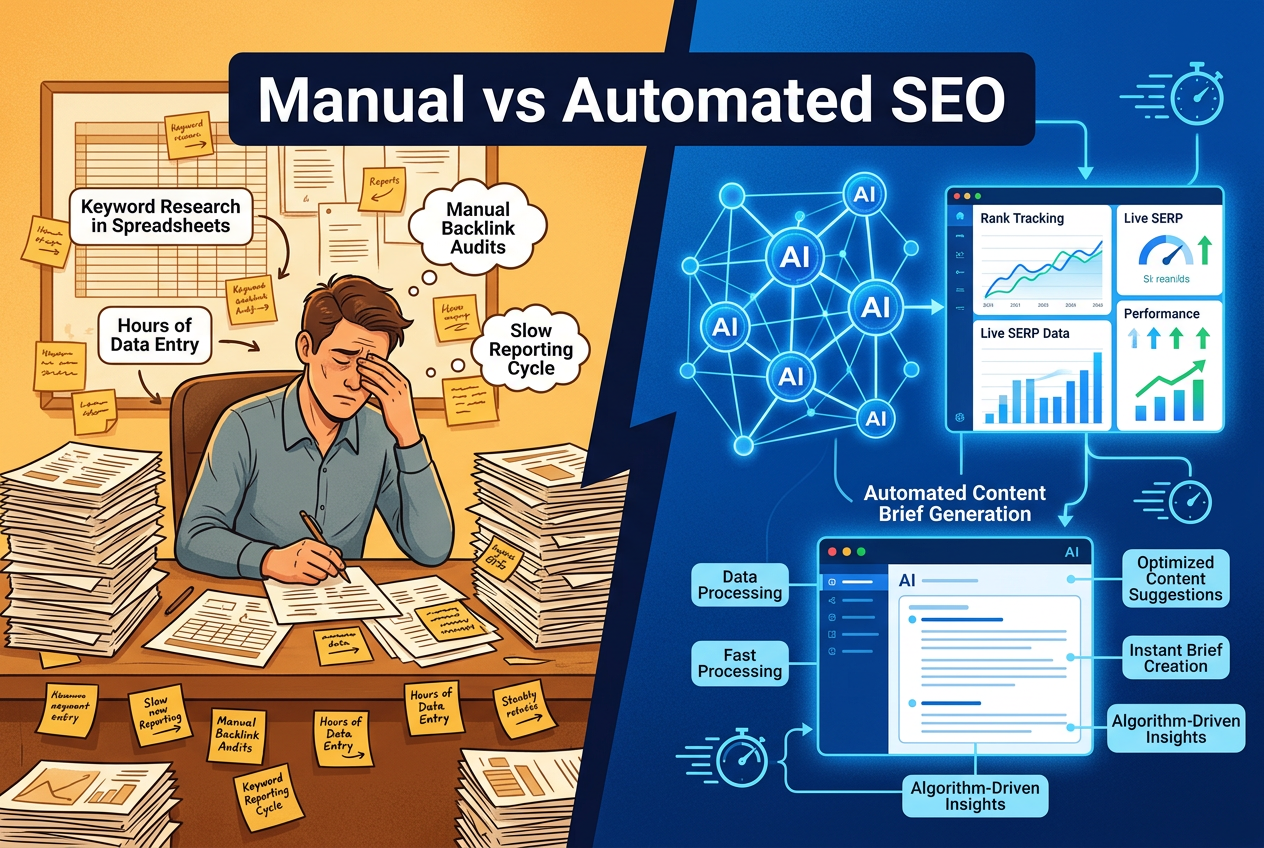
Manual SEO workflows simply can’t keep pace with that kind of environment. Automated tools can.
How Have Automated SEO Tools Changed From Previous Years?
The shift is significant. Before 2024, most SEO tools were built around a simple loop: find keywords, create content, build links, track rankings. That loop still exists, but it’s no longer sufficient.
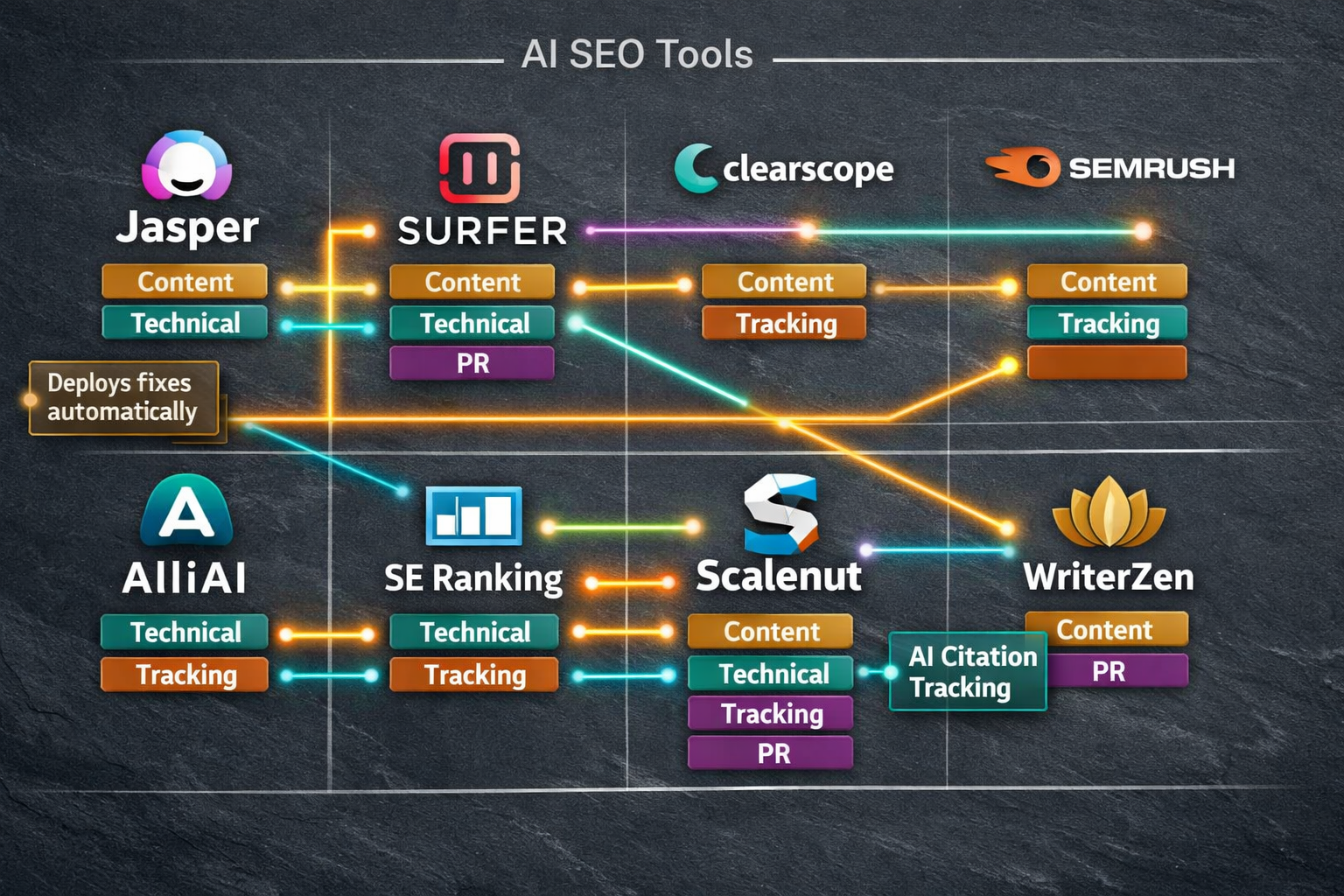
The 2026 AI SEO stack operates as a layered system focused on four distinct functions [2]:
- Visibility tracking — monitoring brand mentions across ChatGPT, AI Overviews, and Gemini
- Content optimization — improving information gain, entity coverage, and E-E-A-T signals
- Technical automation — fixing site issues automatically, not just flagging them
- PR targeting — getting your brand cited by AI systems through strategic digital PR
The core shift in goals: SEO teams are no longer just chasing the #1 blue link. The primary objective has moved toward achieving high AI citation frequency [5]. That requires a fundamentally different set of tools and strategies.
Common mistake: Assuming your current keyword-focused tool stack covers AI visibility. Most legacy tools don’t track whether your brand appears in ChatGPT or Gemini responses at all.
Which Automated SEO Tools Actually Work in 2026?
Based on Semrush’s hands-on review and independent analysis, eight tools consistently deliver results across different layers of the SEO stack [2]:
| Tool | Primary Function | Best For |
|---|---|---|
| Semrush AI Visibility Toolkit | Brand mention tracking in AI answers | Enterprises tracking multi-platform AI presence |
| Semrush AI PR Toolkit | Digital PR for AI citation building | PR teams targeting AI Overview inclusion |
| SparkToro | Audience and source research | Understanding where your audience gets information |
| AlsoAsked | Question-based keyword mapping | Content teams building topical authority |
| Keyword Insights | Keyword clustering and intent mapping | Large-scale content planning |
| SurferSEO | On-page optimization + AI visibility | Content teams managing both traditional and AI SEO [3] |
| AirOps | AI workflow automation | Teams building custom SEO automation pipelines |
| Screaming Frog SEO Spider | Technical site auditing | Developers and technical SEO specialists |
Choose Semrush AI Visibility Toolkit if you need to track brand mentions across ChatGPT, AI Overviews, and Gemini simultaneously, it’s the most comprehensive platform for this specific use case as of 2026 [3].
Choose Screaming Frog if you need deep technical auditing at scale without paying enterprise platform prices.
For content optimization specifically, Clearscope’s NLP term recommendation engine remains the most accurate for semantic content grading and entity relationship analysis [3].
SurferSEO is the better choice if you want a single tool that bridges on-page optimization with AI visibility signals, including geographic layering [3].
What Makes OTTO SEO Different From Other Automated SEO Tools?
OTTO SEO, part of the Search Atlas platform, does something most competing tools still don’t: it directly deploys technical SEO fixes to your website rather than generating a report and leaving implementation to your dev team [3].
Most technical SEO tools follow a detect-and-report model. They crawl your site, identify issues like missing meta descriptions, broken internal links, or slow page speed, and hand you a spreadsheet.
You then have to prioritize, assign, and implement each fix manually.
OTTO SEO skips that middle step. Once connected to your site, it can push fixes automatically, a meaningful time saver for teams without dedicated developer resources.
Edge case: Automated fix deployment works well for straightforward technical issues. For complex structural problems (like a fundamentally broken URL architecture), you’ll still need human judgment before any tool touches your site.
How Do Automated SEO Tools Handle Content Creation?
Content automation has matured considerably. The best tools now cover the full pipeline from research to publishing [4].
Frase analyzes the top 20 Google results for any target keyword to build detailed content outlines automatically.
It also scrapes Quora and Reddit to surface the specific questions your audience is actually asking [1][6].
This is particularly useful for matching search intent rather than just keyword frequency.
Clearscope grades your content against NLP-derived term lists, helping you understand which related entities and concepts need to appear in your article to compete semantically [3].
SurferSEO combines content scoring with AI visibility signals, so you can optimize for both traditional rankings and AI citation likelihood from one interface [3].
Programmatic SEO tools take automation further still, handling AI-powered research, content generation, custom writing style profiles, internal linking, contextual image placement, and meta description writing in a single automated workflow [4].
My experience: I’ve found that fully automated content generation works best for high-volume, lower-competition pages (think location pages or product category descriptions).
For cornerstone content where authority and depth matter most, human editing remains essential, the tools get you 70% of the way there, but the final 30% still requires judgment.
How Should You Choose the Right Automated SEO Tool Stack?
The answer depends on three variables: your team size, your content volume, and your primary visibility goal.
For small teams or solo operators:
- Start with one content optimization tool (Frase or SurferSEO) and one technical audit tool (Screaming Frog)
- Add AI visibility tracking only when you have a content baseline worth tracking
– Mid-size content teams:
- Pair SurferSEO or Clearscope for content authority with a cost-effective scaling tool like SurgeGraph [6]
- Use AlsoAsked for question-based content planning to build topical coverage efficiently
– Enterprise teams:
- Semrush AI Visibility Toolkit becomes worth the investment when you need to monitor brand presence across multiple AI platforms simultaneously [3]
- Add AirOps for custom automation workflows that connect your tools together
Industry note: If you’re in healthcare or finance, your AI citation strategy needs to be sector-specific.
Healthcare searches show 24% overlap between traditional top-10 rankings and AI Overview citations; finance searches show only 11% [7].
That gap means a finance brand ranking #3 organically has a much lower chance of appearing in AI answers than a healthcare brand at the same position, and your tool selection should reflect that.
BlogSEO.io offers an end-to-end platform
What Does a Practical Automated SEO Workflow Look Like?
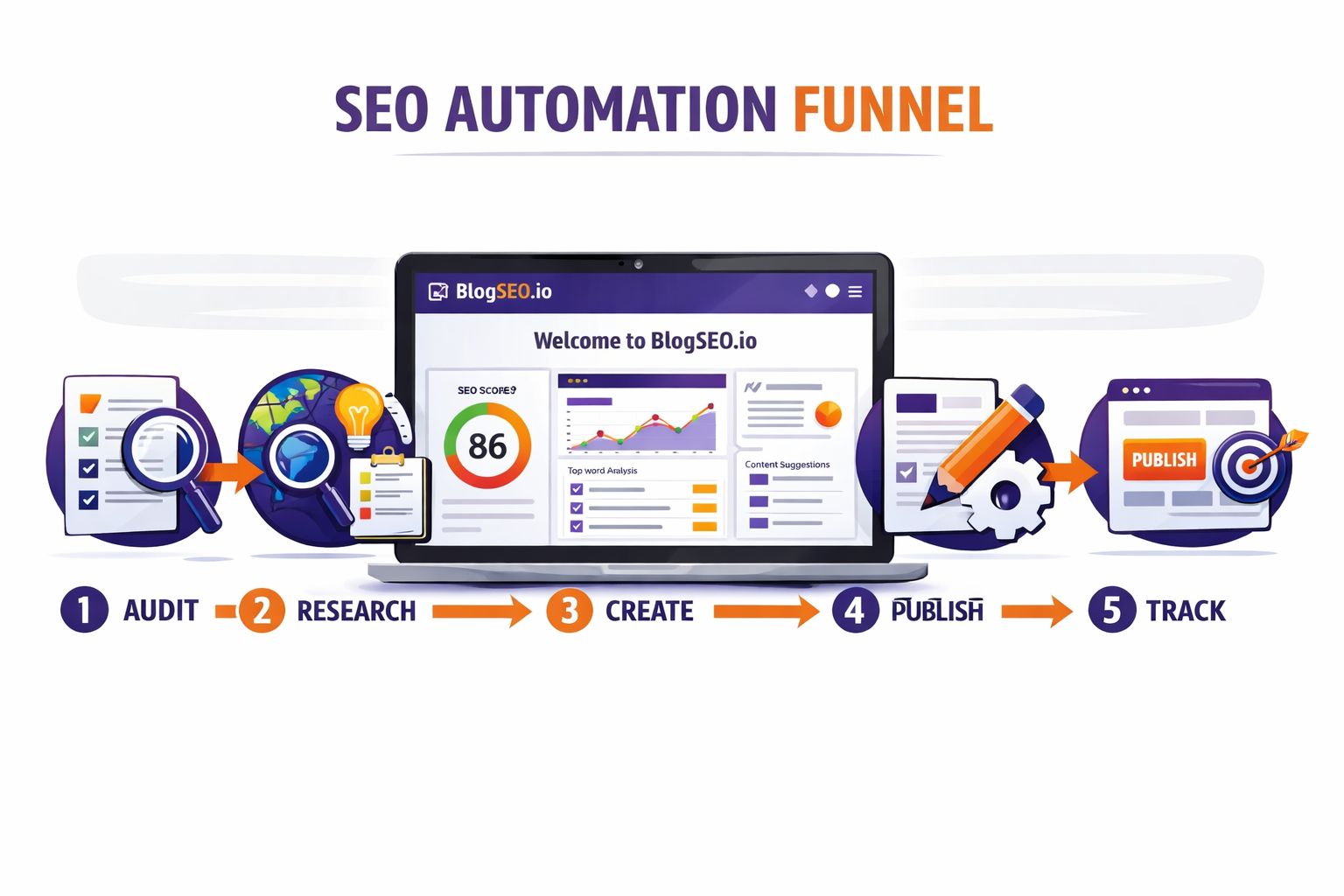
Here’s a five-step workflow that combines the tools above into a repeatable process:
- Audit — Run Screaming Frog or OTTO SEO to identify and (where possible) auto-fix technical issues
- Research — Use AlsoAsked and Keyword Insights to map questions and cluster keywords by intent
- Create — Use Frase to build content briefs from top-ranking pages, then Clearscope or SurferSEO to optimize drafts
- Publish — Use programmatic SEO tools for high-volume pages; use human editing for high-authority content
- Track — Monitor traditional rankings and AI citation frequency using Semrush AI Visibility Toolkit or SurferSEO’s AI tracker
This workflow covers both traditional search and AI-generated answer visibility — which is the minimum viable SEO strategy for 2026.
BlogSEO.io offers an end-to-end platform
Are There Risks to Over-Automating Your SEO?
Yes, and they’re worth taking seriously.
Content quality degradation is the most common failure mode. Fully automated content pipelines can produce technically optimized articles that lack genuine expertise or original perspective, exactly what Google’s E-E-A-T guidelines penalize [5].
Over-reliance on a single tool creates blind spots. No platform tracks every AI system, covers every technical issue, or understands every industry’s citation dynamics equally well.
Automated fix deployment (as with OTTO SEO) carries a small but real risk of pushing changes that conflict with custom site architecture. Always test in a staging environment first.
The practical rule: automate the repeatable, data-heavy tasks (auditing, keyword clustering, rank tracking, content grading).
Keep human judgment in the loop for strategy, editorial quality, and anything that touches your site’s core architecture.
FAQ: Automated SEO Tools
Q: What is the best automated SEO tool for beginners in 2026?
Frase is the most beginner-friendly option for content teams, it generates detailed briefs automatically and has a clear interface. For technical SEO beginners, Semrush’s core platform offers guided audits with plain-language explanations.
Q: Can automated SEO tools improve my ranking in AI Overviews?
Yes, but indirectly. Tools like Semrush AI Visibility Toolkit and SurferSEO’s AI tracker help you identify which content is getting cited and why, so you can replicate those patterns. There’s no direct “submit to AI Overview” function, citation happens when your content is authoritative and well-structured.
Q: How much do automated SEO tools cost?
Entry-level tools like Frase start around $15–$45/month. Mid-tier platforms like SurferSEO and Clearscope typically run $89–$200/month. Enterprise platforms like Semrush can exceed $500/month depending on the features and seat count. Screaming Frog offers a free version with a 500-URL crawl limit.
Q: Do I still need an SEO specialist if I use automated tools?
Yes. Automated tools handle data collection, pattern recognition, and repetitive tasks efficiently. But strategy, competitive positioning, content quality decisions, and interpreting ambiguous data still require human expertise.
Q: What’s the difference between programmatic SEO tools and standard SEO tools?
Programmatic SEO tools automate the entire content production pipeline, research, writing, internal linking, meta descriptions, and publishing, at scale. Standard SEO tools typically focus on one layer (auditing, keyword research, or content grading) and require humans to connect the steps.
Automated SEO Tools: FAQs
Q: Is keyword density still important in 2026?
No, not as a primary metric. Search algorithms now prioritize information gain, entity coverage, and E-E-A-T signals over keyword frequency. The best automated content tools reflect this shift, they grade content on semantic completeness, not word count or keyword repetition [5].
Q: How do I track whether my content appears in ChatGPT or Gemini answers?
Semrush AI Visibility Toolkit is currently the most comprehensive platform for tracking brand mentions across ChatGPT, AI Overviews, and Gemini simultaneously [3]. SurferSEO’s AI Tracker also covers AI visibility alongside traditional on-page metrics.
Q: Can automated SEO tools handle local SEO?
Most major platforms include local SEO features (local rank tracking, Google Business Profile auditing, local citation management). SurferSEO’s geographic layering feature is specifically useful for teams managing both local and national visibility from one platform [3].
Conclusion: Building Your Automated SEO Stack in 2026
The SEO landscape in 2026 rewards teams that can operate on two tracks simultaneously: traditional search rankings and AI citation visibility.
No single automated SEO tool covers both tracks perfectly, which is why a targeted two- or three-tool combination consistently outperforms any all-in-one platform.
Actionable next steps:
- Audit your current tool stack against the four layers (visibility tracking, content optimization, technical automation, PR targeting) and identify gaps
- If you’re not tracking AI citation frequency yet, add that capability first — it’s the fastest-growing blind spot for SEO teams right now
- Match your content optimization tool to your use case: Clearscope for semantic depth, SurferSEO for combined traditional and AI visibility, Frase for intent-driven brief generation
- Automate your technical auditing with Screaming Frog or OTTO SEO, but keep human review in the loop before deploying site-wide fixes
- If you’re ready to scale content production with AI-powered automation, BlogSEO.io offers an end-to-end platform built for exactly this workflow, from AI-assisted research and writing to automated publishing and SEO optimization
The teams winning in search right now aren’t the ones working harder manually. They’re the ones who’ve built smarter, layered automated systems, and they started by picking the right tools.
BlogSEO.io offers an end-to-end platform
References
[1] 12 Ai Search Engine Optimization Tools That Actually Deliver Results In 2026 – https://www.darkroomagency.com/observatory/12-ai-search-engine-optimization-tools-that-actually-deliver-results-in-2026
[2] The 2026 Ai Seo Stack 8 Tools That Actually Work According To Semrushs Hands On Review – https://marketingagent.blog/2026/04/08/the-2026-ai-seo-stack-8-tools-that-actually-work-according-to-semrushs-hands-on-review/
[3] Ai Search Engine Optimization Tools Whats New In 2026 – https://bishopi.io/blog/ai-search-engine-optimization-tools-whats-new-in-2026
[4] Programmatic Seo Tools – https://concurate.com/programmatic-seo-tools/
[5] How Ai Transforming Seo – https://www.clickrank.ai/how-ai-transforming-seo/
[6] Top 6 Ai Seo Tools To Simplify Your Workflow In 2026 – https://www.fyresite.com/top-6-ai-seo-tools-to-simplify-your-workflow-in-2026/
[7] Digital Marketing Updates April 2026 – https://twooctobers.com/blog/digital-marketing-updates-april-2026/
Pingback: Best Enterprise SEO Tools: Manage Content Performance - A1Publishing
Pingback: How to Evaluate SEO Tools: Guide for Teams and Agencies - A1Publishing