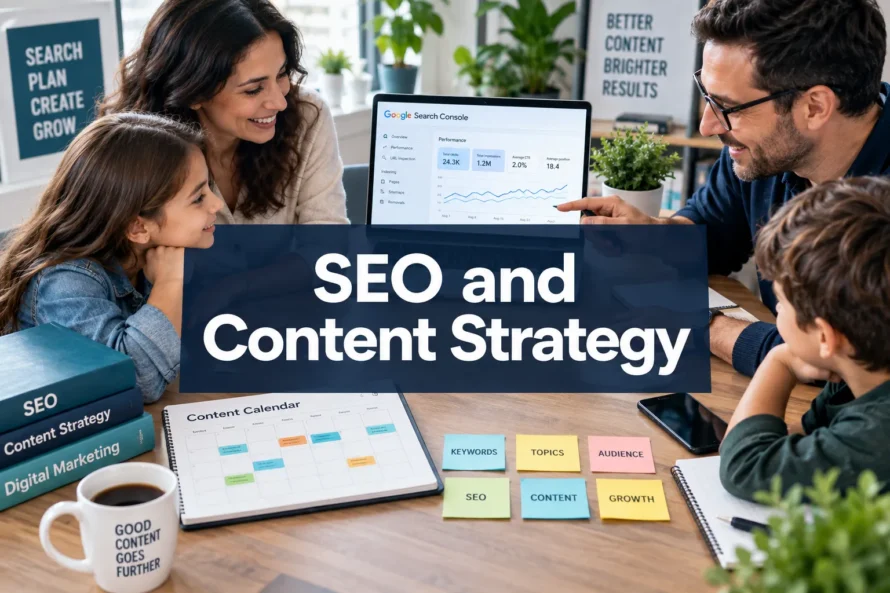
SEO and Content Strategy
Latest Update: September 14, 2026
Quick Answer: SEO and Content Strategy are two disciplines that work best when treated as a single system. SEO tells you what your audience is searching for and how search engines evaluate pages, while content strategy determines what you create, for whom, and how you distribute it. Together, they drive sustainable organic visibility, qualified traffic, and measurable business growth.
Key Takeaways
- A strong SEO and content strategy starts with keyword research tied directly to audience pain points and user intent.
- Google’s August 2026 Spam Update caused an 82% increase in top-10 URLs dropping out of the top 100, confirming that low-quality, bulk-generated content is a serious ranking risk.
- Content strategy is shifting from volume and reach toward relevance, trust, and topical authority, according to 2026 content marketing trend analyses.
- Generative Engine Optimization (GEO), which means structuring content for AI chatbots and conversational search, is now a required layer of any modern content strategy.
- E-E-A-T signals, including visible expertise, real author credentials, and transparent sourcing, are increasingly important differentiators as AI-generated content floods the web.
- Technical SEO hygiene, correct status codes, crawl budget management, and clean site architecture, directly affects how much of your content Google actually indexes.
- Measuring SEO success requires tracking rankings, organic traffic, click-through rates, and conversion data together, not any single metric in isolation.
What Is SEO and Content Strategy?
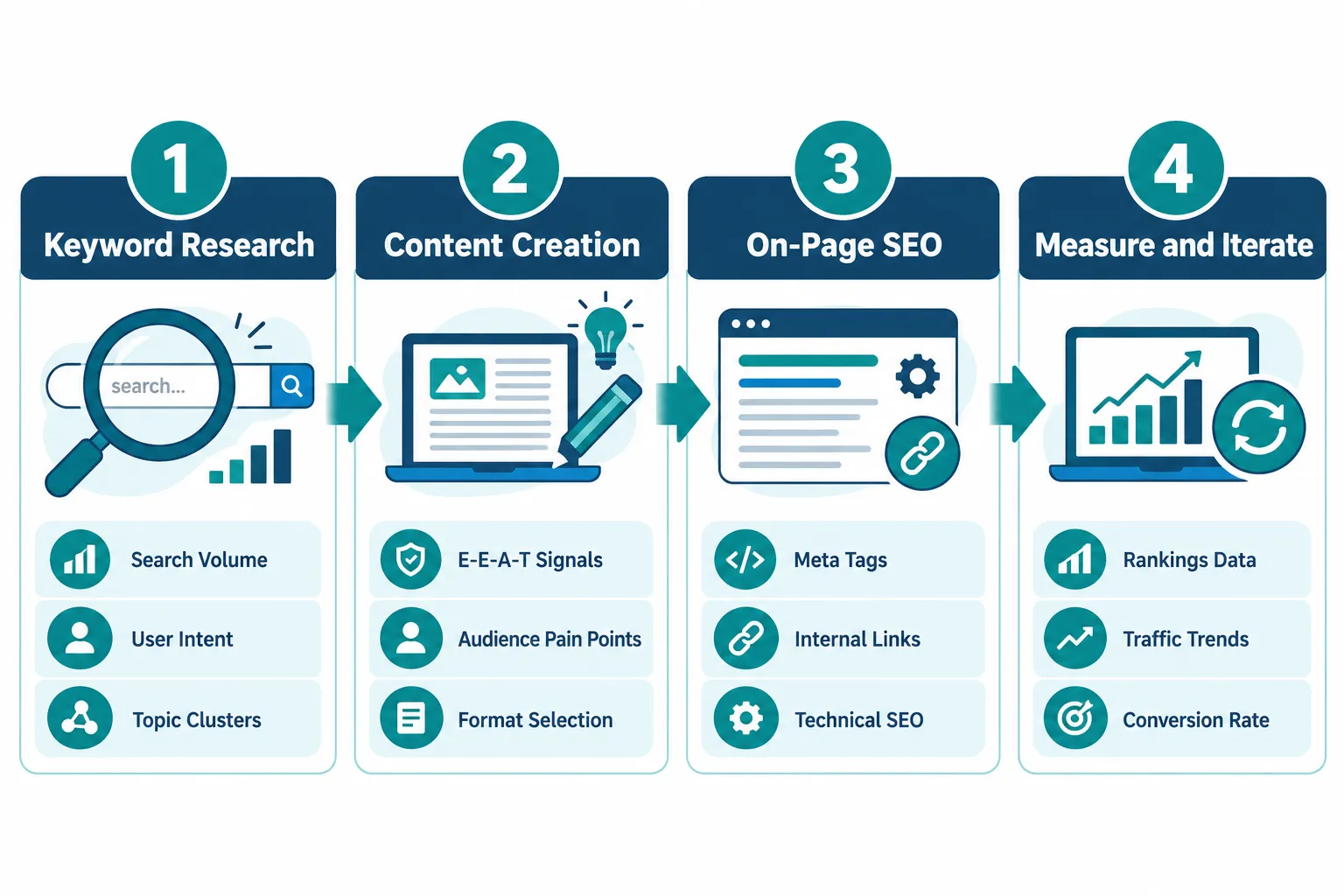
SEO and content strategy is the practice of planning, creating, and distributing content that satisfies both human readers and search engine algorithms.
SEO provides the data layer, keyword research, technical requirements, and ranking signals, while content strategy provides the editorial layer, topics, formats, tone, and publishing cadence.
When these two disciplines operate together, the result is content that ranks, gets read, and converts.
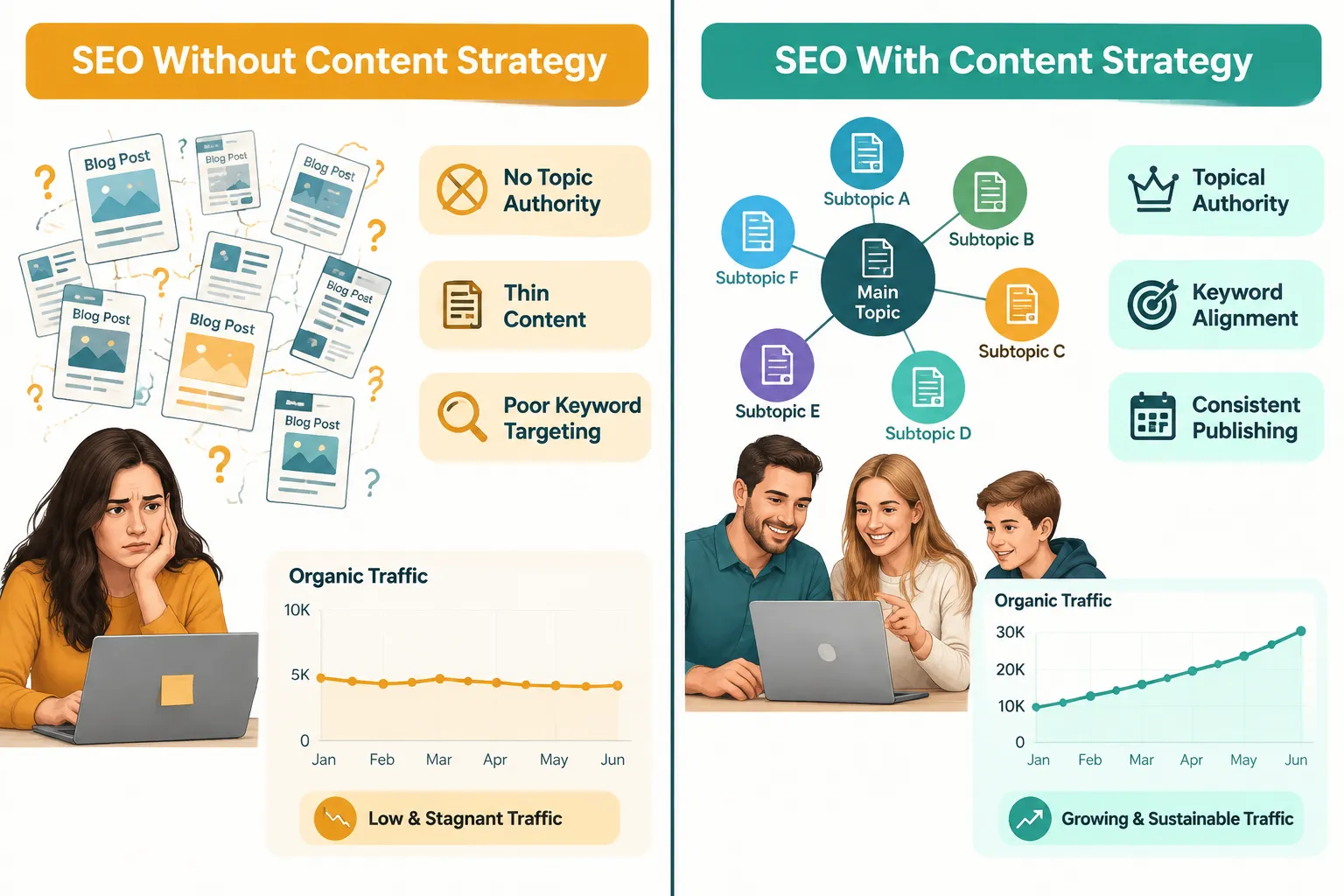
Think of it this way: SEO without a content strategy produces technically sound pages that nobody wants to read. Content strategy without SEO produces well-written material that nobody finds. The combination is what makes organic growth repeatable.
A content strategist working in this space typically handles keyword research, topic clustering, content briefs, editorial calendars, and performance analysis. An SEO content strategist goes one step further by mapping every content decision back to search intent, ranking data, and business goals.
Who this applies to: Any business, blog, or brand that relies on organic search for traffic. The approach scales from a solo content creator targeting a single niche to an enterprise marketing team managing thousands of pages across multiple sites.
Who Is an SEO Content Strategist?
An SEO content strategist is a professional who bridges the gap between search engine optimization and editorial content planning.
Rather than treating SEO as a checklist applied after writing, a content strategist in this role builds SEO requirements into the content planning process from the start, ensuring that every piece of content serves a specific search query, audience segment, and business objective.
Core responsibilities typically include:
- Keyword research and topic mapping: Identifying search terms your audience uses and grouping them into topic clusters that build authority over time.
- Content brief creation: Writing detailed briefs that guide writers on keyword targets, user intent, structure, word count, and internal linking.
- Audience research: Defining audience pain points, demographics, and content consumption habits so that content resonates as well as ranks.
- Performance analysis: Reviewing ranking data, traffic trends, and engagement metrics to decide what to update, expand, or retire.
- Technical SEO coordination: Working with developers on site architecture, page speed, and crawl budget to make sure content is indexed correctly.
SEO content strategist jobs are in high demand in 2026, particularly at agencies, SaaS companies, and e-commerce brands where organic traffic is a primary acquisition channel.
If you are looking to step into this role, start by building skills in keyword research tools like Semrush or Ahrefs, then layer in editorial planning and analytics.
Why Do You Need an SEO Content Strategy?
Without a documented SEO and content strategy, most content programs produce inconsistent results, waste budget on topics that never rank, and fail to build the topical authority that Google rewards. A clear strategy gives every content decision a measurable purpose.
The business case is straightforward. Organic search remains one of the highest-ROI marketing channels available. According to BrightEdge research, organic search drives more than 53% of all website traffic across industries.
Paid traffic stops the moment you stop spending. Content that ranks keeps delivering visitors for months or years after publication.
In 2026, the stakes are higher than ever. Google’s August 2026 Spam Update explicitly targeted bulk, automatically generated low-value content used for search manipulation. Sites relying on scaled AI content without human review saw dramatic ranking drops.
This makes a thoughtful, human-led content strategy not just a best practice but a survival requirement.
Beyond rankings, a content strategy helps you:
- Align content with each stage of the buyer journey, from awareness to decision.
- Avoid keyword cannibalization, where multiple pages compete for the same search query.
- Build internal linking structures that distribute page authority across your site.
- Create a consistent publishing cadence that signals reliability to both users and search engines.
Stage I: Preparation and Research for Your SEO Content Strategy
The research stage is where most content strategies either succeed or fail. Before you create a single piece of content, you need to define your niche, understand your audience, and build a keyword map that reflects real search behavior.
Step 1: Determine Your Niche and Industry Position
Start by defining the specific topic territory your site will own. Broad topics like “marketing” or “health” are too competitive for most sites to rank in without years of authority building. Instead, step down into a specific sub-niche where you can realistically become the most comprehensive resource. This is what SEO practitioners call a “content moat.”
Step 2: Define Your Target Audience and Their Pain Points
Audience pain points are the problems, frustrations, and unanswered questions your readers bring to Google. The best keyword research nbsp starts here, not with a tool, but with a genuine understanding of what your audience needs.
Talk to customers, read forum threads on Reddit, analyze the “People Also Ask” boxes in Google SERPs, and review competitor comment sections to find recurring themes.
Once you know your audience, build a simple profile that includes:
- Demographics (age, role, industry, experience level)
- Primary goals (what they want to achieve)
- Pain points (what is blocking them)
- Content preferences (long-form guides, short videos, interactive tools)
Step 3: Conduct Keyword Research
Keyword research nbsp is the process of identifying the specific search terms your audience uses and evaluating each term for search volume, keyword difficulty, and user intent. Use tools like Google Keyword Planner, Semrush, or Ahrefs to build your initial keyword list.
For each keyword, classify the intent:
- Informational intent: The user wants to learn something (for example, “what is content strategy”).
- Commercial intent: The user is researching options before buying (for example, “best SEO tools for small business”).
- Transactional intent: The user is ready to act (for example, “buy Semrush subscription”).
Matching content format to user intent is one of the most important steps in any SEO content strategy. A transactional keyword needs a product or landing page, not a 2,000-word blog post.
Step 4: Build Topic Clusters
Rather than treating each keyword as an isolated target, group related keywords into topic clusters. Each cluster has one “pillar” page covering a broad topic in depth, supported by multiple “cluster” pages covering specific subtopics. This structure signals topical authority to Google and creates a natural internal linking architecture across your site.
Stage II: Content Creation and Optimization
With research complete, the content creation phase begins. This is where SEO requirements and editorial quality must work together, not compete. 2026 content marketing trend analyses consistently emphasize that depth-first storytelling and authority-led content outperform high-volume, low-quality publishing.
Craft High-Quality Content That Satisfies E-E-A-T
Google’s E-E-A-T framework (Experience, Expertise, Authoritativeness, Trustworthiness) is the lens through which quality raters evaluate content. In 2026, with AI-generated content flooding the web, visible E-E-A-T signals are more important than ever. This means:
- Citing credible, linked sources throughout your content.
- Including specific data points with dates and source attribution.
- Showing real people behind the brand through author bios, case studies, and original research.
- Avoiding vague, generic claims that could have been written by anyone about anything.
Optimize Content for Search and AI Discovery
On-page SEO optimization covers the technical and structural elements that help search engines understand your content. For each page, make sure you:
- Include the primary keyword in the title tag, H1, and first paragraph.
- Use semantic variations and related terms naturally throughout the body.
- Write a compelling meta description that matches search intent.
- Structure content with clear H2 and H3 headings that mirror the questions users ask.
- Add internal links to related pages on your site to build topic cluster authority.
Beyond traditional SERPs, Generative Engine Optimization (GEO) is now a required consideration. AI chatbots like ChatGPT and Google’s AI Overviews surface content differently than traditional search.
To get cited in AI summaries, your content needs clear structure, specific factual claims, and self-contained passages that make sense when quoted out of context.
Design Content for People and Search Engines
The best SEO content serves both audiences simultaneously. Write for your human reader first, using plain language, concrete examples, and logical structure.
Then layer in SEO requirements: keyword placement, heading hierarchy, schema markup, and internal links. Content that reads naturally and is technically sound will consistently outperform content optimized for one audience at the expense of the other.
Distribute Content Using Multiple Channels
Publishing a page and waiting for Google to rank it is not a strategy. Effective content distribution means actively pushing your content to the audiences most likely to engage with it. Channels to consider include:
- Social media: Share content across relevant platforms where your audience spends time. Short-form vertical video and interactive content like quizzes and calculators are dominant content formats in 2026.
- Email marketing: A newsletter keeps your audience engaged between publishing cycles and drives repeat visits.
- Content syndication: Republishing content on platforms like Medium or LinkedIn can extend reach without hurting your original page’s rankings if canonical tags are set correctly.
- Backlink outreach: Earning links from authoritative sites in your niche is still one of the strongest ranking signals Google uses. Evaluate the value of your backlinks regularly and disavow toxic links that could hurt your site.
How SEO and Content Marketing Work Together
SEO and content marketing are not the same thing, but they are most effective when treated as a unified practice.
SEO identifies what people are searching for and sets the technical conditions for ranking. Content marketing creates the material that earns trust, builds relationships, and converts visitors into customers.
The distinction matters because the two disciplines have different success metrics. SEO success is measured in rankings, organic traffic, and click-through rates.
Content marketing success is measured in engagement, lead generation, and customer retention. A winning SEO content marketing strategy tracks both sets of metrics and uses each to inform the other.
Zero-click visibility is an emerging concern in 2026. AI summaries and platform-native answers are reducing traditional click-throughs from search results.
The response is not to abandon SEO but to create content with enough unique “information gain” that it builds brand recognition even when consumed entirely in a snippet or summary feed.
Best Practices for SEO Content Strategy in 2026
These are the practices that separate content programs that grow from those that plateau.
Keep up with continual content production. Google rewards sites that publish consistently. A realistic publishing cadence, even one post per week, beats sporadic bursts of ten posts followed by months of silence.
Do your research before you write. Every piece of content should begin with a keyword research step, a review of the top-ranking pages for that query, and a clear brief that defines the target audience, intent, and angle.
Analyze performance regularly. Use Google Search Console to track impressions, clicks, and average position for your key pages. Review this data monthly and identify pages that are ranking on page two, these are your best opportunities for quick wins through content updates.
Address technical SEO as a foundation. Google’s updated crawl budget documentation from August 2026 now explicitly recommends using HTTP 304 status codes for unchanged pages to conserve crawl resources. For large sites, technical SEO hygiene directly affects how much of your content gets indexed and how quickly.
Use AI as a support tool, not a replacement. AI is increasingly embedded in content workflows for ideation, drafting, and research. However, leading 2026 analyses warn that AI dominance must not displace human judgment, editorial quality, and accountability. The content that wins in 2026 is content where AI assists and humans lead.
How to Measure SEO Success
SEO success is measured by tracking a combination of ranking, traffic, engagement, and conversion metrics over time. No single number tells the full story.
Key metrics to track include:
- Organic traffic: Total sessions from search engines, tracked in Google Analytics or a similar platform.
- Keyword rankings: Position tracking for your target keywords using tools like Semrush, Ahrefs, or Google Search Console.
- Click-through rate (CTR): The percentage of users who click your result after seeing it in the SERPs. Low CTR on high-impression pages signals a weak title tag or meta description.
- Backlink profile: The number and quality of sites linking to your content, tracked via Ahrefs or Semrush.
- Conversion rate: The percentage of organic visitors who complete a desired action, such as signing up, purchasing, or booking a demo.
Set a 90-day review cycle for your content strategy. At each review, identify your top-performing pages and find out what they have in common. Use that data to inform your next content creation cycle.

Common SEO Mistakes to Avoid
Even experienced teams make avoidable errors that cost rankings and traffic. Here are the most common ones.
- Ignoring user intent: Publishing a blog post for a keyword that needs a product page, or vice versa, will almost never rank well regardless of content quality.
- Keyword stuffing: Forcing a keyword into content at an unnatural density signals low quality to both users and Google. Write naturally and trust semantic variations to carry the relevance signal.
- Neglecting internal linking: Many sites create great content but fail to link to it from other pages on the site. Internal links are one of the easiest ways to improve rankings without any off-page effort.
- Publishing and abandoning: Content that was accurate when published can become outdated, inaccurate, or outranked. Build a content refresh schedule into your strategy.
- Skipping technical SEO: Slow page speed, broken links, duplicate content, and poor mobile experience all suppress rankings regardless of content quality.
- Scaling AI content without human review: As the August 2026 Google Spam Update demonstrated, bulk-generated content without genuine user benefit is an active ranking risk.
SEO Content Strategy for Beginners: Where to Start
If you are new to SEO and content strategy, the learning curve can feel steep, but the core process is straightforward. Start with these steps.
- Pick one topic area where you have genuine knowledge or access to expert sources.
- Learn the basics of keyword research using free tools like Google Keyword Planner or the free tier of Semrush.
- Study the top-ranking pages for your target keywords. Note their structure, depth, and the questions they answer.
- Write one comprehensive piece of content that is more useful, more specific, and better structured than what currently ranks.
- Set up Google Search Console to monitor your page’s performance from day one.
- Build one backlink by reaching out to a relevant site and offering a guest post or resource mention.
- Review your data after 90 days and use what you find to plan your next piece.
The most important step for a beginner is to get started with a real piece of content rather than spending months planning. SEO is a discipline you learn by doing.
How Long Does SEO Take to Work?
SEO typically takes three to six months to show meaningful ranking improvements for new content on an established site, and six to twelve months for a new domain with little existing authority.
This timeline varies based on keyword competitiveness, the quality and depth of your content, your site’s existing domain authority, and how actively you build backlinks.
Do not expect overnight results. SEO compounds over time. A piece of content published today may rank on page two within three months and climb to page one over the following six months as it earns more backlinks and engagement signals.
The sites that win at SEO are the ones that treat it as a long-term investment, not a quick-fix channel.
When Should You Hire an SEO Agency?
Hiring an SEO agency makes sense when your team lacks the in-house expertise to execute a full content strategy, when you need to scale content production faster than your current resources allow, or when you have a specific technical SEO problem that requires specialist knowledge.
Before hiring, define what success looks like. Set clear KPIs, a realistic timeline, and a budget that reflects the scope of work. Be cautious of agencies that promise first-page rankings within 30 days or guarantee specific traffic numbers.
Legitimate SEO work takes time, and any agency that claims otherwise is either misleading you or using tactics that will eventually trigger a Google penalty.
FAQ: People Also Ask
What is a good content strategy for SEO?
A good content strategy for SEO combines thorough keyword research, clear audience definition, and a topic cluster structure that builds topical authority over time.
It maps each piece of content to a specific user intent, maintains a consistent publishing cadence, and includes a regular review cycle to update underperforming pages. The strategy should also address technical SEO foundations and distribution across multiple channels.
What are the top 5 SEO strategies?
The top five SEO strategies in 2026 are: first, building topic clusters around high-value keyword groups to establish topical authority; second, optimizing content for E-E-A-T signals including credible sourcing and visible expertise; third, addressing technical SEO issues such as page speed, crawl budget, and mobile usability; fourth, earning high-quality backlinks through original research and outreach; and fifth, structuring content for AI and conversational search through GEO best practices.
What are the 5 pillars of content strategy?
The five pillars of content strategy are: audience research (understanding who you are creating content for and what they need), content planning (mapping topics to business goals and search intent), content creation (producing high-quality material that satisfies both users and search engines).
Content distribution (getting content in front of the right audience through the right channels), and performance measurement (tracking data to evaluate what is working and inform future decisions).
How do I learn SEO as a beginner?
Start by learning the fundamentals through free resources like Google’s Search Central documentation, the Moz Beginner’s Guide to SEO, and Semrush’s free learning platform.
Practice keyword research using free tools, publish content on a real site, and monitor results in Google Search Console.
The fastest way to learn SEO is to apply each concept immediately rather than studying theory in isolation. Expect a six to twelve month learning curve before results become consistent.
Conclusion: Building an SEO and Content Strategy That Lasts
The most durable SEO and Content Strategy is one built on genuine usefulness, consistent execution, and honest measurement.
The rules of search have always rewarded content that genuinely serves the user, and every major Google update in 2026 has reinforced that principle.
Here are your actionable next steps:
- Audit your existing content to identify pages that are close to ranking but need updating.
- Build or refine your keyword map using a topic cluster model.
- Create a 90-day content calendar that assigns each piece a specific keyword target, intent classification, and format.
- Set up tracking in Google Search Console and your analytics platform so you can measure progress from day one.
- Review your technical SEO to make sure your site is crawlable, fast, and mobile-friendly.
- Start creating. The best content strategy is one that gets executed.
If you want to accelerate the process with AI-assisted content planning and performance tracking, WordRocket is a tool worth exploring for streamlining your content strategy workflow from ideation through to publishing.