What is Long Form Content
Last updated: May 23, 2026
Quick Answer: What is Long Form Content, it is any piece of written, video, or multimedia content that covers a topic with significant depth, typically exceeding 1,200 words for written pieces or 10 minutes for video.
The real distinction is not word count alone, it is the quality of depth, structure, and usefulness that separates long form from everything else.
In 2026, it remains one of the strongest formats for SEO, trust-building, and converting informed buyers.
Key Takeaways
- Long form content is defined by depth and structure, not just length, padding does not count.
- For blog posts, most SEO practitioners consider 1,200–1,500+ words the entry point, with 2,000–3,000 words being the sweet spot for competitive topics.
- Long form consistently earns more backlinks, ranks for more keyword variations, and builds more credibility than short posts on the same topic.
- Short form content drives discovery; long form drives conversion and authority, the smartest brands use both.
- Common mistakes include writing long for length’s sake, ignoring skimmability, and failing to answer the reader’s core question early.
- Not every business needs long form content, high-frequency e-commerce product pages and social-first brands may see better ROI from short form.
- AI search optimization in 2026 heavily favors long form pieces with FAQ blocks, question-based headings, and schema markup.
- Tools like WordRocket AI can significantly cut the time and cost of producing high-quality long form pieces.
- Long form video is growing on social platforms, with TikTok supporting up to 10 minutes and Instagram Reels up to 20 minutes as of 2026.
- A hybrid model, short form for reach, long form for depth, is the dominant content strategy in 2026 [8].
What Exactly Counts as Long Form Content?
Long form content is any content that explores a subject with enough depth to genuinely inform, educate, or persuade a reader beyond surface-level treatment.
ActiveCampaign defines it as content that “explores a topic in depth,” emphasizing that depth, not a strict word count, is the real qualifier.
In practice, long form content includes:
- Blog posts and articles (typically 1,200+ words)
- Ultimate guides and pillar pages (2,000–10,000+ words)
- White papers and research reports
- E-books and lead magnets
- Long form video (10+ minutes on YouTube; 10 minutes on TikTok; up to 20 minutes on Instagram Reels)
- Podcast episodes (usually 20+ minutes)
- Case studies and in-depth product reviews
The common thread is that each format gives a topic the space it deserves. A 1,500-word post stuffed with filler is not long form content in any meaningful sense.
A 900-word post that answers a complex question completely and cites evidence? That is closer to the spirit of it.
Decision rule: If your content could be cut by 40% without losing any real value, it is not long form, it is just long.
How Long Does a Blog Post Need to Be to Be Considered Long Form?
Most content strategists use 1,200 to 1,500 words as the minimum threshold for a blog post to qualify as long form. The practical sweet spot for competitive SEO topics sits between 2,000 and 3,000 words.
There is no universal standard, and the right length depends on:
- Topic complexity — a beginner’s guide to a technical subject needs more words than a simple how-to.
- Search competition — check the average length of the top 5 ranking pages for your target keyword.
- Reader intent — someone researching a major purchase wants more detail than someone looking for a quick definition.
“Length alone does not matter if the piece lacks clear hierarchy, skimmability, and answer blocks.” 2026 content guidance
When content becomes too long is covered later in this guide, but the short answer is: stop adding words when you stop adding value.
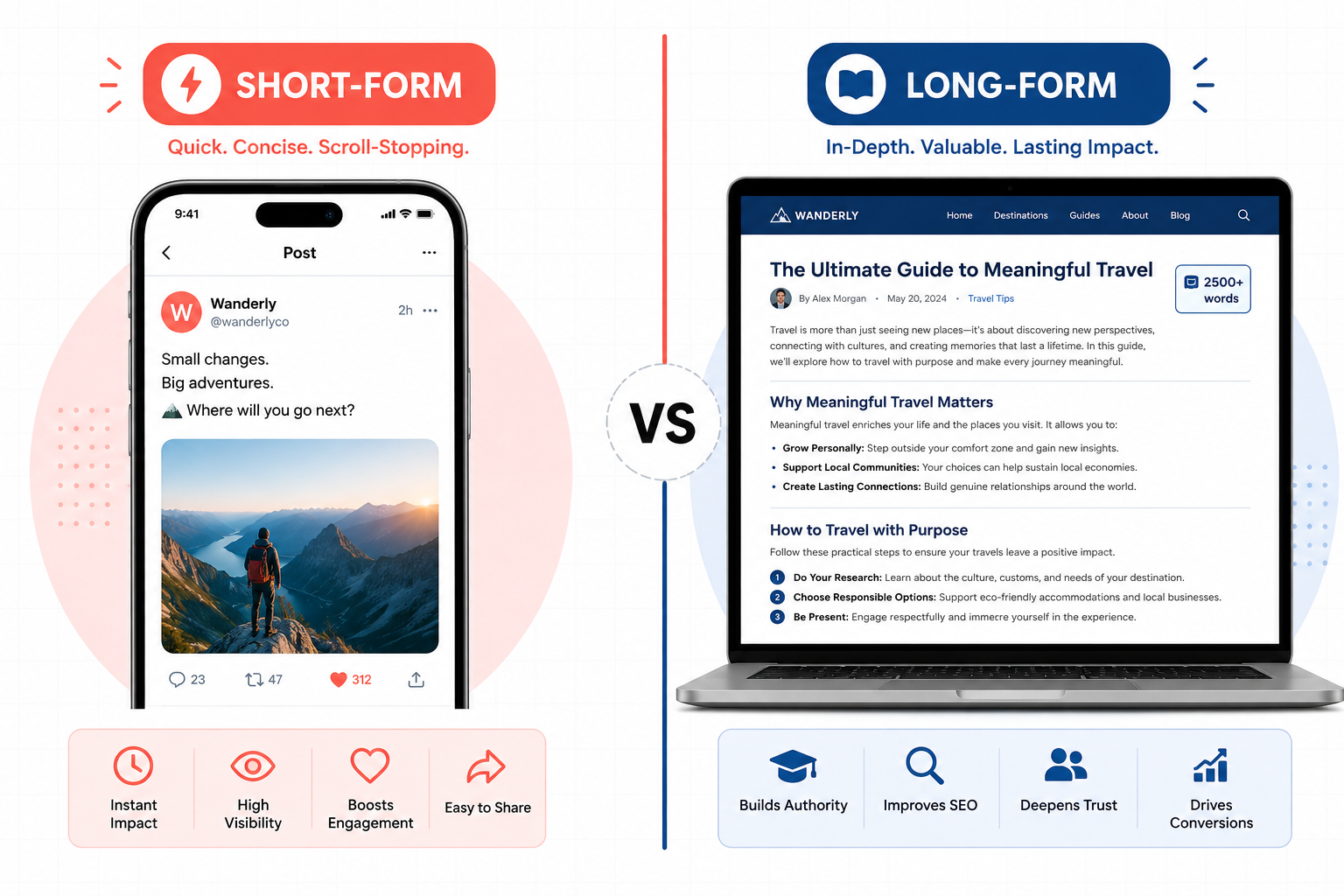
Long Form vs. Short Form Content: Pros, Cons, and When to Use Each
Short form content (typically under 1,000 words or under 5 minutes for video) is best for rapid discovery, social engagement, and top-of-funnel awareness. Long form content is better for depth, SEO, and conversion.
Here is a direct comparison:
| Criteria | Long Form Content | Short Form Content |
|---|---|---|
| Typical Length | 1,200–10,000+ words / 10+ min video | Under 1,000 words / under 5 min video |
| SEO Impact | High — ranks for more keyword variations, earns backlinks | Moderate — good for fast-indexing, trending topics |
| Production Time | 4–12+ hours per piece | 30 min–2 hours per piece |
| Best For | Authority building, SEO, lead generation, AI search extraction | Social discovery, brand awareness, top-of-funnel reach |
| Audience Stage | Middle and bottom of funnel (consideration, decision) | Top of funnel (awareness) |
| Engagement Style | Deep reading, bookmarking, sharing as resource | Quick scroll, like, share, comment |
| Backlink Potential | High — data, guides, and research attract links | Low–Moderate |
| AI Search Visibility | High — FAQ blocks and structured answers get extracted | Moderate — depends on structure |
| Cost Per Piece | $150–$2,000+ (freelance or agency) | $25–$300 |
| Ideal Channels | Blog, YouTube, podcast, email newsletter | TikTok, Instagram, X (Twitter), LinkedIn posts |
Choose long form if: you want to rank on Google, build topical authority, or convert readers who are actively researching a purchase.
Choose short form if: your goal is reach, virality, or rapid brand awareness on social platforms.
Many brands now use a hybrid model: short form content attracts the audience, and long form assets convert them.
How Much Does It Cost to Create Long Form Content?
The cost of long form content varies widely based on who creates it and how. Here are realistic 2026 estimates:
| Creator Type | Cost Per Piece | Quality Range |
|---|---|---|
| Freelance writer (entry-level) | $50–$150 | Variable |
| Freelance writer (experienced) | $300–$800 | Good–Excellent |
| Content agency | $500–$2,000+ | Good–Excellent |
| In-house writer | $35–$75/hour | Depends on skill |
| AI-assisted (e.g., WordRocket AI) | $20–$100 | Good with editing |
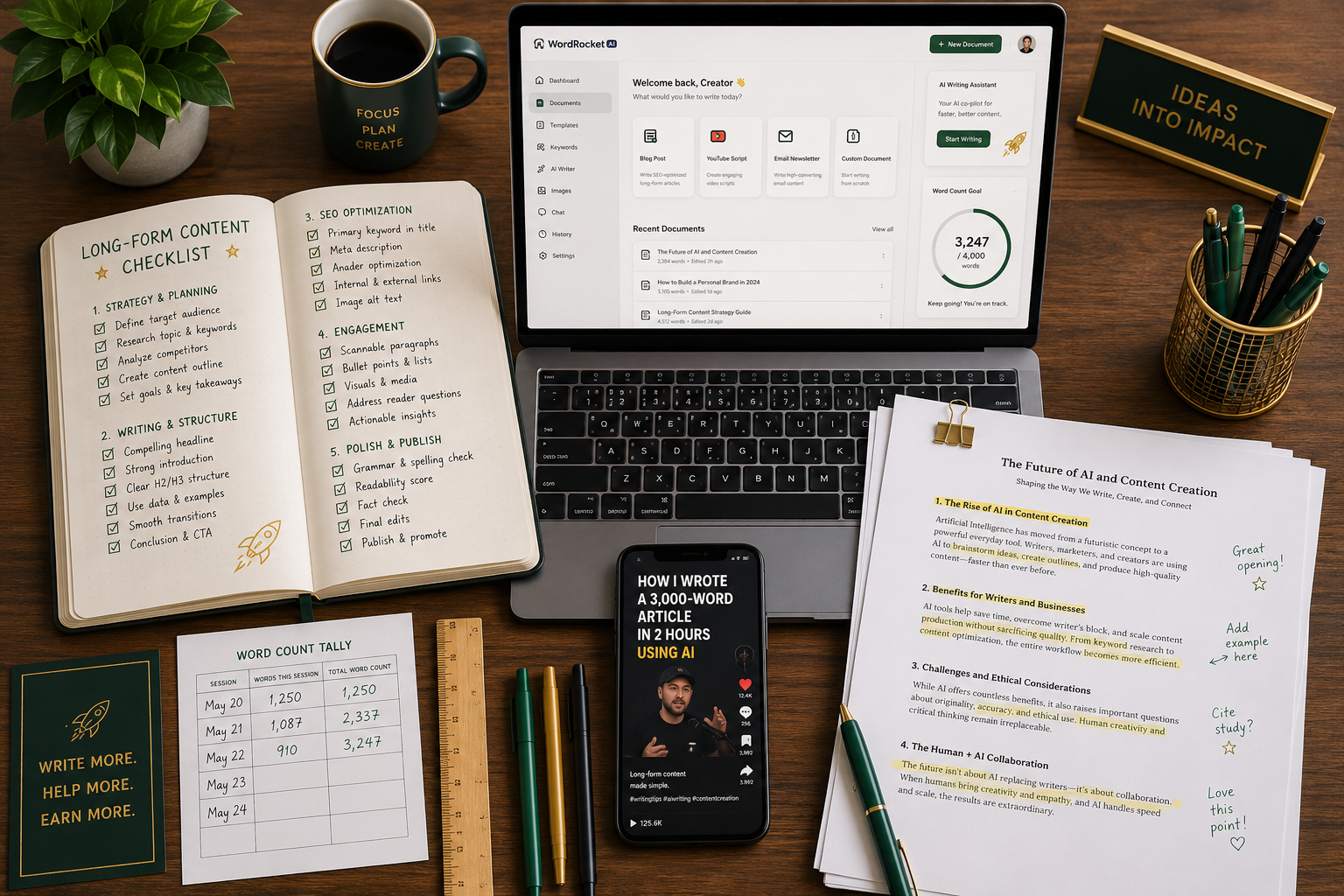
AI writing tools have significantly changed the cost equation. Platforms like WordRocket AI can produce a structured first draft in minutes, which a writer then refines, cutting total production time from 8 hours to 2–3 hours on many projects.
Common mistake: Paying for volume over quality. Ten thin 1,500-word posts will almost always underperform two well-researched 3,000-word guides.
How Much Time Does It Take to Write a Good Long Form Piece?
A well-researched long form article of 2,000–3,000 words typically takes 6–12 hours from research to final edit for an experienced writer working without AI assistance. With AI tools, that drops to 2–4 hours for a polished draft.
The time breaks down roughly as:
- Research and outline: 1–2 hours
- First draft: 2–4 hours
- Editing and fact-checking: 1–2 hours
- SEO formatting (headings, meta, internal links): 30–60 minutes
If you are consistently spending more than 12 hours on a single post, the process likely needs a better outline or a writing tool to handle the structural work.

Why Isn’t My Long Form Content Ranking on Google?
Long form content does not automatically rank. If yours is not performing, the most common reasons are:
- Keyword mismatch — the piece targets a term with no real search volume, or the intent is wrong (informational vs. transactional).
- Thin depth despite high word count — padding with repetition does not signal expertise to Google.
- Poor structure — no clear H2/H3 hierarchy, no FAQ section, no answer blocks that AI systems can extract [8].
- No backlinks — even excellent content needs some authority signals to compete on tough keywords.
- Slow page speed — long pages with unoptimized images load slowly on mobile, which hurts rankings.
- Missing E-E-A-T signals — no author bio, no citations, no evidence of real expertise.
Fix the structure first. A well-organized 2,000-word piece with clear headings and a FAQ block will almost always outrank a 4,000-word wall of text.
How to Optimize Long Form Content for SEO
Optimizing long form content for SEO in 2026 means satisfying both traditional search algorithms and AI-powered answer systems.
Core SEO checklist for long form content:
- Use the primary keyword naturally in the H1, first paragraph, and 2–3 H2s.
- Add a FAQ section with question-based headings that mirror real search queries.
- Include schema markup (Article, FAQ, HowTo where relevant).
- Break content into scannable sections, no block of text should exceed 150 words without a subheading or list.
- Link to 2–3 authoritative external sources and 2–3 relevant internal pages.
- Optimize images with descriptive alt text and compressed file sizes.
- Write a meta description that includes the primary keyword and a clear value proposition.
- Add a table of contents for pieces over 2,000 words.
AI search optimization is now a core part of this process. Structured answer blocks and FAQ sections make content easier for AI Overviews and AI Mode to extract and cite.
Is Long Form Content Good for Every Industry?
Long form content works best in industries where buyers research before purchasing, but it is not a universal solution].
Industries where long form content performs strongly:
- SaaS and B2B technology
- Financial services and insurance
- Health, wellness, and medical information
- Legal services
- Education and e-learning
- Home improvement and real estate
Industries where long form may not be the priority:
- Fast-fashion e-commerce (product pages and social ads drive more sales)
- Food and beverage brands focused on social discovery
- Entertainment and pop culture (short form video dominates)
- Local service businesses with simple, low-research purchases
What Types of Businesses Should Avoid Long Form Content?
Businesses that should deprioritize long form content are those where the buying decision is impulsive, visual, or based on price rather than research.
A nail salon, a fast-food brand, or a streetwear label will almost always see better returns from short video and social content than from a 3,000-word blog post.
That said, “avoid” is too strong a word for most cases. Even primarily visual brands benefit from occasional long form pieces, product care guides, brand story pages, or sustainability reports, that support SEO and press coverage.
Edge case: E-commerce brands with complex products (supplements, tech gadgets, specialty equipment) often find that long form buying guides drive significant organic traffic and reduce return rates by setting accurate expectations.
Common Mistakes People Make with Long Form Content
These are the patterns I see most often when auditing underperforming content:
- Writing long to look authoritative rather than to genuinely serve the reader.
- No clear structure — readers cannot skim to find what they need, so they leave.
- Ignoring the opening — burying the main answer in paragraph seven.
- Keyword stuffing — repeating the target phrase unnaturally to hit a density target.
- No internal links — missing the chance to move readers deeper into the site.
- Publishing and forgetting — long form content needs periodic updates to stay accurate and competitive.
- Skipping the FAQ — this is now one of the highest-value sections for AI search visibility.
When Does Long Form Content Become Too Long?
Content becomes too long the moment it starts repeating itself, adding examples that do not add new understanding, or padding out sections to hit a word count.
There is no maximum word count that applies universally, a 10,000-word technical guide for enterprise software buyers can be exactly right, while a 2,500-word post about a simple recipe is almost certainly too long.
A practical test: read each paragraph and ask, “Would a smart, busy reader miss this if it were cut?” If the answer is no, cut it.
Long form content that earns its length tends to have:
- Multiple distinct subtopics, each with real depth
- Data, examples, or case studies that require explanation
- A reader who has genuine need for comprehensive information before acting
Can Long Form Content Work for Social Media?
Yes — and the definition of “long form” on social platforms has expanded considerably in 2026. TikTok supports videos up to 10 minutes,
Instagram Reels up to 20 minutes, and YouTube Shorts up to 3 minutes, giving creators more room than ever for substantive content on social channels.
However, long form social content works differently than long form blog content. It needs:
- A strong hook in the first 3–5 seconds (or first sentence for text posts)
- Episodic or serialized structure, audiences follow a series better than a single long post
- Platform-native formatting (captions, chapters, timestamps for video)
Sprout Social notes that brands are now using serialized formats rather than one-off lengthy posts to retain audiences across long form social content. The content that performs is episodic, not just extended.
Best Tools for Creating Long Form Content
The right tool depends on your workflow, but here are the most practical options in 2026:
- WordRocket AI, AI-assisted long form content creation with SEO structure built in. Strong choice for marketers who need to produce consistent, high-quality articles at scale without a full writing team.
- Surfer SEO — content optimization and NLP-based keyword guidance for long form posts.
- Clearscope — topic research and content grading for SEO-focused long form writing.
- Notion or Google Docs — for outlining, collaboration, and drafting.
- Grammarly or Hemingway Editor — for readability and grammar checks before publishing.
For most content teams in 2026, an AI writing assistant handles the structural draft, a human editor refines it for accuracy and voice, and an SEO tool validates keyword coverage. That workflow cuts production time significantly without sacrificing quality.
Frequently Asked Questions About Long Form Content
Q: What is long form content in simple terms?
Long form content is any piece of content, written, video, or audio, that covers a topic in enough depth to genuinely inform or persuade. For blog posts, that usually means 1,200+ words. For video, it typically means 10+ minutes.
Q: Does long form content still rank well in 2026?
Yes. Long form content continues to rank well when it is well-structured, answers real questions, and earns backlinks. In 2026, AI search systems also favor structured long form pieces with FAQ sections and clear heading hierarchies.
Q: Is long form content better than short form for SEO?
For organic search, long form content generally performs better because it covers more semantic variations of a topic, earns more backlinks, and gives Google more signals to assess relevance. Short form is better for social discovery.
What is Long Form Content: FAQs
Q: How do I know if my long form content is too long?
If you can remove 20–30% of the content without losing any key information or value, it is too long. Good long form content earns every word.
Q: Can AI write long form content?
AI tools can produce strong first drafts of long form content quickly, but human editing is still needed for accuracy, nuance, and brand voice. Tools like WordRocket AI are designed specifically for this workflow.
Q: What is the difference between a pillar page and a long form blog post?
A pillar page is a comprehensive long form piece that covers a broad topic and links out to related cluster content. A standard long form blog post covers a specific topic in depth but may not serve as a hub for other content. Both are long form formats, but pillar pages are a deliberate SEO architecture choice.
Q: How often should I update long form content?
For competitive topics, review and update long form content every 6–12 months. Add new data, remove outdated references, and check that internal and external links still work.
Q: Does long form content work for e-commerce?
Yes, particularly for complex or high-consideration products. Buying guides, comparison posts, and detailed product reviews drive organic traffic and help buyers make confident decisions, which can reduce return rates.
Conclusion: What is Long Content and What Should You Do Next?
Long form content is the format that earns trust, ranks for competitive keywords, and converts readers who are genuinely evaluating their options, which describes exactly the audience reading this guide right now.
In 2026, the strategy has matured. Length alone never was the point. Depth, structure, and genuine usefulness are what separate content that ranks and converts from content that disappears.
The brands winning with long form are those combining smart topic selection, AI-assisted production, and rigorous editing.
Actionable next steps:
- Audit your existing content. Identify your top 5 posts that are between 800–1,500 words. Could any of them be expanded into a comprehensive, authoritative guide?
- Pick one high-intent keyword your audience searches before making a purchase decision. Write a 2,000+ word guide that answers every question they have.
- Add a FAQ section to every long form piece you publish, this is one of the fastest wins for AI search visibility in 2026.
- Use a tool to speed up production. WordRocket AI is built for exactly this: producing structured, SEO-ready long content without the 10-hour writing marathon.
- Set a review calendar. Your best long form pieces will decay without updates. Schedule a review every 6–12 months.
The readers who find you through a well-written long form guide are already interested, already informed, and much closer to buying. That is the real value of getting this format right.
References
[1] Long Form Content – https://www.activecampaign.com/glossary/long-form-content
[2] Long Form Content – https://www.networksolutions.com/blog/long-form-content/
[3] Long Form Content Will Dominate – https://www.jacklimebear.com/post/long-form-content-will-dominate
[4] A Comprehensive Guide To Long Form Content Creation – https://obaninternational.com/blog/a-comprehensive-guide-to-long-form-content-creation/
[5] Long Form Vs Short Form Content What Works 2026 – https://www.linkedin.com/pulse/long-form-vs-short-form-content-what-works-2026-shushan-ghandilyan-imsbf
[6] Long Form Vs Short Form Content – https://devenup.com/blog/long-form-vs-short-form-content
[7] Is Long Form Content Making A Come Back – https://disruptmarketing.co/blog/is-long-form-content-making-a-come-back/
Pingback: Best SEO Tools For Agencies: 2026 Guide to a Winning Tool Stack - A1Publishing
Pingback: SEO and Content Strategy: The Complete 2026 Guide