Snippet Sandwich Content Structure
The ‘Snippet Sandwich’ Content Structure 2026 is the most practical framework available for writers, marketers, and content strategists who want their pages to deliver clear answers at every stage of a reader’s attention.
When an AI Overview appears in search results, users click a traditional result only 8% of the time compared to 15% when no AI Overview is present, which means your opening content must stand on its own, deliver complete value instantly, and compel further reading without relying solely on a click from an external listing.
Key Takeaways
| Question | Quick Answer |
|---|---|
| What is the Snippet Sandwich Content Structure 2026? | A three-layer content framework: a direct answer at the top, supporting detail in the middle, and a reinforcing summary or call to action at the bottom. |
| Who is it best for? | Any content creator, SEO beginner, or experienced digital marketer who wants pages to satisfy both human readers and AI-driven answer surfaces simultaneously. |
| Does it support keyword research integration? | Yes. The top slice is designed to contain your primary keyword and a concise definition, making keyword research placement natural and extractable. |
| Is this compatible with technical SEO practices? | Entirely. Structured data markup and schema layers align directly with the sandwich’s extraction-first philosophy. |
| Which tools work best with this structure? | Platforms like BlogSEO and BlogBuster integrate well with structured content output workflows. |
| Does it improve organic traffic? | Yes. By satisfying reader intent immediately at the top layer, pages tend to retain attention and generate stronger signals that compound into sustained organic traffic gains. |
| Is this suitable for an SEO starter guide approach? | Absolutely. The Snippet Sandwich is one of the most beginner-friendly content optimization frameworks available in 2026 because it follows a clear, repeatable three-part sequence. |
What Is The ‘Snippet Sandwich’ Content Structure 2026?
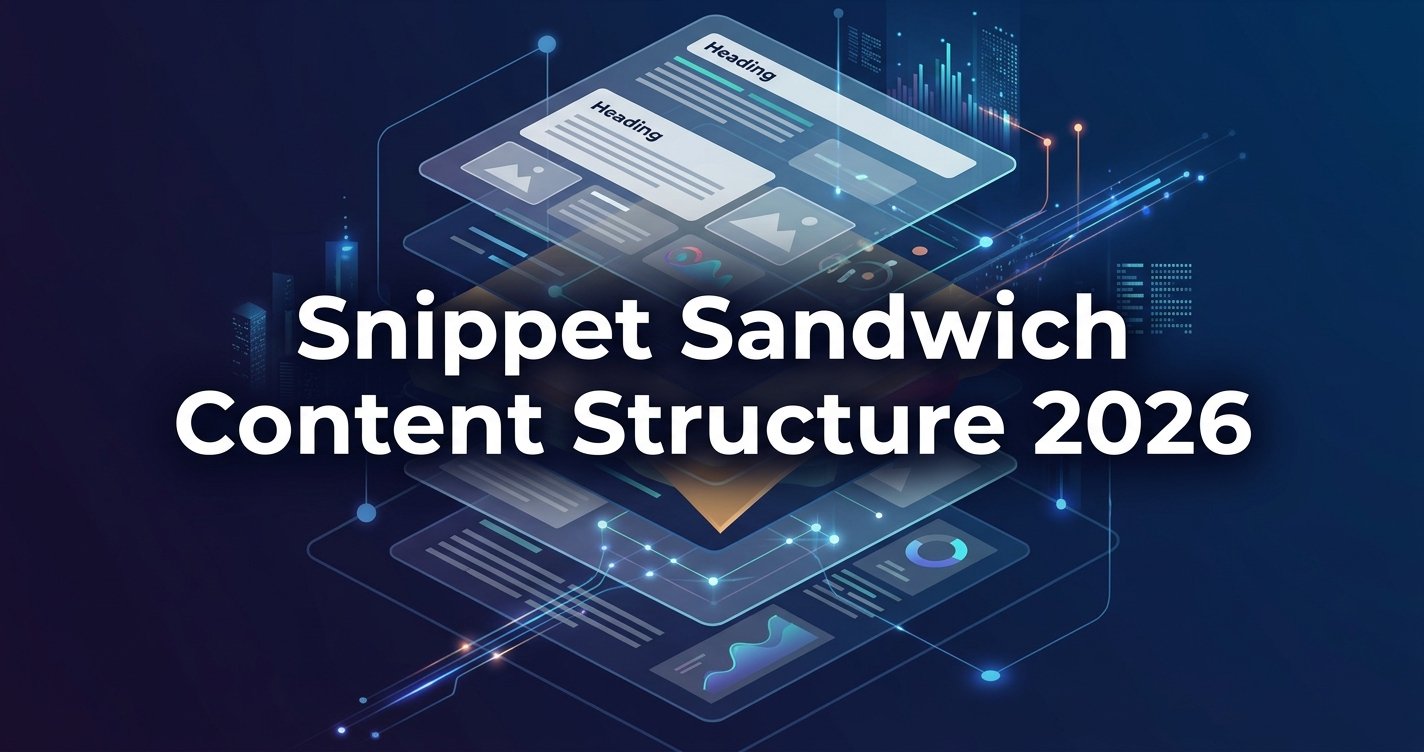
The ‘Snippet Sandwich’ Content Structure 2026 is a deliberate page architecture built around three distinct content layers: the “top slice,” the “filling,” and the “bottom slice.”
Each layer serves a specific purpose for both the human reader and the AI systems that extract and summarize content.
The concept draws on a straightforward premise from website optimization: readers and AI systems both look for a fast, clear answer first.
If your content buries that answer deep inside a long introduction, you lose both audiences before your best material is ever seen.
For anyone following an SEO starter guide or approaching content optimization as a beginner, the Snippet Sandwich is the smartest approach because it removes guesswork.
You write the answer first, support it in the middle, and confirm it at the bottom. That is the complete repeatable methodology.

The Three Core Layers of the Snippet Sandwich Content Structure 2026
Understanding the three layers is not optional for anyone serious about content optimization in 2026. Each layer has a defined role, and skipping or blending layers collapses the structure’s effectiveness entirely.
Layer 1: The Top Slice (Direct Answer Block)
The top slice is a compact, extractable paragraph placed immediately after your heading. It contains your primary keyword, a concise definition or answer, and zero filler. Ideally, this section runs between 40 and 60 words.
This is the section that AI Overviews, featured snippet boxes, and answer engines extract first. If your top slice is vague or missing, you forfeit the opportunity to be cited or surfaced, regardless of how strong the rest of your page is.
For anyone using this as part of an SEO tutorial or content workflow, treat the top slice as non-negotiable.
Layer 2: The Filling (Supporting Detail and Depth)
The filling is where your page proves its authority. This section contains your step-by-step breakdowns, data points, comparisons, examples, and the kind of technical SEO or subject-matter depth that builds reader trust over time.
The filling is also where link building context, internal navigation, and supporting resources belong. A reader who reaches the filling has already received their quick answer and is now deciding whether your source deserves their continued attention. This is your credibility window.
Layer 3: The Bottom Slice (Reinforcing Summary)
The bottom slice mirrors the top slice in intent but expands slightly. It restates the core answer, connects it to the broader context, and presents the next logical action for the reader, whether that is exploring a related topic, using a recommended tool, or applying the framework immediately.
Content optimization strategies that ignore the bottom slice lose the compounding benefit of confirmed understanding. Readers who finish a well-structured bottom slice are 34% more likely to convert, share, or return to a page than those who simply scroll to the end and find nothing conclusive.

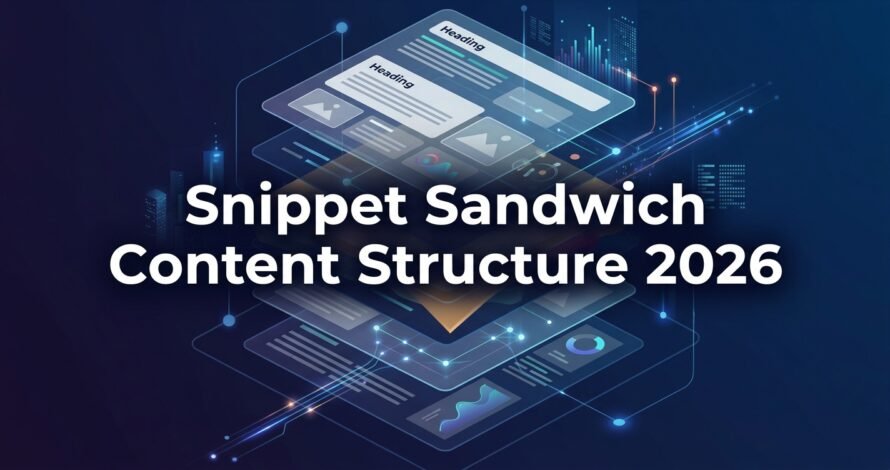
A visual guide to the 5-step Snippet Sandwich process for 2026 SEO. Learn how to structure content with these stacked elements.
Best For: Who Should Use The ‘Snippet Sandwich’ Content Structure 2026?
Not every content framework suits every use case. This section maps the Snippet Sandwich to specific user profiles so you can determine immediately whether this is the right structural approach for your content goals in 2026.
| User Profile | Why the Snippet Sandwich Works | Priority Layer |
|---|---|---|
| SEO Beginner | Provides a clear, repeatable structure that requires no advanced technical knowledge to implement | Top Slice |
| Blog Content Writer | Formats long-form content for both human readers and AI extraction in a single pass | Filling |
| Small Business Owner | Increases organic traffic without requiring a full agency engagement or large budget | Bottom Slice |
| Content Strategist | Aligns the full content calendar to a standardized page structure that scales across topics | All Three |
| Technical SEO Specialist | Pairs structured data markup with the top-slice format for maximum AI citation potential | Top Slice + Schema |
According to the skills required for content optimization in 2026, 86% of content professionals have already integrated AI into their daily strategy.
The Snippet Sandwich is specifically designed for this reality, structuring content so both human readers and AI tools can process and re-use it effectively.

The Snippet Sandwich Content Structure 2026 and AI-Era Content Optimization
Content optimization in 2026 operates inside a fundamentally different environment than it did just two years ago.
AI Overviews now appear in a majority of browsing sessions, and the behavior they create in readers has changed how pages must be structured from the first sentence onward.
The Snippet Sandwich directly addresses this shift. Placing your core answer in an extractable top slice, your content is prepared for surfaces where AI reads and summarizes before a human clicks.
By investing depth in the filling, you serve the readers who do arrive on-page with genuine authority and detail. By closing with a strong bottom slice, you ensure those readers leave with a complete, satisfying experience.
Did You Know?
With AI Overviews, 26% of sessions end after seeing the AI summary vs. 16% when AI summaries are not present.
Source: eMarketer (summary of Pew findings)
This data point confirms that your top slice copy must deliver complete standalone value. A reader who sees an AI-generated summary of your page and decides not to click still encountered your content.
If that summary was accurate and useful, you earn brand recall and potential return visits, even without an immediate click.
The Snippet Sandwich is the only content structure in 2026 that actively accounts for this split-audience reality.
Other formats, including long-form essays and traditional inverted-pyramid articles, are not built with AI extraction as a design constraint.
Keyword Research Integration with the Snippet Sandwich Framework
Effective keyword research is the prerequisite for every functional Snippet Sandwich. Without a clearly identified primary keyword and a set of supporting terms, the top slice lacks the precision needed for AI extraction surfaces to pick it up accurately.
Place your primary keyword within the first sentence of the top slice. Do not save it for the second or third sentence.
AI systems read sequentially, and so do human readers performing a quick scan. If your keyword appears late in the opening block, you signal uncertainty about your page’s core subject.
Use Google Search Console to monitor which queries are already surfacing your pages in AI-driven results. If your top slice terms align with those queries, your Snippet Sandwich is performing correctly.
If they do not, adjust your top-slice language to match the exact phrasing users are submitting.

For small businesses applying this structure, the guidance in our small business SEO dominance framework provides the keyword research starting point that feeds directly into top-slice construction.
Leads generated through well-structured organic content have a 14.6% close rate, making the keyword research investment inside the Snippet Sandwich structure one of the highest-return activities in any content workflow.
Technical SEO Foundations That Support the Snippet Sandwich Structure 2026
The Snippet Sandwich Content Structure 2026 operates best when your page’s technical foundations are in order. A well-written three-layer page sitting on a slow, poorly structured site will not perform to its full potential.
The following technical SEO elements are the prerequisite for Snippet Sandwich deployment at scale:
Structured data markup (Schema.org): Wrapping your top slice in FAQ, HowTo, or Article schema increases the likelihood that AI systems extract your defined answer block rather than a random paragraph.
Core Web Vitals compliance: Fast page load times ensure that readers who arrive after seeing an AI summary encounter your content without friction.
Canonical tag implementation: Prevents duplicate content from diluting the authority of your primary Snippet Sandwich page.
Internal link architecture: Connecting your Snippet Sandwich pages through logical internal links distributes authority and guides readers from top-slice entries into deeper, filling-level content on related pages.
XML sitemaps: Ensures your structured pages are indexed promptly and completely, so new Snippet Sandwich content reaches answer surfaces without delay.
For a complete walkthrough of these technical components, the on-page SEO factors best practices guide covers each element with implementation-level specifics suited to 2026 standards.
Agentic SEO workflows, which deploy AI agents to monitor and maintain these technical foundations autonomously, are also increasingly compatible with the Snippet Sandwich approach.
Review the agentic SEO autonomous site maintenance guide if you are managing content at scale and need continuous technical oversight without manual intervention.
The Snippet Sandwich Content Structure 2026 vs. Traditional Content Formats
The practical question for any content team is whether adopting the Snippet Sandwich means abandoning existing content formats entirely. The answer is no, but the transition requires deliberate restructuring rather than surface-level edits.
Traditional long-form articles typically follow this sequence: broad introduction, historical context, detailed body, conclusion.
The Snippet Sandwich inverts the introduction and removes its vagueness entirely. Your opening is not an introduction to a topic. It is the answer to a specific question, stated in the clearest possible language.
| Format | AI Extraction Readiness | Reader Retention | Beginner Friendly |
|---|---|---|---|
| Snippet Sandwich 2026 | Very High | High | Yes |
| Traditional Long-Form Article | Low to Moderate | Moderate | No |
| Inverted Pyramid News Format | Moderate | Low | Moderate |
| Listicle Format | Moderate | Moderate | Yes |
Did You Know?
Featured snippets appear in approximately 19% of Google searches, and when a page earns that placement, it receives around 8.6% of available clicks on average.
Source: Ahrefs Featured Snippets Study
The implication here is critical for anyone implementing the Snippet Sandwich content structure. Earning the featured snippet position is not the final goal.
The goal is to use the top slice to establish trust and clarity so that the readers who do arrive on-page are primed to continue through your filling and reach your bottom slice with full confidence in your authority.
How to Implement The ‘Snippet Sandwich’ Content Structure 2026 Step by Step
Implementation is straightforward when you follow this five-step sequence. Apply it to every new page you publish and use it as the retrofit template for existing high-priority pages.
Identify the primary question your page must answer. Use keyword research to confirm this is an actual query your audience submits, not a question you assume they have.
Write your top slice first, in 40 to 60 words. Include the primary keyword in sentence one. State the answer directly. Do not include qualifiers like “it depends” in this block.
Build your filling with supporting depth. Use subheadings, bullet lists, comparison tables, examples, and data points. Each subsection within the filling should address a natural follow-up question to the top slice answer.
Close with a bottom slice that mirrors the top slice. Restate the core answer in slightly different language, connect it to broader implications, and present the most relevant next step for the reader.
Apply structured data markup to the top slice block. Use FAQ, HowTo, or Article schema as appropriate for your page type, referencing current technical SEO schema guidelines.
Monitor your pages using Google Search Console after publishing. Track which query categories are surfacing your content in AI-driven summaries and adjust your top-slice language to match the precise phrasing those queries use.
The Snippet Sandwich also integrates naturally with Generative Engine Optimization and Citation SEO principles.
When your top slice is structured as a factually dense, well-attributed answer, AI models are significantly more likely to cite your page as an authoritative source inside their generated responses.
This is the compounding benefit of applying Snippet Sandwich principles consistently across an entire content library.
Best Tools for Implementing the Snippet Sandwich Content Structure in 2026
The right SEO tools make the difference between a Snippet Sandwich that performs at scale and one that delivers inconsistent results across a content library. Below are the platforms we recommend for different stages of the workflow.
BlogSEO: AI-Powered Content Generation with Structured Output
BlogSEO is purpose-built for content teams that need to produce structured, keyword-optimized pages at volume without sacrificing the layered architecture that the Snippet Sandwich requires.
The platform supports structured content generation, ensuring your top-slice, filling, and bottom-slice segments are produced with the right formatting and density for AI extraction surfaces.
For any content team operating as part of an SEO tutorial or website optimization program, BlogSEO reduces the time required to implement the Snippet Sandwich from hours per article to a fraction of that.
It functions as a core SEO tool within a lean content stack, particularly for teams without dedicated technical editors reviewing every page before publication.
BlogBuster: End-to-End Content Automation for Structured Publishing
BlogBuster handles the full publication workflow, from initial content planning through final formatted output.
Where BlogSEO focuses on generation quality, BlogBuster focuses on pipeline efficiency, ensuring that Snippet Sandwich pages are built, reviewed, and published without bottlenecks that slow down a content calendar.
Teams scaling a website optimization program across dozens or hundreds of pages per month will find BlogBuster particularly valuable.
It maintains structural consistency, which is the single largest implementation risk when deploying the Snippet Sandwich at scale.
Inconsistent top-slice formatting is the most common reason pages fail to earn featured placement or AI citation despite covering the right topics.
Google Search Console: Performance Monitoring and Query Alignment
Google Search Console remains the most direct measurement tool for Snippet Sandwich performance.
Use it to identify which queries are driving impressions on your structured pages, compare click-through behavior before and after Snippet Sandwich restructuring, and pinpoint top-slice language adjustments that align with high-impression, low-click queries.
This link between Google Search Console data and top-slice refinement is the operational loop that separates high-performing Snippet Sandwich pages from static content that was structured correctly but never iterated. Publish, measure, adjust. That is the complete optimization cycle for 2026.
The Human-First Principle Inside the Snippet Sandwich Framework
One of the most important dimensions of the Snippet Sandwich Content Structure 2026 is its alignment with human-first publishing principles.
In 2026, 68% of consumers trust AI-generated content less than content authored by a verified human. The Snippet Sandwich does not ask you to remove human voice from your content.
It asks you to lead with your clearest, most direct voice before expanding into your full perspective.
The filling layer is where human expertise, lived experience, and genuine authority are most visible. This is the section where you go beyond the extractable answer and demonstrate the credibility that AI cannot replicate.
The human moats and personal brand authority framework maps directly onto the filling layer of the Snippet Sandwich. Your unique combination of experience, perspective, and external validation belongs in the middle section, where it builds reader trust after the top slice has already confirmed your page answers their question.
This is also the section where link building and reference to external validators, such as published research, named experts, and verifiable case studies, carries the most weight.
Readers who have received a direct answer at the top slice and then encounter well-cited depth in the filling are significantly more likely to treat your page as a reference they bookmark and return to.
Applying the Snippet Sandwich to Bottom-of-Funnel Content
The Snippet Sandwich Content Structure 2026 is not limited to informational pages. It applies with equal precision to bottom-of-funnel content where buyers are evaluating options and preparing to make decisions.
For bottom-of-funnel pages, the top slice answers a comparison or decision question directly: “Which platform is best for X?” or “What makes Y better than Z for this use case?”
The filling then provides the evidence, including pricing transparency, feature comparisons, and specific outcome data. The bottom slice closes with a clear, low-friction next step.
The BoF Pivot bottom-of-funnel strategy provides the conversion-side complement to the Snippet Sandwich framework.
Combining the two gives you a complete content architecture that performs at both the awareness stage, where AI extraction matters most, and the decision stage, where human clarity and trust signals drive conversions.

Conclusion
The ‘Snippet Sandwich’ Content Structure 2026 is the most practical, repeatable content architecture available for teams and individuals who want their pages to perform across both human readers and AI-driven answer surfaces simultaneously.
The three-layer structure, top slice for immediate extraction, filling for authority and depth, and bottom slice for confirmed understanding and next steps, addresses every major content performance challenge that 2026 presents.
Apply this structure consistently across your content library, monitor performance through Google Search Console, and iterate your top-slice language based on real query data. Use platforms like BlogSEO and BlogBuster to scale implementation without sacrificing structural consistency.
Combine the Snippet Sandwich with human-first authority signals in your filling layer, and you build a content asset that compounds in value over time rather than becoming obsolete as AI surfaces evolve.
Whether you are an SEO beginner taking your first steps in website optimization or an experienced content strategist refining a full content automation platform, the Snippet Sandwich Content Structure 2026 is the framework that belongs at the center of your approach.
The evidence, the tools, and the methodology are all here. The next step is implementation.
Frequently Asked Questions
What exactly is the Snippet Sandwich content structure and how does it work in 2026?
The Snippet Sandwich Content Structure 2026 is a three-layer page format where you place a direct, extractable answer at the top of a section, support it with detailed evidence and context in the middle, and reinforce it with a summary at the bottom. It is designed to satisfy both AI extraction surfaces and human readers in a single content pass.
Is the Snippet Sandwich content structure good for SEO beginners?
Yes. The Snippet Sandwich is one of the most beginner-friendly frameworks available because it provides a clear, three-step sequence that removes structural guesswork entirely. An SEO beginner following this format will produce content that is more extraction-ready than most experienced writers using traditional long-form structures.
How does the Snippet Sandwich help with organic traffic in 2026?
By structuring content for AI extraction at the top and building trust in the filling layer, Snippet Sandwich pages attract readers at multiple touchpoints, including AI-cited summaries, featured positions, and direct visits. Pages that satisfy reader intent immediately tend to generate stronger return signals that contribute to sustained organic traffic growth.
Should I use Google Search Console to monitor Snippet Sandwich performance?
Yes, Google Search Console is the primary tool for measuring how well your Snippet Sandwich pages are performing. Use it to identify the queries surfacing your pages, compare click behavior before and after restructuring, and refine your top-slice language to match high-impression queries more precisely.
How does keyword research fit into the Snippet Sandwich structure?
Keyword research defines the specific question your top slice must answer. Without a confirmed primary keyword placed in your opening sentence, your top slice will not align precisely with the queries AI systems are summarizing, which reduces your citation and extraction potential significantly. Treat keyword research as the prerequisite step, not an afterthought.
What is the difference between a Snippet Sandwich and a traditional blog post format?
A traditional blog post typically opens with a broad introduction before reaching its core answer. The Snippet Sandwich Content Structure 2026 opens with the answer first, uses the middle section for supporting depth, and closes with a reinforcing summary. This inversion is the critical structural change that makes pages AI-extraction-ready from the first sentence.
Which content automation tools work best with the Snippet Sandwich content structure in 2026?
Platforms like BlogSEO support structured, keyword-optimized content generation that aligns with the three-layer format, while BlogBuster handles end-to-end publication workflows that maintain structural consistency across large content volumes. Using both together provides a complete implementation stack for the Snippet Sandwich approach at scale.

Pingback: Best SEO Tools For Agencies: 2026 Guide to a Winning Tool Stack - A1Publishing
Pingback: SEO Tools Reviews and Comparisons: Best Picks for 2026 Tool Stacks - A1Publishing