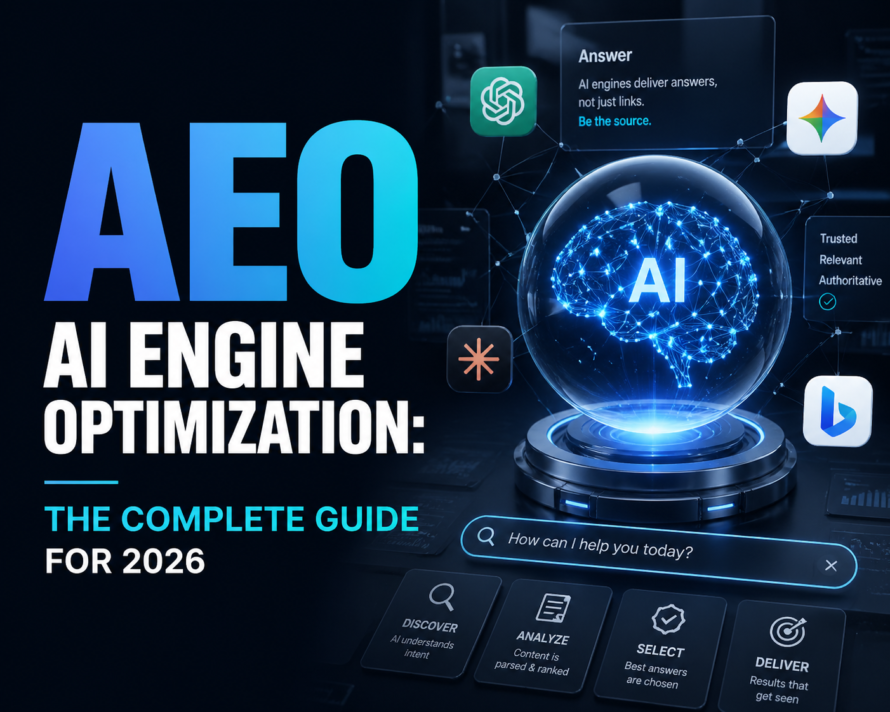
AEO AI Engine Optimization
Last updated: April 27, 2026
Quick Answer: AEO AI Engine Optimization is the practice of structuring and formatting web content so that AI-powered answer engines, such as ChatGPT, Google’s AI Overviews, Perplexity, and Bing Copilot, can accurately extract, cite, and surface that content in direct responses.
Unlike traditional SEO, which targets ranked blue links, AEO targets the answer layer, the zero-click, conversational responses that AI systems generate for users.
Businesses that invest in AEO now are positioning themselves to stay visible as AI-driven search continues to replace classic keyword based browsing.
Key Takeaways
- AEO AI Engine Optimization focuses on making content machine-readable and answer-worthy, not just keyword-rich.
- AI answer engines like Perplexity, Google AI Overviews, and ChatGPT pull from structured, authoritative, self-contained content passages.
- Schema markup, entity clarity, and conversational formatting are the three core technical pillars of AEO.
- Traditional SEO and AEO are not opposites, they share a foundation but diverge in execution and measurement.
- Content written for AEO should answer a specific question completely within a single passage, without requiring the reader to scroll for context.
- Featured snippets, FAQ schema, and How-To schema remain strong signals for AI citation eligibility.
- AEO is most critical for informational and navigational queries, transactional content still relies heavily on traditional SEO.
- Measuring AEO success requires tracking AI citation frequency, brand mentions in AI responses, and answer box appearances, not just organic ranking positions.
What Is AEO AI Engine Optimization and Why Does It Matter in 2026?
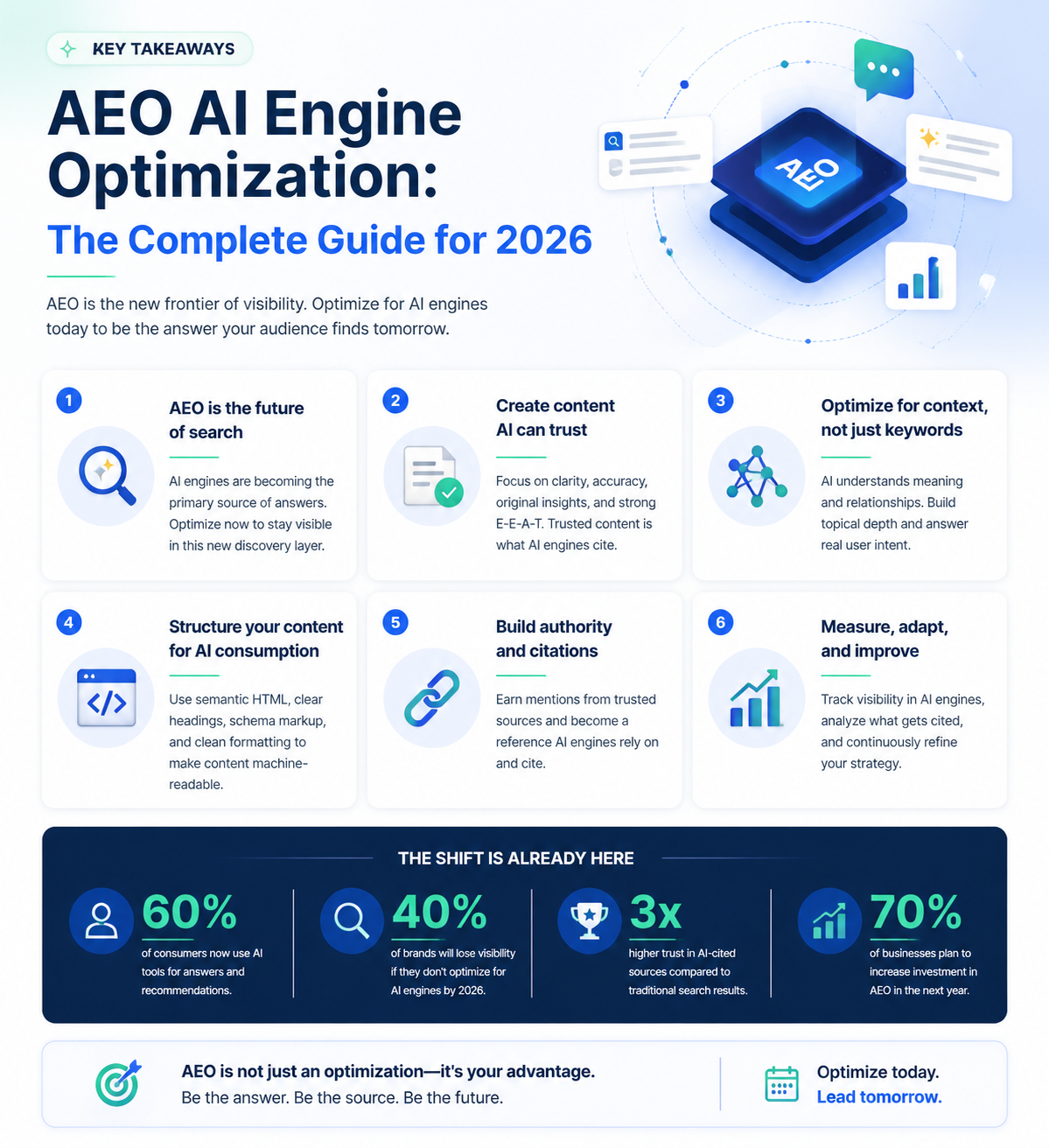
AEO AI Engine Optimization is the discipline of preparing digital content specifically for AI-driven answer engines.
Where traditional SEO asks “will Google rank this page?”, AEO asks “will an AI system cite this passage when a user asks a related question?”
The shift matters because user behavior has changed. A growing share of searches now end inside an AI-generated response rather than on a clicked website.
Google’s AI Overviews, which rolled out broadly in 2024, now appear on a significant portion of informational queries in the U.S. Perplexity.ai and ChatGPT’s browsing mode have further fragmented the classic search funnel.
For content creators, marketers, and brand strategists, this means:
- Visibility is no longer just about ranking — it’s about being cited.
- Authority signals have shifted — AI systems favor content that is specific, structured, and verifiable.
- Zero-click is the new first click — if your brand appears in an AI answer, users may never visit your site, but they still encounter your expertise.
“Being cited by an AI engine in 2026 is the equivalent of ranking #1 in 2016 it’s the most visible real estate in the search experience.”
How Does AEO Differ From Traditional SEO?
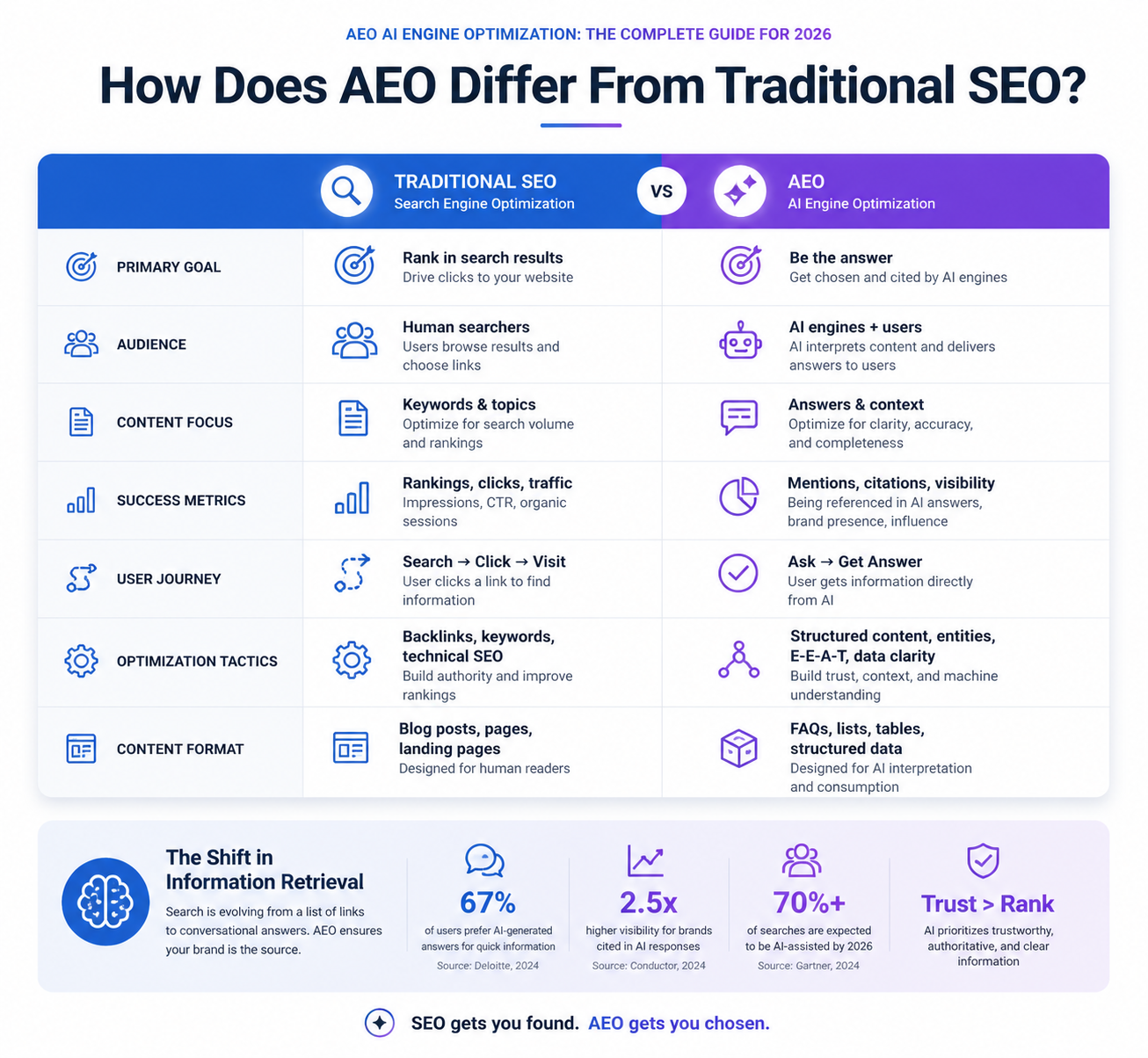
AEO and traditional SEO share the same foundation, quality content, technical health, and credible backlinks, but they diverge significantly in format, intent targeting, and measurement.
| Dimension | Traditional SEO | AEO AI Engine Optimization |
|---|---|---|
| Primary goal | Rank in the top 10 blue links | Be cited in AI-generated answers |
| Content format | Long-form, keyword-dense pages | Self-contained, answer-first passages |
| User intent focus | Broad keyword matching | Specific question-answer pairs |
| Technical signals | Backlinks, page speed, Core Web Vitals | Schema markup, entity clarity, structured data |
| Success metric | Organic ranking position, CTR | AI citation frequency, brand mention in responses |
| Best for | Transactional and navigational queries | Informational and conversational queries |
Choose traditional SEO if your primary goal is driving e-commerce conversions or local foot traffic.
Choose AEO if you publish educational, informational, or thought-leadership content that users are likely to ask AI assistants about directly.
A common mistake is treating AEO as a replacement for SEO. It isn’t. A page that ranks well in traditional search is also more likely to be indexed and trusted by AI systems. The two strategies reinforce each other.
What Are the Core Pillars of AEO AI Engine Optimization?
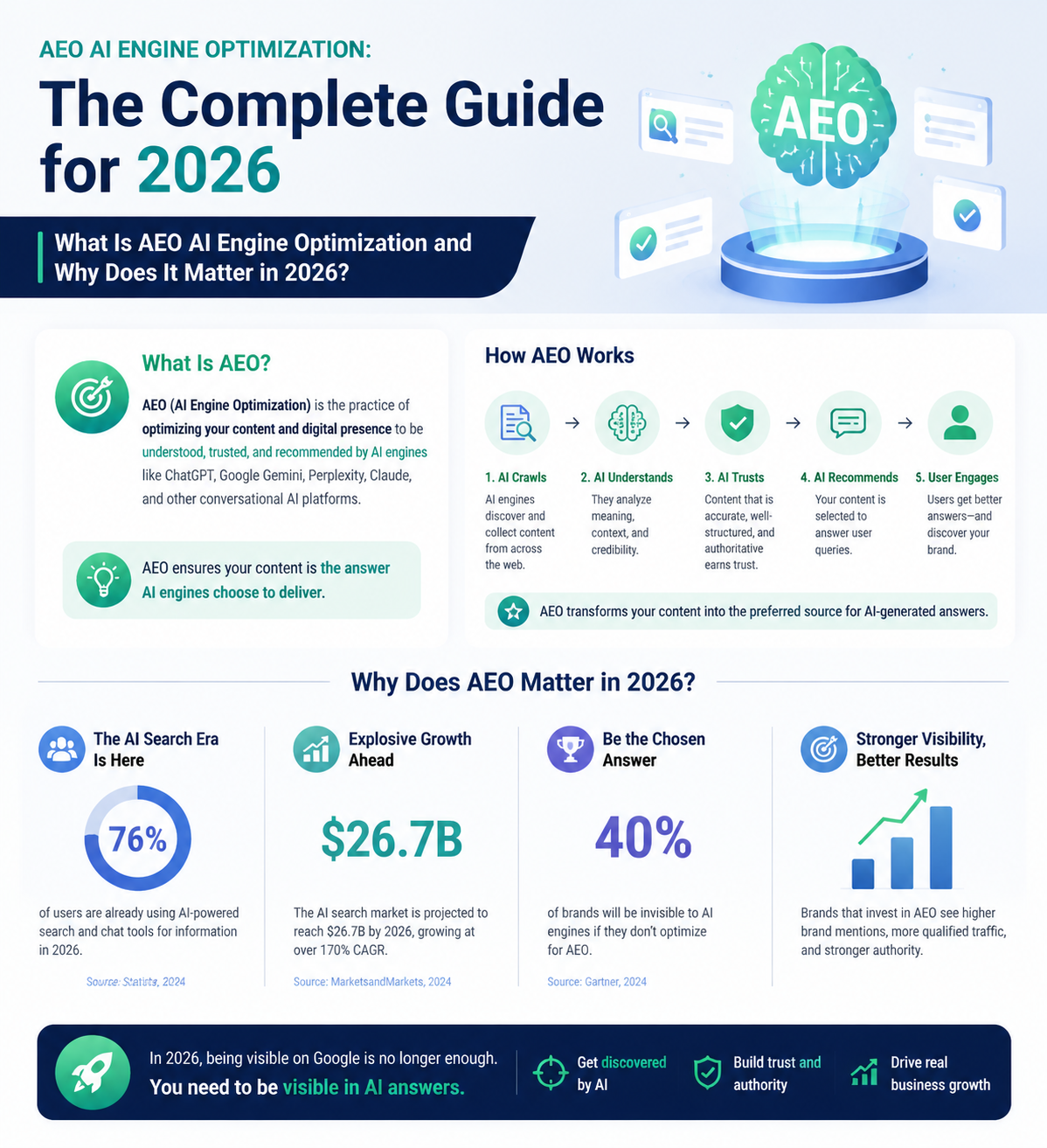
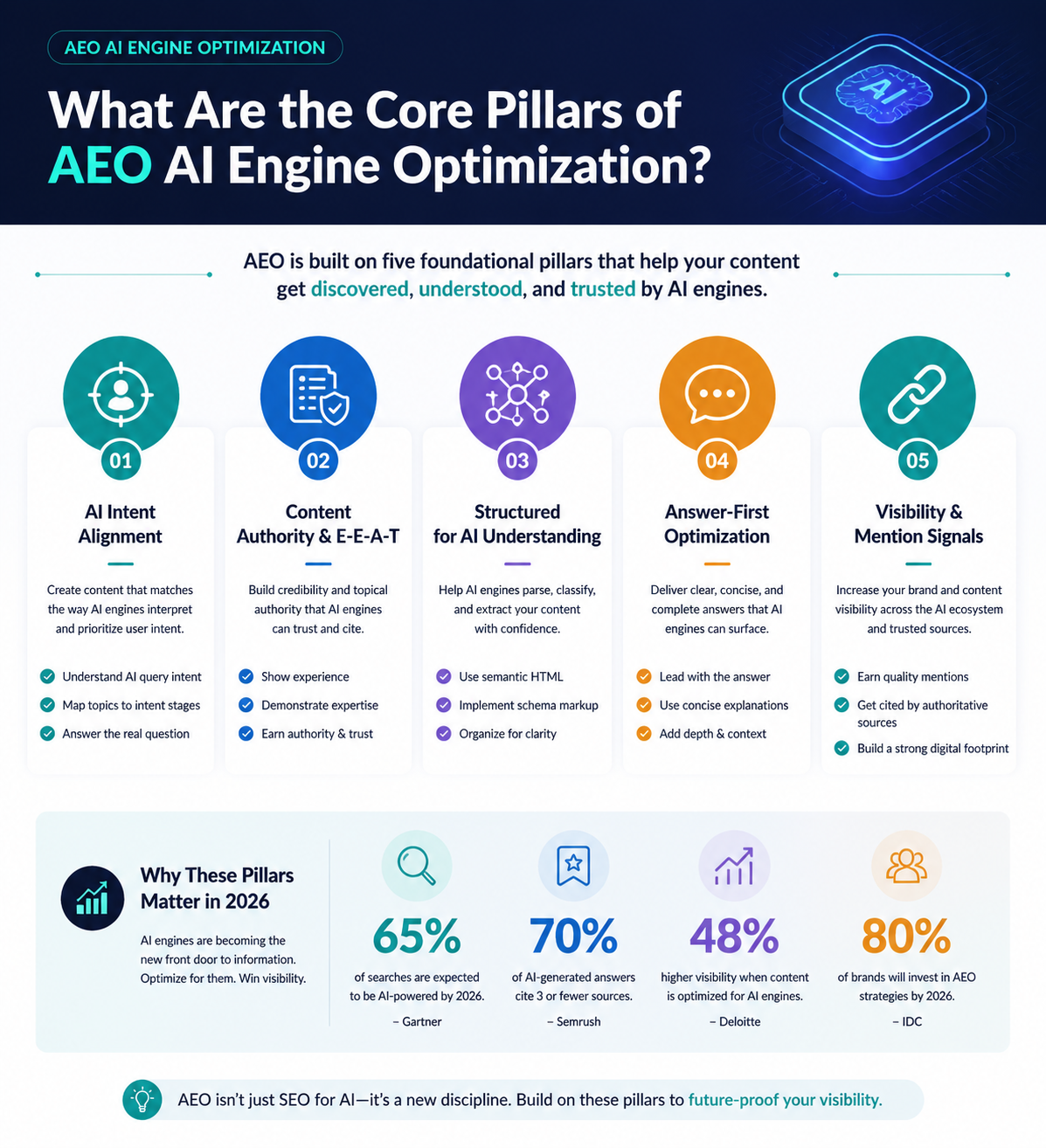
The three core pillars of AEO are structured data, entity authority, and conversational content formatting. Each one addresses a different layer of how AI systems read, evaluate, and surface content.
1. Structured Data and Schema Markup
AI answer engines rely heavily on structured data to understand what a page is about and whether it answers a specific question. The most impactful schema types for AEO include:
- FAQ Schema — marks up question-and-answer pairs directly on the page.
- How-To Schema — signals step-by-step instructional content.
- Article and NewsArticle Schema — establishes authorship, publication date, and topic.
- Speakable Schema — specifically designed for voice and AI assistant responses.
Implementing these via JSON-LD (Google’s recommended format) is the most reliable method.
2. Entity Authority
AI systems build knowledge graphs around named entities, people, organizations, places, concepts. Content that clearly establishes its entities and connects them to verified external sources (Wikipedia, Wikidata, authoritative .gov or .edu pages) is more likely to be treated as a credible source.
Practical steps:
- Name the author and link to their credentials.
- Reference well-known entities by their full, consistent name.
- Use internal linking to connect related entity pages on your own site.
3. Conversational Content Formatting
AI engines extract passages, not pages. Each section of your content should be able to stand alone as a complete answer. This means:
- Open every section with a direct answer (1-3 sentences).
- Avoid burying the answer in background context.
- Keep paragraphs short (3-5 sentences maximum).
- Use clear, specific language — avoid vague pronouns like “it” or “they” without naming the subject.
How Do You Audit Your Content for AEO Readiness?
An AEO audit checks whether your existing content is structured for AI citation eligibility. Start with these five steps:
- Run a schema validation check using Google’s Rich Results Test or Schema.org validator. Identify pages with missing or broken structured data.
- Review your FAQ and How-To content for answer-first formatting. If the answer appears after three paragraphs of context, restructure it.
- Check entity consistency — are your author names, brand names, and topic entities spelled and formatted the same way across all pages?
- Test your content in AI engines — search for questions your content should answer in Perplexity or ChatGPT. Is your site cited? If not, identify which competitor is and analyze their formatting.
- Measure AI citation frequency — tools like Brandwatch, Mention, and emerging AEO-specific platforms now track how often your brand appears in AI-generated responses.
Edge case: Paywalled or login-gated content is rarely cited by AI engines because crawlers cannot access it. If your most authoritative content sits behind a paywall, consider publishing a free summary version optimized for AEO.
What Content Types Perform Best in AEO AI Engine Optimization?
Informational content that directly answers specific questions performs best in AEO. AI systems are built to respond to user queries, so they favor content that mirrors that structure.
High-performing content types for AEO:
- Definition articles (“What is X?”) — clear, authoritative definitions are frequently cited.
- Step-by-step guides — structured with numbered steps and How-To schema.
- Comparison content — tables and structured comparisons are easy for AI to extract.
- FAQ pages — especially those using FAQ schema with concise, direct answers.
- Statistic roundups — AI systems often cite specific, sourced data points.
Lower-performing content types:
- Opinion essays without clear factual claims.
- Long narrative articles without structured headings.
- Content that relies heavily on images or video with no supporting text.
- Pages with thin content (under 300 words) that lack entity context.
What Are the Most Common AEO Mistakes to Avoid?
The most common AEO mistake is writing for keywords instead of questions. AI engines process natural language queries, so content that answers “how do I reduce my website’s bounce rate?” will outperform content optimized for the keyword “bounce rate reduction tips.”
Other frequent errors:
- Vague passage structure — starting sections with “This section covers…” instead of a direct answer.
- Missing schema — publishing FAQ content without FAQ schema leaves value on the table.
- Inconsistent entity naming — referring to your brand as “we,” “the company,” and your actual brand name interchangeably confuses AI knowledge graphs.
- No author credentials — anonymous content is less likely to be trusted as a citation source.
- Ignoring E-E-A-T signals — Google’s Experience, Expertise, Authoritativeness, and Trustworthiness framework also informs AI citation decisions.
How Should You Measure AEO AI Engine Optimization Success?
AEO success is measured differently from traditional SEO. Organic ranking position is no longer the primary signal.
Key AEO metrics to track:
- AI citation frequency — how often your brand or content appears in AI-generated responses for target queries.
- Brand mention volume in AI tools — tracked via social listening and emerging AI monitoring platforms.
- Featured snippet capture rate — featured snippets remain a strong proxy for AI citability.
- Direct traffic from AI referrals — some AI tools (Perplexity, Bing Copilot) do send referral traffic; monitor this in your analytics.
- Answer box appearances — track which queries trigger an AI overview or answer box that includes your content.
Set a baseline now by documenting which of your target queries currently surface AI-generated answers, and whether your content appears in them. Reassess monthly.
FAQ: AEO AI Engine Optimization
Q: Is AEO only relevant for large websites?
No. Small and mid-size sites can compete effectively in AEO because AI engines prioritize answer quality and structure over domain authority alone.
Q: Does AEO replace the need for backlinks?
No. Backlinks remain a trust signal that AI systems use to evaluate credibility. AEO adds a new layer; it doesn’t remove the old ones.
Q: How long does it take to see results from AEO?
Results vary, but structured data changes can be picked up by crawlers within days to weeks. Appearing in AI citations consistently typically takes one to three months of sustained effort.
Q: Do I need a developer to implement schema markup?
Not always. CMS plugins like Yoast SEO (WordPress) and Rank Math support FAQ and How-To schema without custom code. For complex implementations, developer support is recommended.
Q: Is AEO the same as voice search optimization?
They overlap significantly but are not identical. Voice search optimization focuses on spoken query phrasing; AEO is broader and covers all AI answer surfaces, including text-based chat interfaces.
Q: What’s the single most impactful AEO change I can make today?
Restructure your top informational pages so that each H2 section opens with a direct, self-contained answer to the question implied by that heading.
Q: Does AEO apply to e-commerce sites?
Partially. Product pages benefit less from AEO, but category pages, buying guides, and product comparison content are strong AEO candidates.
Q: Can AEO hurt my traditional SEO?
No. The structural changes that improve AEO — cleaner headings, schema markup, direct answers — also improve traditional SEO performance.
Conclusion: Actionable Next Steps for AEO AI Engine Optimization
AEO AI Engine Optimization is not a future trend, it’s a present-day requirement for any brand that depends on search visibility.
AI answer engines are already reshaping how users find information, and content that isn’t structured for citation eligibility is quietly losing ground.
Start here:
- Audit your top 10 informational pages for answer-first formatting and missing schema.
- Add FAQ schema to any page that already contains question-and-answer content.
- Establish clear author entities with linked credentials on all published content.
- Test your target queries in Perplexity and Google AI Overviews, document who is being cited and why.
- Set up brand monitoring to track AI citation frequency as a core KPI alongside organic traffic.
The brands that treat AEO as a strategic priority in 2026 will hold a measurable advantage as the AI answer layer continues to expand. The technical barrier to entry is low. The competitive window is still open.
References
- Google Search Central. (2023). Structured data documentation: FAQ, How-To, and Speakable schema. https://developers.google.com/search/docs/appearance/structured-data
- Google Search Central. (2024). AI Overviews help documentation. https://developers.google.com/search/docs/appearance/ai-overviews
- Schema.org. (2023). Schema.org full hierarchy and vocabulary. https://schema.org
- Search Engine Journal. (2024). E-E-A-T and its role in AI-generated search results. https://www.searchenginejournal.com