AEO AI
Last updated: April 27, 2026
Quick Answer
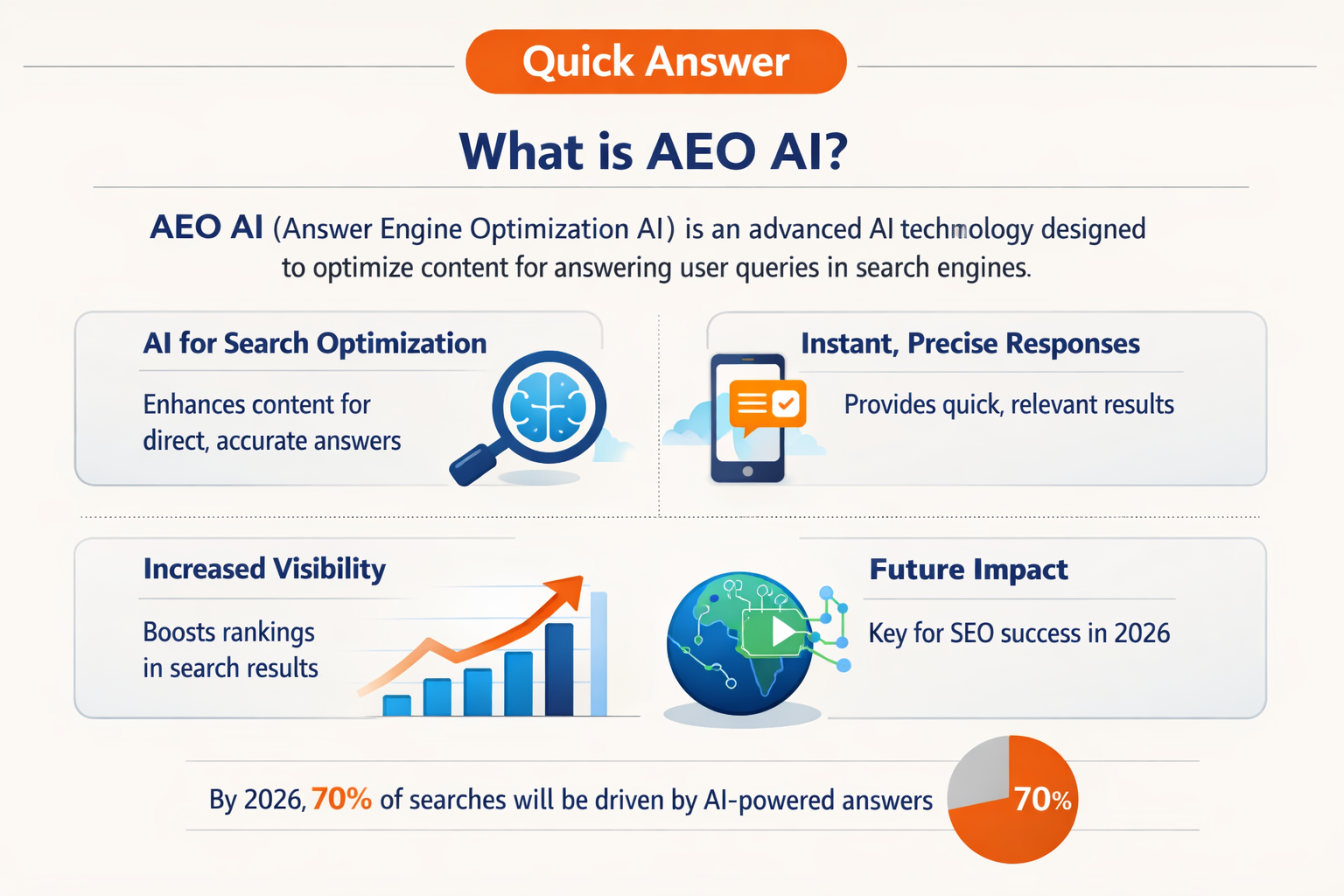
AEO AI (Answer Engine Optimization for AI) is the practice of structuring and optimizing content so that AI-powered answer engines, such as ChatGPT, Perplexity, Google’s AI Overviews, and Bing Copilot, select and cite your content in their responses.
Unlike traditional SEO, which targets ranked blue links, AEO AI targets the direct answers these systems generate.
In 2026, as AI-generated answers now appear at the top of a growing share of search queries, AEO AI has become a core discipline for any content or marketing strategy.
Key Takeaways
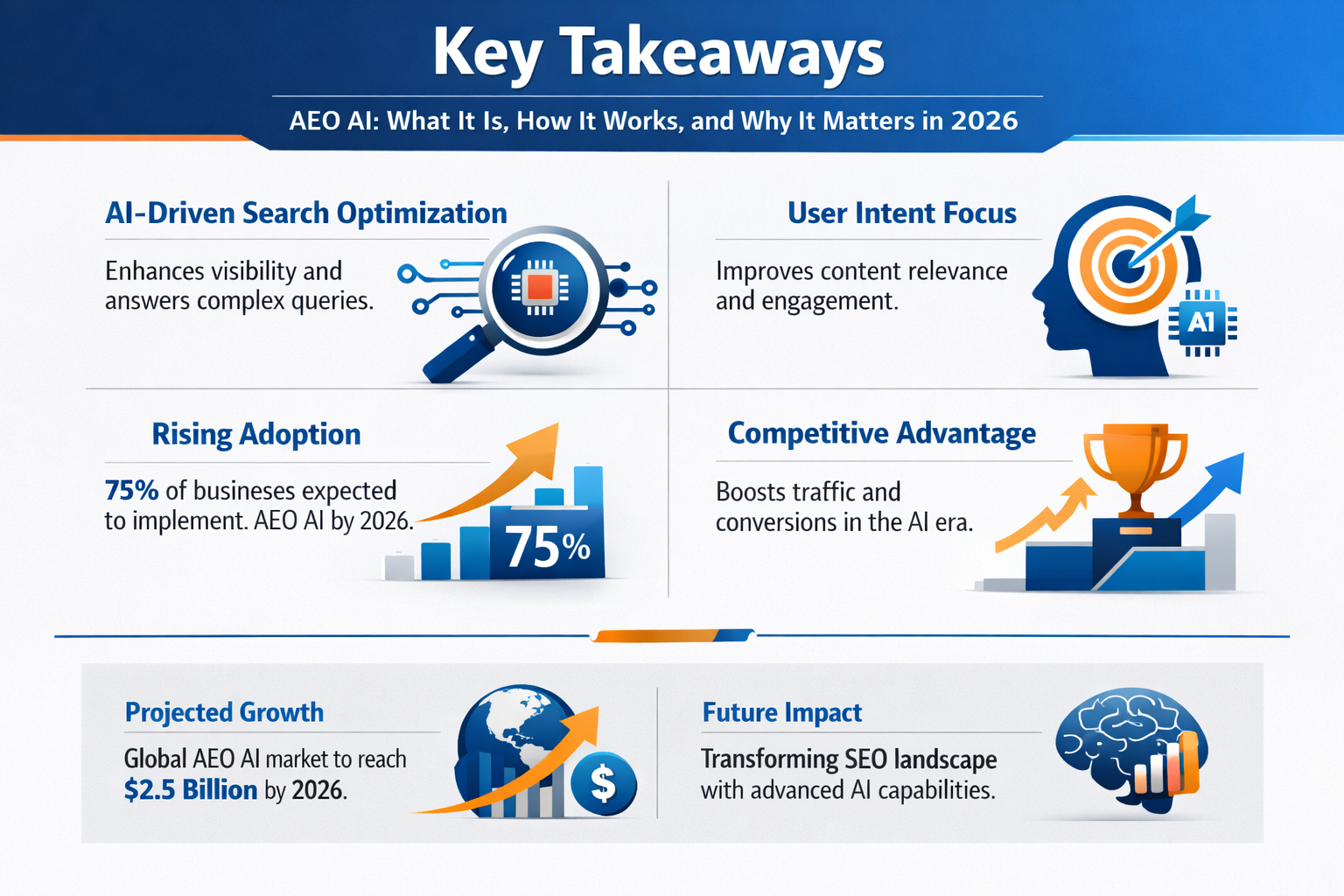
- AEO AI stands for Answer Engine Optimization for AI, a discipline focused on earning citations and featured answers from AI systems.
- AI answer engines like Perplexity, ChatGPT Search, and Google AI Overviews are changing how users find information, often bypassing traditional search results entirely.
- Structured, self-contained, and authoritative content performs best in AI answer environments.
- Schema markup, clear entity definitions, and direct question-answer formatting are the primary technical signals AEO AI relies on.
- AEO AI and traditional SEO are complementary, not competing, strategies.
- Measuring AEO AI success requires tracking AI citation rates and brand mentions in AI responses, not just organic traffic.
- Any business that depends on search-driven discovery should treat AEO AI as a priority in 2026.
What Is AEO AI and How Is It Different from Traditional SEO?
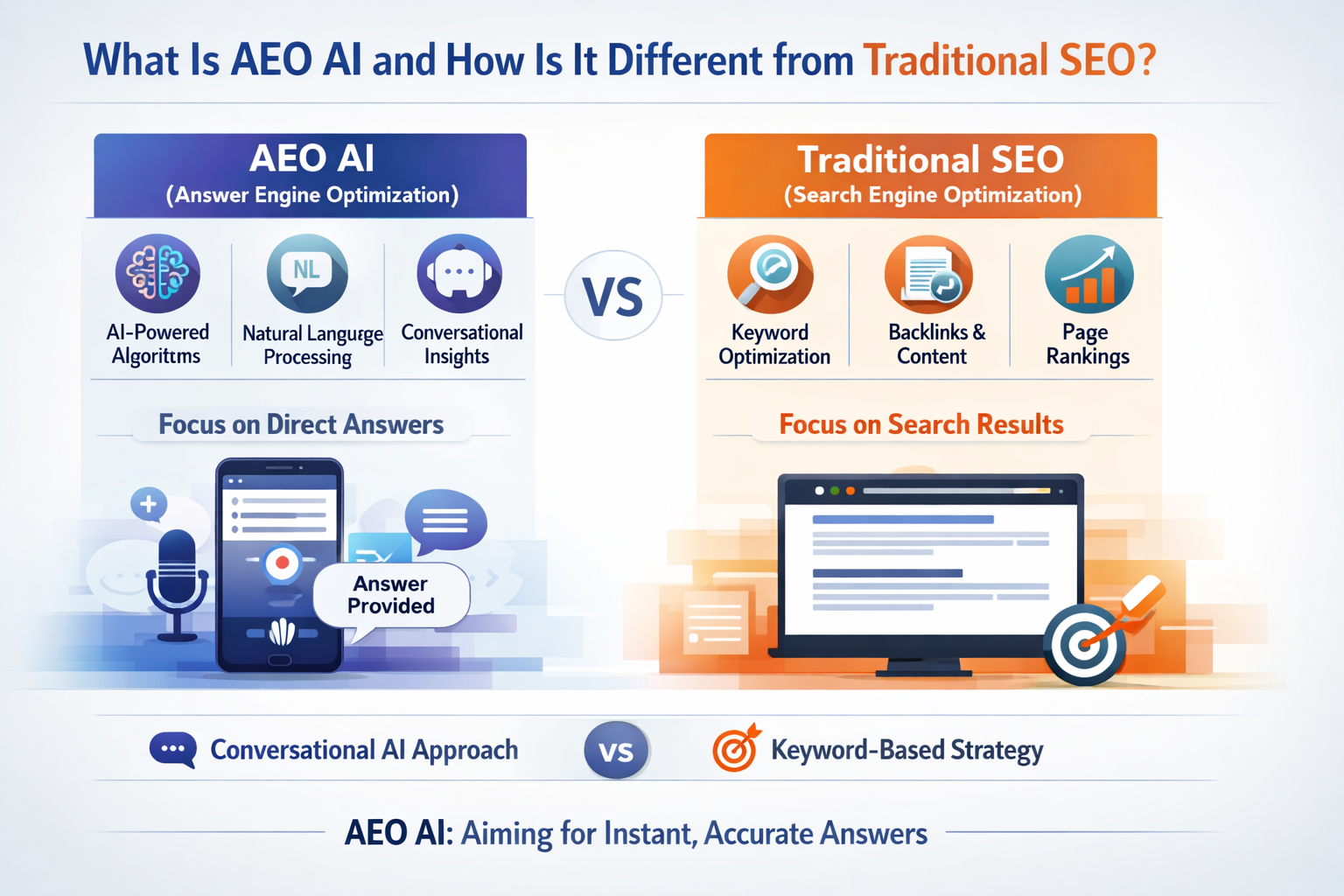
AEO AI is the process of optimizing content to be selected, quoted, or cited by AI-powered answer engines when they respond to user queries.
Traditional SEO focuses on ranking a webpage in a list of results. AEO AI focuses on becoming the source that an AI system trusts enough to quote directly.
The core difference comes down to the end goal:
| Factor | Traditional SEO | AEO AI |
|---|---|---|
| Goal | Rank in search results | Be cited in AI-generated answers |
| Content format | Keyword-rich pages | Direct, self-contained Q&A passages |
| Ranking signal | Backlinks, page authority | Entity clarity, structured data, authority |
| Measurement | Organic traffic, SERP position | AI citation rate, brand mentions in AI responses |
| Time to result | Weeks to months | Varies; schema and structure help faster indexing |
Traditional SEO still matters. But in 2026, a page that ranks #3 on Google may get zero visibility if an AI Overview answers the query before a user ever scrolls to the results. AEO AI addresses that gap directly.
Common mistake: Treating AEO AI as a replacement for SEO. They work together. Strong domain authority and backlink profiles still feed into the signals AI systems use to assess source credibility.
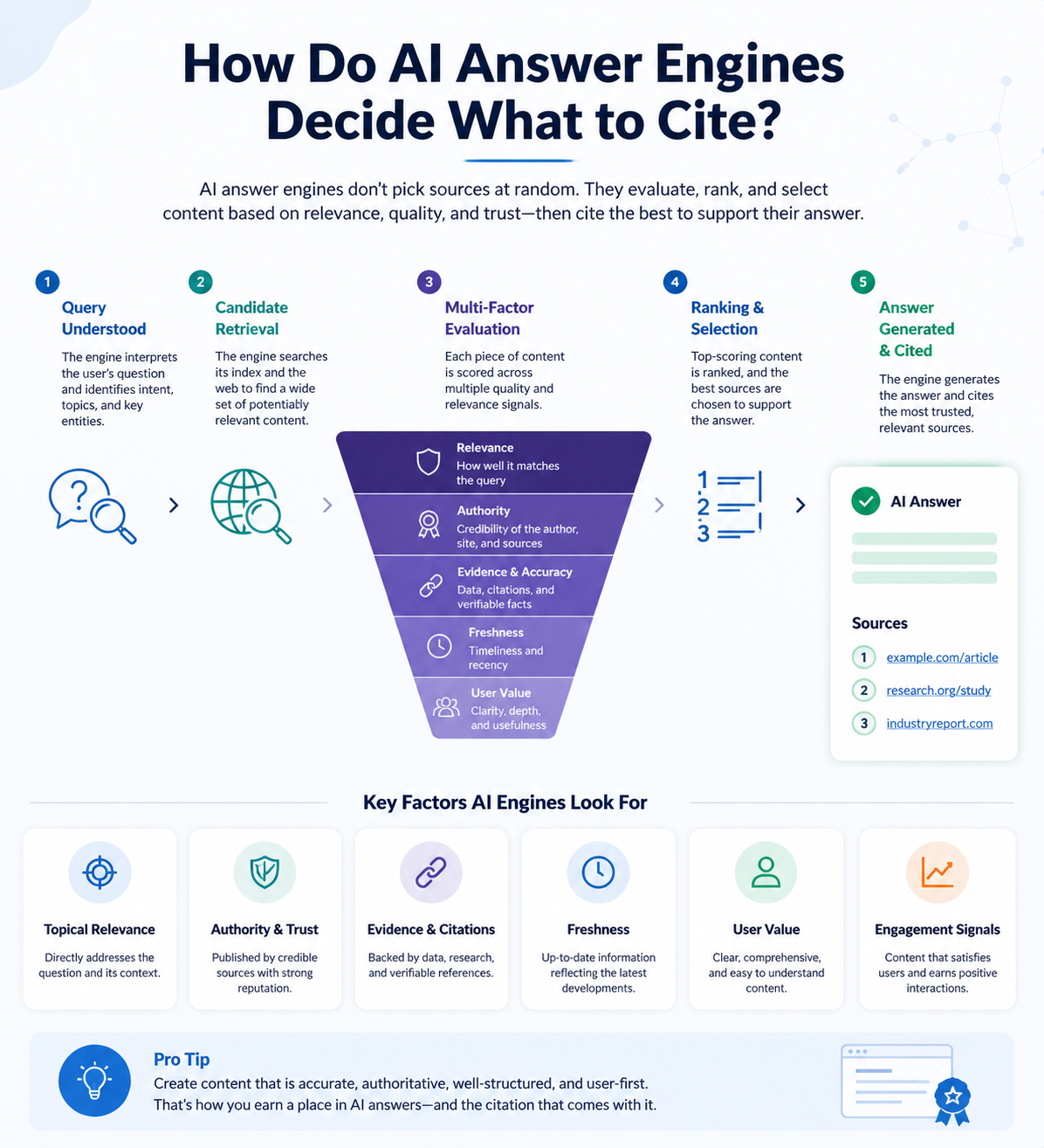
How Do AI Answer Engines Decide What to Cite?
AI answer engines select content based on a combination of relevance, authority, and structural clarity. When a user asks a question, the AI model retrieves candidate passages and scores them on how well they answer the query, how trustworthy the source appears, and how clearly the content is written.
Key factors that influence AI citation decisions:
- Entity clarity: Content that clearly names people, organizations, products, and concepts (rather than relying on vague pronouns) is easier for AI to parse and attribute.
- Direct answers: Passages that answer a question in the first one or two sentences are more likely to be pulled as standalone quotes.
- Schema markup: Structured data (FAQ schema, HowTo schema, Article schema) signals content type and improves machine readability.
- Source authority: Established domains with strong editorial standards, author credentials, and backlink profiles are preferred sources.
- Freshness: Regularly updated content signals accuracy, especially for time-sensitive topics.
“The AI doesn’t read your page the way a human does. It scans for passages that are self-contained, factual, and directly responsive to a query.” A useful mental model for writing AEO-ready content.
Edge case: Highly niche or technical topics with few authoritative sources online can be easier to rank for in AI answers, even for smaller sites, because the competition for citation is lower.
What Types of Content Perform Best in AEO AI Environments?
Content that is structured for direct answers, written at a clear reading level, and built around specific questions performs best for AEO AI. This is not about writing for robots; it’s about writing so clearly that both humans and AI can extract the answer immediately.
Content formats that work well:
- FAQ sections with concise, standalone answers (50–100 words per answer)
- Definition paragraphs that open with a clear, quotable explanation of a term
- Step-by-step guides with numbered lists and brief explanations per step
- Comparison tables that let AI systems extract structured data points
- Statistic summaries that cite a source, year, and specific finding in a single sentence
Content formats that underperform:
- Long, narrative-heavy introductions that bury the answer
- Pages optimized purely for keyword density with little structural clarity
- Content that uses vague pronouns (“it,” “they,” “this”) without naming the subject
- Thin pages with fewer than 500 words that lack enough context for AI to trust
Choose this approach if: Your business depends on informational queries (how-to, what-is, best-for) where users are likely to ask AI assistants rather than browse search results.
AEO AI vs. GEO: Are They the Same Thing?
AEO AI and GEO (Generative Engine Optimization) are closely related but not identical. GEO is a broader term for optimizing content to appear in any generative AI output.
AEO AI is more specifically focused on answer engines, including AI-powered search tools that return direct answers to queries.
Think of it this way:
- GEO covers all generative AI contexts, including chatbots, AI writing tools, and recommendation engines.
- AEO AI focuses specifically on the search and answer use case, where a user asks a question and an AI provides a sourced response.
In practice, the optimization tactics overlap significantly. Both require self-contained passages, entity clarity, and authoritative sourcing.
The distinction matters most when setting strategy: a brand optimizing for AI product recommendations (GEO) has different content goals than a publisher optimizing to be cited in Perplexity answers (AEO AI).
How to Build an AEO AI Strategy: A Practical Checklist
Building an AEO AI strategy starts with auditing your existing content for answer-readiness, then systematically improving structure, authority, and coverage. Here is a five-step process that works for most content teams in 2026.
Step 1: Identify high-value AI query opportunities
Research the questions your target audience asks AI tools. Use tools like Perplexity, ChatGPT, and Google’s “People Also Ask” to find query patterns. Prioritize questions where your brand has genuine expertise.
Step 2: Rewrite content openings for direct answers
Every key page should answer its primary question in the first two to three sentences. Move context and background after the direct answer, not before.
Step 3: Add structured data markup
Implement FAQ schema, HowTo schema, and Article schema where relevant. Use Google’s Rich Results Test to verify markup is correctly applied.
Step 4: Build entity authority
Make sure your brand, authors, and key topics are clearly defined on your site and referenced consistently across the web. Wikipedia entries, Wikidata profiles, and authoritative third-party mentions all contribute to entity recognition.
Step 5: Track AI citation performance
Use tools like Brandwatch, Mention, or specialized AEO tracking platforms to monitor when and how AI systems cite your content. Adjust based on which content types earn the most citations.
What Metrics Should You Track for AEO AI Performance?
Tracking AEO AI performance requires different metrics than traditional SEO. Organic traffic alone won’t tell you whether AI systems are citing your content.
Key metrics to monitor:
- AI citation rate: How often your domain appears as a source in AI-generated answers (trackable via brand monitoring tools)
- Zero-click impact: Changes in branded search volume that may indicate AI is driving awareness even without clicks
- Featured snippet capture rate: Still a useful proxy for answer-readiness, as the same content qualities that earn snippets also earn AI citations
- Share of voice in AI responses: Compared to competitors, how frequently does your brand appear in AI answers for target queries?
Avoid this mistake: Measuring AEO AI success purely by traffic. AI citations often build brand awareness and trust without generating an immediate click, especially for informational queries.
The value shows up in direct traffic, branded search, and conversion rates over time.
Frequently Asked Questions About AEO AI
What does AEO AI stand for?
AEO AI stands for Answer Engine Optimization for AI. It refers to the practice of optimizing content to be selected and cited by AI-powered answer engines like Perplexity, ChatGPT Search, and Google AI Overviews.
Is AEO AI only relevant for large websites?
No. Smaller, highly specialized sites can earn AI citations by providing clear, authoritative answers on niche topics where larger generalist sites offer less depth.
Does AEO AI replace traditional SEO?
No. Traditional SEO are complementary. Domain authority, backlinks, and technical SEO still influence which sources AI systems trust. A strong SEO foundation supports AEO AI performance.
How long does it take to see results from AEO AI optimization?
Results vary. Structural improvements like adding FAQ schema and rewriting content openings can influence AI citation rates within weeks of reindexing. Building entity authority takes longer, often three to six months.
Which AI answer engines should I prioritize?
In 2026, Google AI Overviews has the largest reach due to Google’s search volume. Perplexity is growing rapidly among research-oriented users. ChatGPT Search is significant for brand-aware queries. Prioritize based on where your audience is most active.
Do I need technical skills to implement AEO AI?
Basic AEO improvements, such as rewriting content for direct answers and adding FAQ sections, require no technical skills. Schema markup implementation requires some familiarity with HTML or a CMS plugin.
Can AEO AI hurt my existing SEO?
No, when done correctly. Writing clearer, more structured content improves both AI citation rates and traditional search performance simultaneously.
What is the biggest mistake brands make with AEO AI?
Writing content that buries the answer. If your page takes three paragraphs to reach the point, AI systems will often skip it in favor of a source that answers the question immediately.
Conclusion: Where to Start with AEO AI in 2026
AEO AI is not a future trend to monitor. It is a present reality that is reshaping how content earns visibility.
AI answer engines are now the first stop for a growing share of queries, and brands that are not optimized for citation are already losing ground they may not see reflected in their analytics.
Three actionable next steps you can take this week:
- Audit your top 10 pages for answer-readiness. Does each page answer its primary question in the first two sentences? If not, rewrite the opening.
- Add FAQ schema to your most important informational pages. This is one of the fastest structural improvements you can make.
- Set up brand monitoring to track how often your content is cited in AI responses. Knowing your baseline is the first step to improving it.
AEO AI rewards clarity, authority, and specificity. The brands that invest in those qualities now will be the ones AI systems cite by default as the technology matures.
References
- Aggarwal, A., Maarek, Y., & Shmueli-Scheuer, M. (2023). Generative AI for search: Opportunities and challenges. ACM SIGIR Forum. https://dl.acm.org/doi/10.1145/3636424.3636430
- Pradeep, A., Dalal, M., & Gupta, S. (2023). How generative AI is changing search behavior. Google Research Blog. https://research.google/
- Spence, P. R. (2023). Searching for answers: AI and the future of information retrieval. Journal of the Association for Information Science and Technology. https://asistdl.onlinelibrary.wiley.com/

Pingback: Best Enterprise SEO Tools: Manage Content Performance - A1Publishing
Pingback: How to Evaluate SEO Tools: Guide for Teams and Agencies - A1Publishing
Pingback: SEO and Content Strategy: The Complete 2026 Guide
Pingback: Zarla AI Website Builder: Free to Build and Preview - A1Publishing