SurgeGraph AI Detector
Last updated: April 27, 2026
Quick Answer: The SurgeGraph AI Detector is a free, registration-free tool that scans pasted text (up to 15,000 characters) and tags each sentence as either human-written or AI-generated. Independent testing, however, found its detection accuracy to be significantly below what its marketing claims, making it a questionable choice for anyone who needs reliable AI content verification.
Key Takeaways
- SurgeGraph is primarily an SEO and AEO content platform, not a dedicated AI detection company. The AI detector is a secondary feature.
- Free to use with no sign-up required, accepting up to 15,000 characters of copy-pasted text.
- No file uploads supported — no PDFs, no Word documents, text only.
- Sentence-level tagging lets you see exactly which sentences are flagged as AI-generated.
- Independent accuracy testing was poor: detection scores ranged from 3% to 29% on confirmed AI-generated content, according to Originality.ai’s review.
- A built-in humanizer tool is included in the broader SurgeGraph platform.
- Better alternatives exist if accuracy is your primary concern, especially for education, publishing, or compliance use cases.
- The ethical and legal landscape around AI detection is evolving fast, and no detector should be used as sole proof of AI authorship.
What Is the SurgeGraph AI Detector?
The SurgeGraph AI Detector is a text analysis tool built into the SurgeGraph platform that attempts to classify written content as either human-authored or AI-generated.
It uses natural language processing and machine learning pattern recognition to analyze linguistic signals in submitted text.
SurgeGraph itself is primarily an answer engine optimization (AEO) and SEO platform designed to help content teams build articles, outlines, and optimized blog posts using AI.
The AI detector sits alongside those content generation features, offering users a way to check whether their published or in-progress content might be flagged by other AI detection systems.
Who it’s designed for: Content marketers, SEO professionals, bloggers, and agencies who are already using SurgeGraph’s broader content suite and want a quick, no-cost sanity check on their text.
Who it’s not ideal for: Educators, academic institutions, publishers, or compliance teams who need high-confidence, auditable AI detection results.
How Does the SurgeGraph AI Detector Work Technically?
At its core, the SurgeGraph AI Detector applies machine learning models trained to recognize statistical patterns common in AI-generated text, things like token probability distributions, sentence rhythm, and lexical predictability.
Here’s a simplified breakdown of the detection process:
- Text ingestion: You paste up to 15,000 characters directly into the tool. No account needed.
- Preprocessing: The system tokenizes the text, breaking it into sentences and word units.
- Pattern scoring: Each sentence is scored against trained models that compare its linguistic fingerprint to known AI and human writing samples.
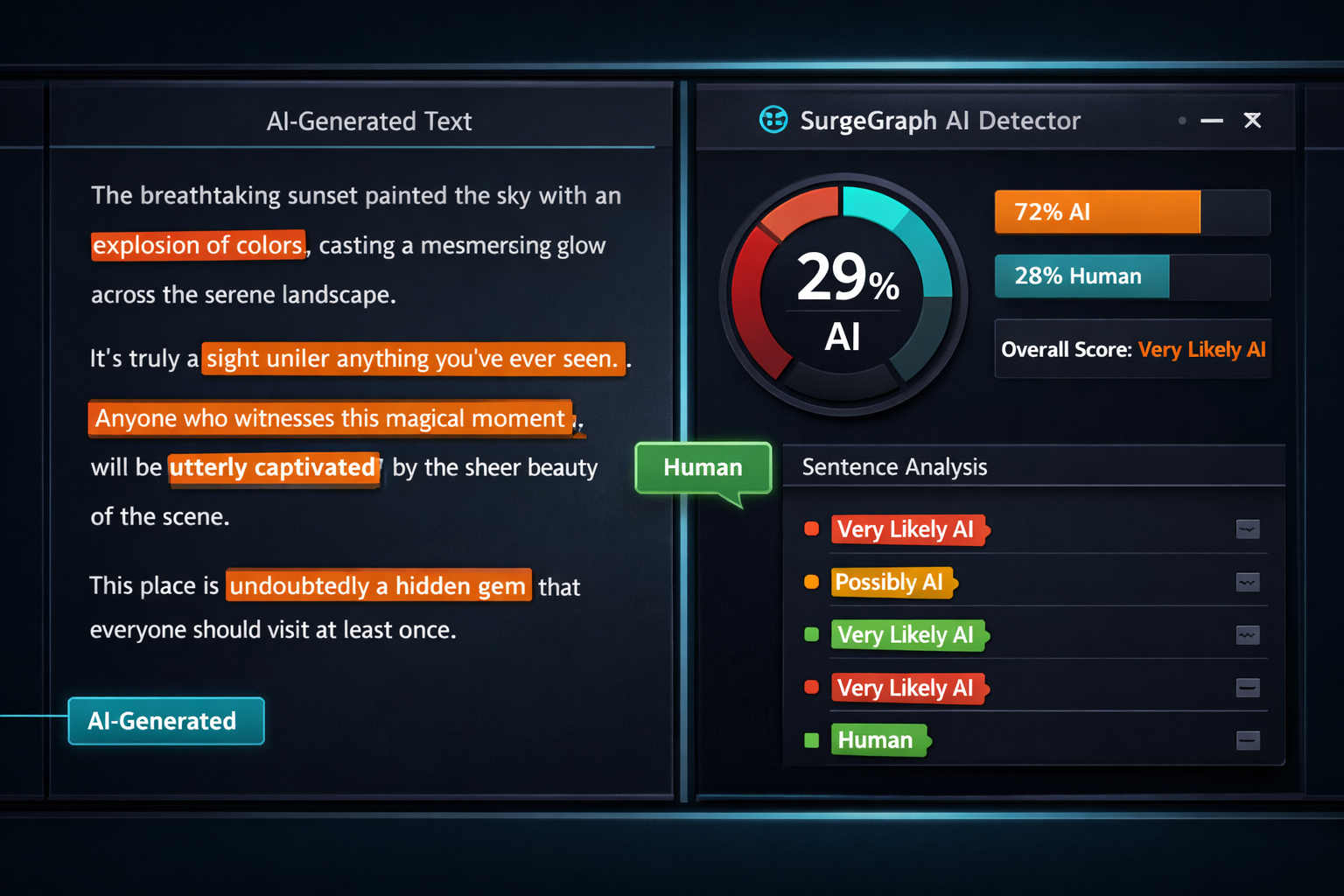
- Classification output: Each sentence receives a label, “human-written” or “AI-generated”, and an overall percentage score is displayed.
- The key technical concept here is perplexity and burstiness. Human writing tends to vary more in sentence complexity (high burstiness), while large language models like GPT-4 or Claude often produce text with lower perplexity, meaning the word choices are statistically “safer” and more predictable. Detectors exploit this gap.
The problem is that as AI models improve and as humanizer tools (including SurgeGraph’s own built-in humanizer become more common, this gap narrows. That’s the core tension in AI detection technology right now.
“AI detection is fundamentally a moving target. Every improvement in generation models reduces the signal that detectors rely on.” A commonly cited principle in NLP research circles.
SurgeGraph AI Detector Features: What You Actually Get
| Feature | Details |
|---|---|
| Cost | Free |
| Registration required | No |
| Character limit | Up to 15,000 characters |
| File upload support | No — text paste only |
| Analysis granularity | Sentence-level tagging |
| Output format | Human vs. AI label per sentence + overall score |
| Built-in humanizer | Yes (part of SurgeGraph platform) |
| API access | Not confirmed for the free detector |
What works well:
- Zero friction to get started — paste and scan
- Sentence-level breakdown helps you pinpoint which parts of a document need revision
- No paywall for basic use
What’s missing:
- No file upload (PDF, DOCX) support [2]
- No confidence intervals or uncertainty scores per sentence
- No model attribution (it won’t tell you if text came from GPT-4 vs. Claude vs. Gemini)
- No audit trail or exportable report
How Accurate Is the SurgeGraph AI Detector?
This is where the honest answer gets uncomfortable. According to independent testing conducted by Originality.ai, the SurgeGraph AI Detector performed poorly across multiple samples of confirmed AI-generated content.
Test results from Originality.ai’s review:
- One AI-generated sample scored only 3% AI probability
- A second sample scored 10% AI probability
- The highest-scoring sample reached just 29% AI probability
All three samples were known to be AI-generated. A reliable detector should score these significantly higher, ideally above 80% for clearly AI-produced content.
What this means in practice:
- If you’re a content manager trying to verify whether a freelancer submitted AI-written work, SurgeGraph’s detector would likely miss it.
- If you’re a student or writer trying to self-check before submission, a low score here doesn’t guarantee you’ll pass other detectors.
- If you’re an educator or publisher making consequential decisions, this tool should not be used as evidence.
Why the low accuracy? SurgeGraph’s primary business is generating AI content and helping users publish it. [4]
A highly sensitive AI detector would, in effect, flag its own platform’s output, creating an obvious product conflict. This doesn’t mean the inaccuracy is intentional, but it’s a dynamic worth understanding.
SurgeGraph AI Detector vs. Competing Tools
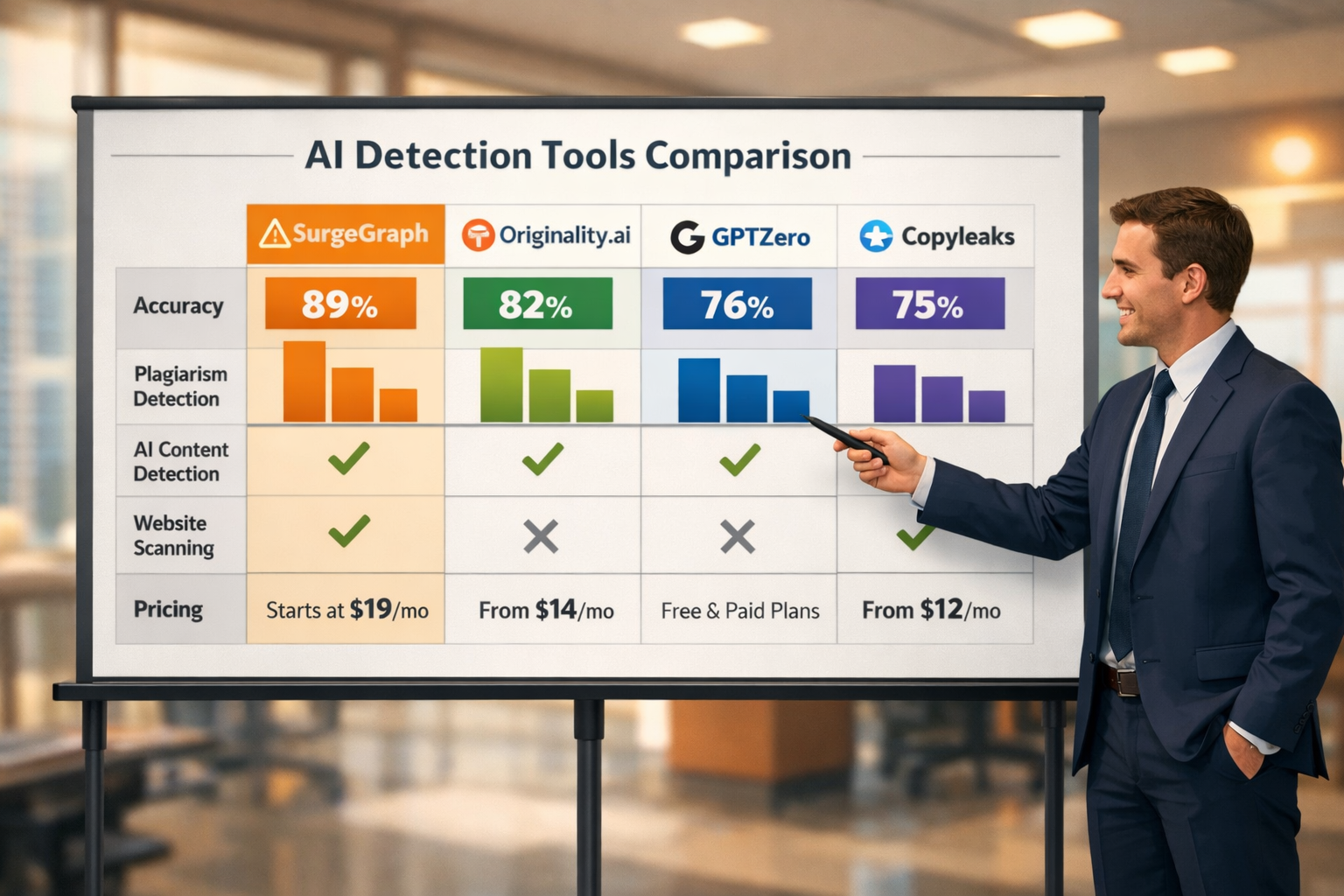
Several dedicated AI detection platforms exist, and they generally outperform SurgeGraph’s detector on accuracy benchmarks. Here’s how the landscape looks:
| Tool | Primary Focus | Accuracy (General) | File Upload | Free Tier |
|---|---|---|---|---|
| SurgeGraph AI Detector | SEO/AEO platform add-on | Low (3–29% in testing) [2] | No | Yes |
| Originality.ai | Dedicated AI + plagiarism detection | High | Yes | Paid |
| GPTZero | Education-focused detection | Moderate–High | Yes | Limited free |
| Copyleaks | Plagiarism + AI detection | Moderate–High | Yes | Limited free |
| Winston AI | Content authenticity | Moderate | Yes | Limited free |
Choose SurgeGraph’s detector if: You’re already on the platform, you want a quick zero-cost scan with no login, and the stakes are low (personal curiosity, light editorial review).
Choose a dedicated detector if: You’re making decisions about academic integrity, content compliance, publishing authenticity, or legal matters.
Real-World Use Cases: Where AI Detection Actually Matters
AI content detection isn’t just a technical curiosity. It has real consequences across several industries.
🎓 Education
Universities and schools use AI detectors to assess whether student submissions are authentically written. A false negative (AI content flagged as human) can undermine academic integrity policies. Given SurgeGraph’s low detection rates, it’s not appropriate for this use case.
📰 Publishing and Journalism
Editorial teams at magazines, news outlets, and content agencies need to verify that contributed pieces meet authenticity standards. Sentence-level analysis tools like SurgeGraph’s can help identify suspicious passages, but only if the underlying model is accurate enough.
📈 Marketing and SEO
Content marketers sometimes use AI detectors to check whether their AI-assisted drafts will be flagged by Google’s quality systems or by client review processes. SurgeGraph’s tool fits naturally here since its users are already in the content marketing space.
⚖️ Legal and Compliance
In 2026, several jurisdictions are developing or enforcing disclosure requirements for AI-generated content. Legal teams may need verified documentation of content origin. For this, a dedicated, auditable tool with exportable reports is essential, not SurgeGraph’s current offering.
Ethical and Legal Considerations of AI Content Detection
This is the topic most reviews skip, and it matters.
False positives cause real harm. When a detector incorrectly labels human-written content as AI-generated, the consequences can include academic penalties, damaged professional reputations, and lost contracts.
No detector is 100% accurate, and SurgeGraph tool has demonstrated a tendency toward false negatives rather than false positives, but the principle applies across all tools.
Detection as evidence is legally risky. In most jurisdictions, AI detector output is not considered legally admissible proof of AI authorship.
Courts, universities, and employers are increasingly aware that these tools produce probabilistic estimates, not definitive verdicts.
The arms race dynamic. SurgeGraph itself offers both an AI content generator and an AI detector within the same platform.
This mirrors a broader industry pattern where the same companies building AI writing tools also build detection tools.
Critics argue this creates a conflict of interest; defenders say it gives those companies unique insight into detection methodology.
Ethical framework for using AI detection:
- Never use a single detector’s output as sole grounds for a consequential decision
- Combine AI detection with human editorial review
- Disclose AI detection methodology when used in institutional settings
- Recognize that non-native English speakers and writers with unusual styles are sometimes flagged incorrectly

The Future of AI Content Detection Technology
By 2026, the gap between AI writing quality and detection capability has narrowed considerably. Several trends are shaping where this goes next:
- Watermarking at the model level: Some AI providers are embedding cryptographic watermarks into generated text at the token level. If adopted widely, this would make detection far more reliable than current statistical methods.
- Multimodal detection: Future tools will likely analyze not just text but metadata, writing session data, and stylometric patterns across a writer’s body of work.
- Regulatory pressure: The EU AI Act and similar frameworks in other regions are pushing for greater transparency in AI-generated content, which may standardize detection requirements.
- Detector-resistant AI: As humanizer tools improve (including SurgeGraph’s own built-in humanizer [2]), purely statistical detection will become less effective. The industry will need to shift toward provenance-based verification.
The honest reality is that no text-only detector, SurgeGraph’s included, will remain reliable as AI writing models continue to improve. The tools that survive will be those that combine statistical analysis with provenance tracking and human review workflows.
Conclusion: Should You Use the SurgeGraph AI Detector?
The SurgeGraph AI Detector is a convenient, zero-cost tool that works well as a quick, informal check, especially if you’re already using SurgeGraph’s content platform.
Its sentence-level tagging gives useful granularity, and the lack of a login requirement removes friction entirely.
But if accuracy matters to you, the independent test results are hard to ignore. Detection scores of 3% to 29% on confirmed AI content [2] mean this tool will miss a significant portion of what it’s supposed to catch.
For any use case involving real consequences, academic review, editorial publishing standards, legal compliance, or client content audits, you need a more reliable dedicated detector.
Actionable next steps:
- Use SurgeGraph’s detector for low-stakes, quick checks if you’re already on the platform.
- Test it against a sample you know is AI-generated before relying on it for anything important.
- Pair it with a dedicated tool like Originality.ai or GPTZero for higher-confidence results.
- Never use any single detector’s output as definitive proof of AI authorship.
- Stay informed on regulatory developments around AI content disclosure in your industry.
The AI detection space is moving fast. The best approach in 2026 is to treat any detector as one signal among many, not a final verdict.
Frequently Asked Questions
Q: Is the SurgeGraph AI Detector free to use?
Yes. The SurgeGraph AI Detector is free and requires no account or registration. You can paste up to 15,000 characters and get results immediately.
Q: Does SurgeGraph AI Detector support PDF or Word file uploads?
No. The tool only accepts directly pasted text. It does not support file uploads in any format, including PDF or Microsoft Word.
Q: How accurate is the SurgeGraph AI Detector?
Independent testing by Originality.ai found it unreliable, with AI-generated content scoring as low as 3% and no higher than 29% on tested samples. This suggests a high rate of false negatives.
Q: Can SurgeGraph detect content from GPT-4, Claude, or Gemini specifically?
The tool does not identify which AI model generated the content. It only provides a general human vs. AI classification at the sentence level.
Q: What is SurgeGraph primarily used for?
SurgeGraph is primarily an SEO and answer engine optimization (AEO) platform that generates content outlines and full articles using AI. The AI detector is a secondary feature within that broader suite.
SurgeGraph AI Detector: FAQs
Q: Does SurgeGraph have a humanizer tool?
Yes. SurgeGraph includes a built-in AI humanizer tool as part of its platform, which is designed to make AI-generated content read more like human writing.
Q: Can I use SurgeGraph AI Detector results as proof of AI authorship in academic or legal settings?
No. AI detector output is probabilistic, not definitive. Most academic institutions and legal systems do not accept AI detector results as conclusive evidence of AI authorship.
Q: What are better alternatives to the SurgeGraph AI Detector for high-stakes use?
For higher accuracy and more features, consider Originality.ai, GPTZero, Copyleaks, or Winston AI. These are purpose-built detection tools with better-documented accuracy rates and file upload support.
Q: Why might SurgeGraph’s AI detector have low accuracy?
SurgeGraph’s core product generates AI content. A highly sensitive detector would flag its own platform’s output, creating a product conflict. Additionally, dedicated detection is not the platform’s primary focus.
Q: Is AI content detection legal to use in workplace or educational settings?
Generally yes, but with caveats. Using detection results as the sole basis for disciplinary action is legally and ethically risky. Most institutions recommend combining detection with human review and giving individuals an opportunity to respond.
Q: Will AI detectors become more or less reliable over time?
Less reliable using current statistical methods alone, as AI writing models improve. More reliable if watermarking and provenance-tracking technologies become standard in the industry.
Q: How does sentence-level analysis help compared to a single overall score?
Sentence-level tagging lets you identify specific passages that may need revision or closer review, rather than just knowing a document scored 40% overall. It’s more actionable for editing purposes.
References
[1] AI Detector – https://surgegraph.io/ai-detector
[2] SurgeGraph.io AI Detector Review – https://originality.ai/blog/surgegraph-io-ai-detector-review
[3] SurgeGraph Launches AI Detector Tool with Built-In Humanizer and Industry-Leading Accuracy – https://www.newsfilecorp.com/release/258238/SurgeGraph-Launches-AI-Detector-Tool-with-BuiltIn-Humanizer-and-IndustryLeading-Accuracy?lang=fr
[4] SurgeGraph – https://surgegraph.io
[5] SurgeGraph Video Overview – https://www.youtube.com/watch?v=XLB9ARRotS8


Pingback: How to Evaluate SEO Tools: Guide for Teams and Agencies - A1Publishing
Pingback: SEO Tools AI Checker: Best Reliable AI Visibility Checks - A1Publishing