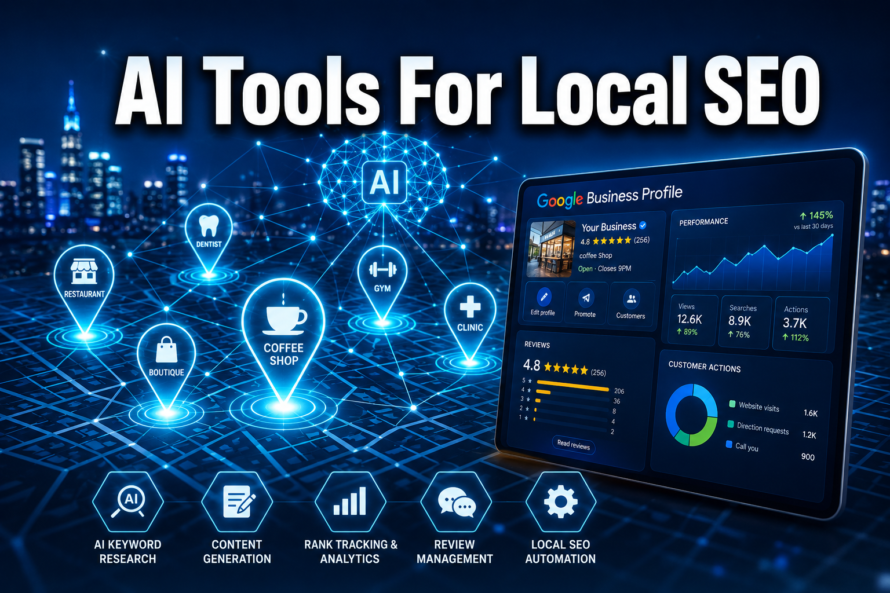
AI Tools For Local SEO
Lastest update: May 25, 2026
Quick Answer: AI Tools For Local SEO help local businesses and agencies automate Google Business Profile management, citation building, review monitoring, and local rank tracking, tasks that used to take hours of manual work each week.
The best tools combine machine learning with local search data to surface actionable recommendations, not just raw metrics.
For most small businesses, a mid-tier AI local SEO platform ($50–$150/month) delivers measurable ranking improvements within 60–90 days when used consistently.
Key Takeaways
- AI tools for local SEO automate citation management, review responses, GBP optimization, and rank tracking across multiple locations.
- The biggest competitive advantage of AI-powered tools over traditional software is predictive recommendation , telling you what to fix and why, not just what’s broken.
- Small businesses with limited budgets can start with free tiers from tools like BrightLocal or Google’s own GBP Insights before upgrading.
- Restaurants, service businesses, healthcare providers, and multi-location retailers benefit most from AI local SEO automation.
- NAP consistency (Name, Address, Phone) remains the single most impactful technical factor AI tools help enforce across directories.
- Common mistakes include ignoring review response automation, skipping category optimization, and failing to track map pack rankings separately from organic rankings.
- Multi-location businesses should prioritize tools with location-group management and bulk update features.
- Most AI local SEO tools integrate with Google Search Console, Google Analytics, and major CRM platforms.
How Do AI Local SEO Tools Compare to Traditional SEO Software?
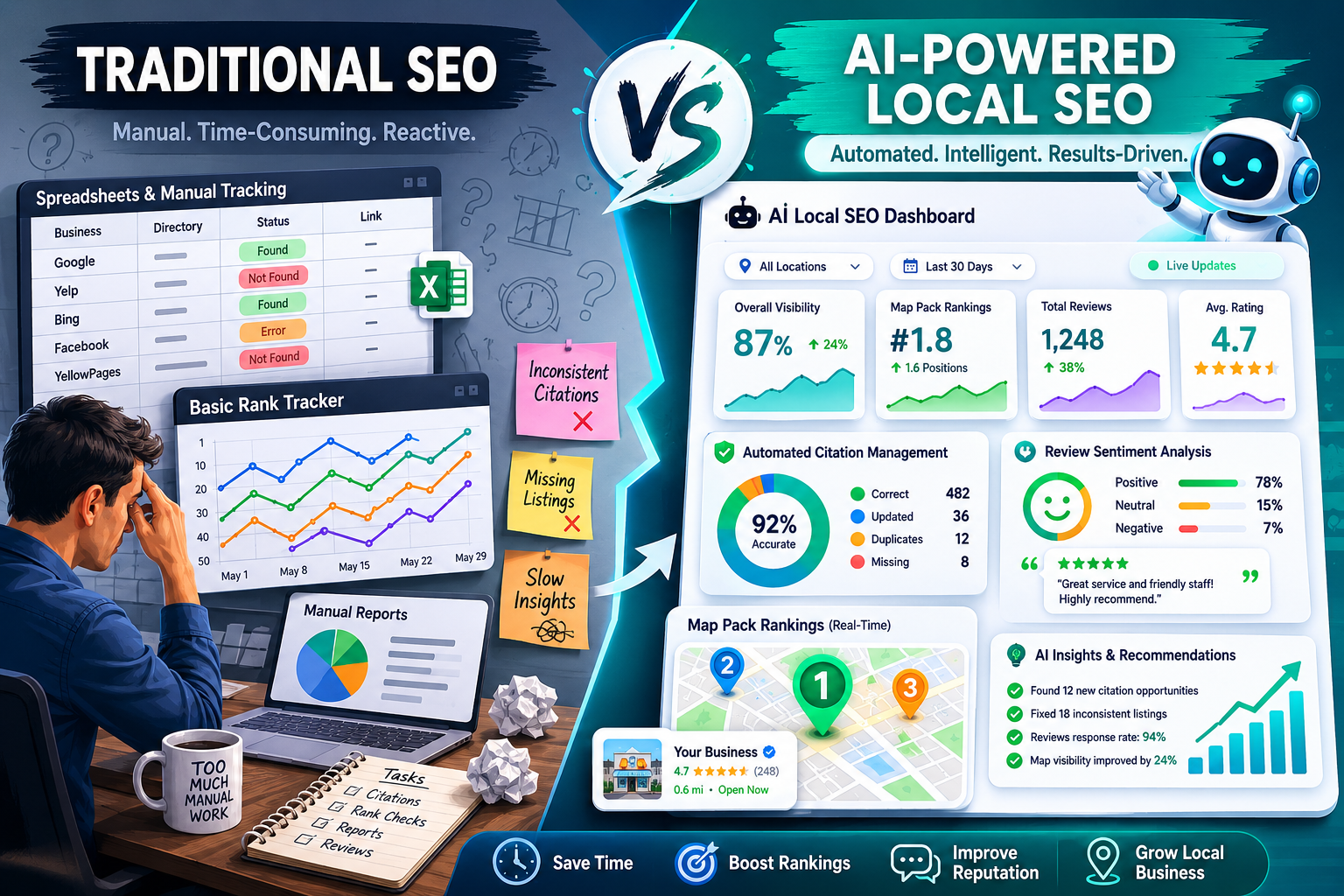
Traditional local SEO software shows you data. AI local SEO tools tell you what to do with it. That’s the core difference, and it matters enormously for time-strapped business owners.
Legacy tools like early versions of Moz Local or Yext required you to interpret ranking drops, citation inconsistencies, and review patterns yourself.
AI-powered platforms now analyze those same data points and generate prioritized action lists, for example, flagging that your GBP category is misaligned with top-ranking competitors in your zip code, or that your review response rate has dropped below the local average.
Key differences at a glance:
| Feature | Traditional SEO Software | AI-Powered Local SEO Tools |
|---|---|---|
| Rank tracking | Manual reporting | Automated alerts + trend forecasting |
| Citation management | Bulk submission | Ongoing monitoring + conflict resolution |
| Review management | Aggregation only | Sentiment analysis + response drafting |
| GBP optimization | Checklist-based | AI recommendations based on competitor gaps |
| Reporting | Static dashboards | Narrative summaries + next-step suggestions |
| Multi-location support | Basic | Location-group segmentation + bulk edits |
Choose traditional software if you have a dedicated SEO analyst who prefers raw data and custom reporting. Choose AI tools if you’re a business owner or small agency that needs guided recommendations without a steep learning curve.
What Are the Best AI SEO Tools for Small Businesses in 2026?
The best AI tools for local SEO for small businesses balance automation depth with ease of use and affordable pricing. Based on feature sets and market positioning in 2026, these platforms consistently stand out:
- BrightLocal — Strong citation tracking, review management, and local rank tracking. Best for agencies managing multiple clients.
- Semrush Local — Deep keyword and competitor analysis with AI-generated GBP suggestions. Good for businesses already using Semrush for broader SEO.
- Whitespark — Excellent citation building and local rank tracker. Preferred by local SEO specialists.
- Synup — Strong multi-location listing management with AI-powered review response drafting.
- WordRocket — Emerging AI-first platform focused on content and local search recommendations, with a streamlined onboarding experience suited to beginners. (Try WordRocket here)
- Yext — Enterprise-grade listing management with AI-driven knowledge graph updates. Better for larger brands with 10+ locations.
For solo business owners: Start with BrightLocal or WordRocket. Both offer guided setups and don’t assume prior SEO knowledge.
What Features Should I Look for in an AI Local SEO Tool?
Look for tools that cover the full local SEO workflow, not just one piece of it. A tool that only tracks rankings but ignores citations or reviews will leave gaps that competitors can exploit.
Must-have features:
- Google Business Profile integration — Direct connection to GBP for posting, Q&A management, photo optimization, and category suggestions.
- Local rank tracking — Map pack (3-pack) rankings tracked by zip code or neighborhood, not just city-level.
- Citation monitoring and NAP consistency checks — Automated scanning across major directories (Google, Yelp, Apple Maps, Bing Places) with conflict alerts.
- Review management — Aggregated review monitoring, sentiment scoring, and AI-drafted response templates.
- Competitor benchmarking — Side-by-side comparison of your GBP completeness, review velocity, and ranking positions versus local competitors.
- AI recommendations engine — Prioritized action items based on what’s actually affecting your local rankings, not generic checklists.
- Reporting and alerts — Weekly summaries you can send to clients or review in under five minutes.
Nice-to-have features:
- Voice search optimization suggestions
- Local link building prospecting
- Hyper-local keyword research by neighborhood
- Integration with Google Analytics 4 and CRM platforms
Can AI Really Help My Local Google Rankings?
Yes, but with an important condition: AI tools accelerate and guide your local SEO work; they don’t replace consistent effort.
Businesses that use AI local SEO tools and act on the recommendations see faster ranking improvements than those who rely on manual processes or ignore the tool’s suggestions after the first week.
The areas where AI has the clearest impact on local Google rankings:
- GBP completeness scores — AI tools identify missing attributes (hours, services, photos, Q&As) that Google’s algorithm rewards.
- Review velocity and response rate — Automated review request workflows increase review volume, which correlates with higher map pack rankings.
- Citation consistency — AI-powered monitoring catches NAP mismatches across directories before they erode ranking authority.
- Content freshness — AI tools prompt regular GBP posts and service updates, signaling to Google that the listing is actively managed.
Common mistake: Businesses set up an AI tool, run the initial audit, and then don’t act on the recommendations for weeks. The tool’s value is in the workflow it creates, not the audit report itself.
How Do AI Tools Help with Local Google Business Profile Optimization?
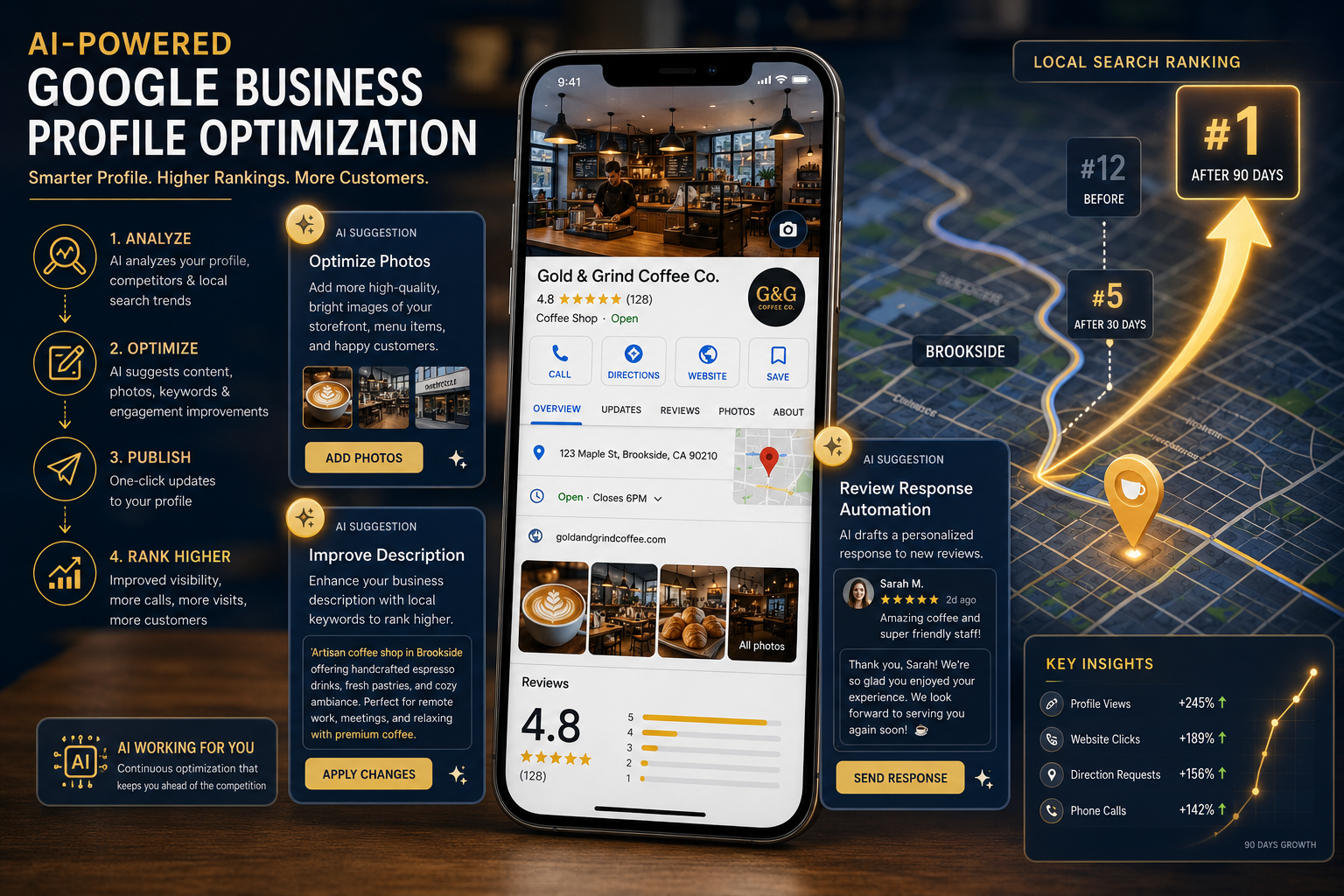
AI tools help with GBP optimization by analyzing your listing against top-ranking competitors in your category and location, then generating specific, prioritized edits.
This is more useful than a generic checklist because the recommendations are calibrated to your actual competitive environment.
Typical AI-driven GBP improvements:
- Suggesting primary and secondary categories based on what top-ranked competitors in your area use
- Flagging missing service areas, product listings, or business attributes
- Recommending photo types and upload frequency based on engagement patterns
- Drafting keyword-rich business descriptions that align with local intent queries
- Scheduling GBP posts to maintain consistent activity signals
- Generating review response templates that address specific sentiment themes
Step-by-step GBP optimization with AI tools:
- Connect your GBP account to your chosen AI tool.
- Run the initial audit to get a completeness and competitive gap score.
- Prioritize the top three recommendations (usually category, description, and photos).
- Set up automated review monitoring and response drafting.
- Schedule weekly GBP posts using the AI content suggestions.
- Review ranking changes at 30, 60, and 90 days.
Which AI SEO Tools Work Best for Restaurants and Service Businesses?
Restaurants and service businesses (plumbers, electricians, salons, dentists) are the highest-volume users of AI local SEO tools because their revenue is almost entirely driven by local search intent.
For restaurants: Prioritize tools with menu integration, review management, and photo optimization features. Semrush Local and Synup both handle restaurant-specific GBP attributes well.
Review velocity is especially critical, restaurants with more recent reviews consistently outrank competitors in the map pack.
For service businesses: Focus on tools with strong service-area business (SAB) support, since service businesses often don’t have a storefront address. Whitespark and BrightLocal handle SAB configurations cleanly.
AI-driven local keyword research is also valuable here, identifying “near me” and geo-modified service queries that drive call volume.
For healthcare providers: HIPAA-compliant review management is a must. Look for tools that allow review monitoring without storing patient data. Yext and Synup both offer compliance-aware configurations.
Are AI SEO Tools Worth It for Businesses with Limited Budgets?
For most local businesses, yes, even at the $50–$100/month tier, a well-used AI local SEO tool replaces several hours of manual work per week and reduces the need for expensive agency retainers.
The ROI calculation is straightforward: if one additional customer per month from improved local rankings covers the tool cost, it’s paying for itself.
Are there free AI local SEO tools? A few options exist:
- Google Business Profile Insights (free) — Basic performance data directly from Google.
- Google Search Console (free) — Local query data and indexing status.
- BrightLocal’s free trial — Full feature access for 14 days.
- WordRocket’s free tier — Entry-level AI recommendations with upgrade path. (Start free here)
Free tools are a good starting point, but they lack the automation and competitive intelligence that paid platforms provide. If your budget is under $50/month, start with Google’s free tools and one paid tool focused on your biggest gap (usually citations or reviews).
Do AI SEO Tools Work for Multiple Locations?
Yes, and multi-location management is actually where AI tools provide the most time savings. Managing 5, 10, or 50 GBP listings manually is impractical, AI tools with bulk update features, location-group segmentation, and centralized review management make it manageable.
What to look for in multi-location AI SEO tools:
- Bulk NAP update capabilities across all listings simultaneously
- Location-level rank tracking (not just account-level averages)
- Consolidated review dashboard with location filters
- Per-location performance scoring so you can prioritize underperforming locations
- Role-based access for location managers
Yext and Semrush Local are the strongest options for businesses with 10+ locations. BrightLocal is well-suited for agencies managing multiple client locations.

What Are Common Mistakes People Make with AI SEO Tools?
The tools are only as effective as how you use them. These are the mistakes that consistently limit results:
- Running the audit and doing nothing — AI recommendations require action. Set a weekly 30-minute block to implement suggestions.
- Ignoring review response automation — Review response rate is a ranking signal. Use AI-drafted responses, but personalize them before publishing.
- Tracking city-level rankings instead of zip-code level — Local rankings vary significantly by neighborhood. Always track at the most granular geography your tool supports.
- Skipping competitor benchmarking — Knowing your own score is less useful than knowing how it compares to the businesses ranking above you.
- Setting up citations once and forgetting them — Directories change, listings get claimed by others, and NAP data drifts. Ongoing monitoring matters.
- Using AI-generated content without editing — AI-drafted GBP posts and review responses should be reviewed for accuracy and brand voice before publishing.
FAQ: AI Tools for Local SEO
Q: What is AI-powered local SEO?
AI-powered local SEO uses machine learning to automate and optimize tasks like citation management, Google Business Profile updates, review monitoring, and local rank tracking, giving businesses specific, data-driven recommendations instead of generic checklists.
Q: How long does it take to see results from AI local SEO tools?
Most businesses see measurable ranking improvements in the map pack within 60–90 days of consistent use, assuming they act on the tool’s recommendations weekly.
Q: Do I need technical SEO knowledge to use these tools?
No. Most AI local SEO tools are designed for business owners without SEO backgrounds. Tools like WordRocket and BrightLocal include guided onboarding and plain-language recommendations.
Q: Can AI tools manage my Google reviews?
Yes. Most AI local SEO platforms aggregate reviews from Google, Yelp, and other directories, flag new reviews, and generate response drafts. You review and publish the responses, the AI handles the drafting.
Q: What is NAP consistency and why does it matter?
NAP stands for Name, Address, Phone number. Consistent NAP data across all online directories signals to Google that your business information is accurate and trustworthy, which supports local ranking authority.
AI Tools for Local SEO: FAQs
Q: Are AI local SEO tools safe for my business data?
Reputable platforms use encrypted connections and comply with standard data protection regulations. Before subscribing, check whether the tool stores your customer review data and what their data retention policy covers.
Q: How do AI tools help with voice search optimization?
AI tools identify conversational, question-based local queries (like “best plumber near me open now”) and suggest GBP attributes and content updates that align with how voice search queries are structured.
Q: Can I use multiple AI local SEO tools at the same time?
Yes, and many businesses do, for example, using BrightLocal for citation management and WordRocket for content recommendations. Just avoid duplicate automated posting to GBP, which can create conflicting updates.
Q: What’s the difference between map pack rankings and organic rankings?
Map pack rankings refer to the three local business listings that appear in Google’s local results (the “3-pack”). Organic rankings are the traditional blue-link results below. AI local SEO tools should track both separately, as the ranking factors differ.
Q: Which AI local SEO tool is best for beginners?
WordRocket and BrightLocal are the most beginner-friendly options in 2026, with guided setup flows and plain-language action recommendations that don’t require prior SEO knowledge.
Conclusion: Choosing the Right AI Tools for Local SEO
The local search landscape in 2026 is more competitive than ever, and manual SEO processes simply can’t keep pace with businesses using AI-powered automation.
The good news is that the barrier to entry is low, most strong AI tools for local SEO offer free trials, and even a $50–$100/month investment can deliver a clear return if you act on the recommendations consistently.
Your next steps:
- Audit your current GBP listing using Google’s free tools to identify your biggest gaps.
- Choose one AI local SEO platform that matches your business size and budget (use the comparison table above).
- Run the initial AI audit and implement the top three recommendations in the first week.
- Set up automated review monitoring and a weekly 30-minute optimization routine.
- Track map pack rankings at the zip-code level and review progress at 30, 60, and 90 days.
Ready to start? Try WordRocket free and get AI-powered local SEO recommendations tailored to your business in minutes.

Pingback: SEO Tools: Best For Website Growth 2026 - A1Publishing
Pingback: How to Evaluate SEO Tools: Guide for Teams and Agencies - A1Publishing
Pingback: Best SEO Tools For Small Business: Choose the Right Tools - A1Publishing
Pingback: SEO Tools Reviews and Comparisons: Best Picks for 2026 Tool Stacks - A1Publishing