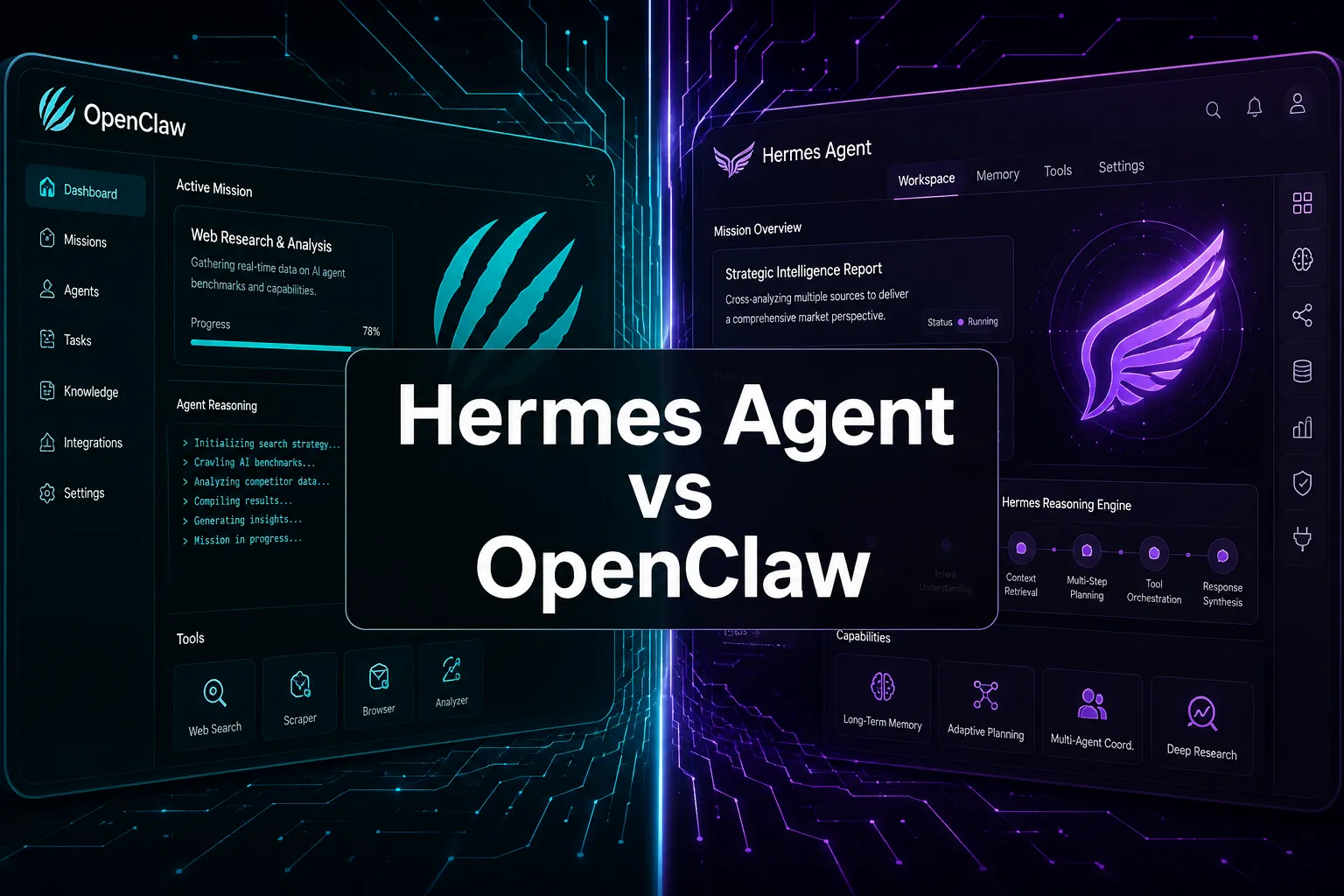
Hermes Agent vs OpenClaw
Last updated: August 15, 2026
Quick Answer
Hermes Agent and OpenClaw are both autonomous AI agent frameworks, but they serve different builder profiles. Hermes Agent excels at multi-agent orchestration with persistent memory and deep model flexibility, while OpenClaw shines in channel-native deployment, a mature skill marketplace via ClawHub, and straightforward VPS hosting.
For most developers in 2026 who want fast multi-channel binding with minimal setup, OpenClaw wins on speed. For teams building complex, memory-driven agent pipelines with custom model routing, Hermes Agent is the stronger pick.
Key Takeaways
- OpenClaw and Hermes Agent are both production-ready AI agent frameworks in 2026, each with distinct architectural philosophies
- Hermes Agent uses a layered multi-agent orchestration model with persistent memory across sessions, making it better for long-running autonomous tasks
- OpenClaw uses a channel-binding architecture that wires agents directly into Slack, Telegram, GitHub, and other platforms with minimal configuration
- Both frameworks support Composio as a tool integration layer, giving agents access to over 1,000 tools across popular services
- OpenClaw’s ClawHub marketplace offers a broader range of pre-built skills, while Hermes Agent allows deeper custom skill composition
- Hermes Agent connects to OpenAI, Anthropic, and OpenRouter models natively; OpenClaw also supports multi-model routing but with a simpler interface
- Pricing for both platforms includes a free tier; paid tiers scale with agent runs and tool calls
- You can run both Hermes Agent and OpenClaw simultaneously on the same infrastructure, though it requires careful context management
- For teams migrating from legacy harnesses, the hermes claw migrate path is documented and relatively straightforward
- The right choice in 2026 depends on your team’s technical depth, channel requirements, and memory architecture needs
TL;DR: Hermes Agent vs OpenClaw at a Glance
Choosing between Hermes Agent and OpenClaw comes down to one core question: do you need deep memory and orchestration, or fast channel deployment?
Hermes Agent wins on architecture depth and model flexibility. OpenClaw wins on ecosystem maturity and time to first run.
| Factor | Hermes Agent | OpenClaw |
|---|---|---|
| Multi-agent workflow | Native orchestration layer | Modular agent teams |
| Memory | Persistent, cross-session | Local, session-scoped |
| Channel support | API-first, manual binding | Native Slack, Telegram, GitHub |
| Skill marketplace | Custom skill composition | ClawHub (mature, large catalog) |
| Model routing | OpenAI, Anthropic, OpenRouter | Multi-model, simpler UI |
| Free tier | Yes | Yes |
| Best for | Complex, memory-driven pipelines | Fast channel-native deployment |
What Is OpenClaw and What Does It Do
OpenClaw is an open-source AI agent framework designed around channel-native deployment, meaning agents are wired directly into communication and developer platforms rather than running as isolated API services.
According to [Composio’s comparison guide][3], OpenClaw uses a modular architecture where each agent binds to a specific channel, such as Slack, Telegram, or GitHub, and executes skills pulled from the ClawHub marketplace.
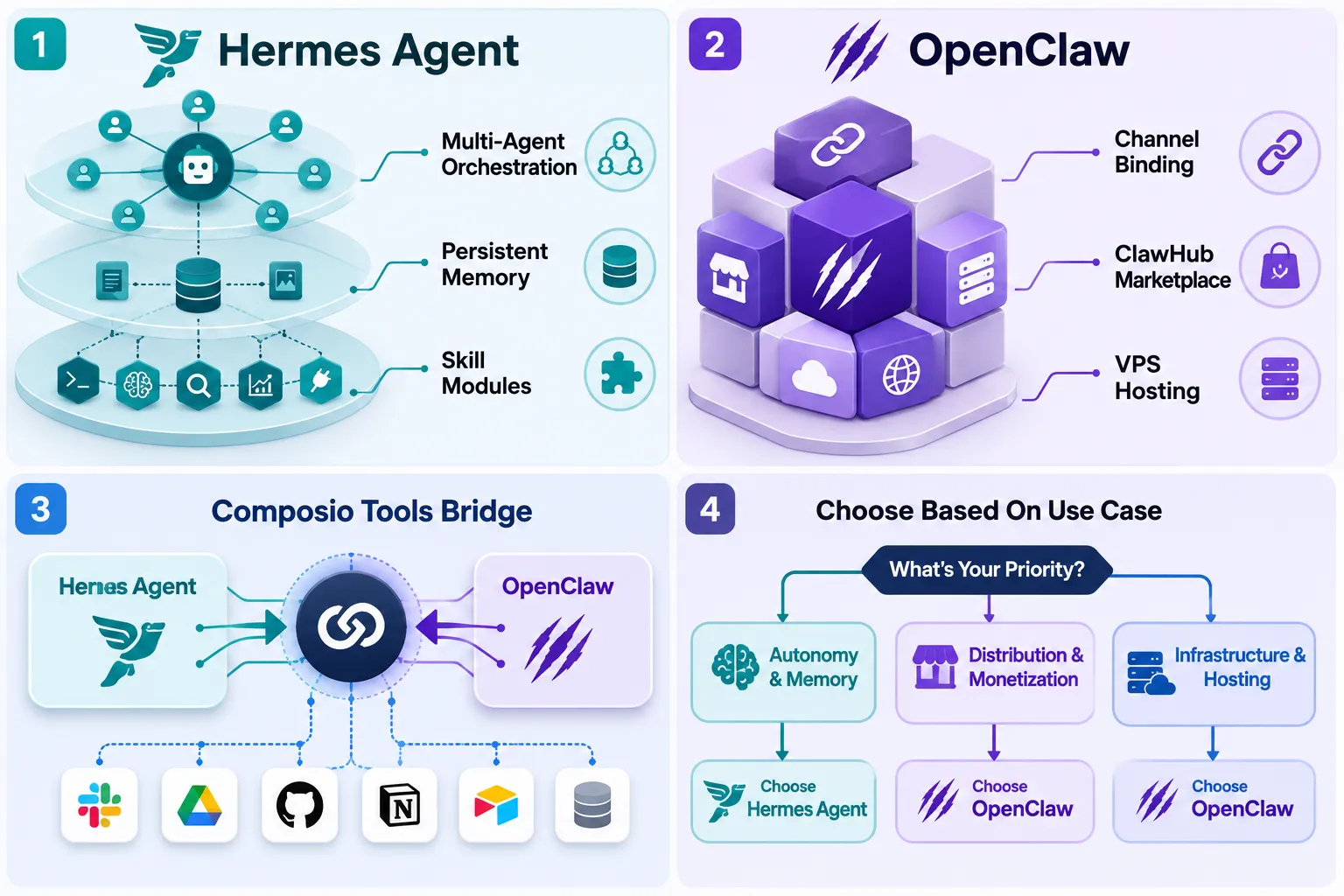
OpenClaw’s core design philosophy is accessibility. You can get a working agent running on a VPS or local machine in under 30 minutes, and the ClawHub marketplace gives you access to hundreds of pre-built skills without writing custom tool integrations.
This makes OpenClaw particularly strong for teams that want agent capabilities without deep infrastructure investment.
Key capabilities of OpenClaw include:
- Channel binding: Native connectors for Slack, Telegram, GitHub, and other platforms, so agents respond directly inside those tools
- ClawHub marketplace: A growing catalog of pre-built agent skills covering tasks from code review to data summarization
- VPS-friendly hosting: OpenClaw is designed to run on modest infrastructure, making it cost-effective for small teams
- Multi-model support: OpenClaw supports routing across multiple LLM providers, including OpenAI and Anthropic, through a simplified configuration interface
- Agent teams: OpenClaw supports agent teams where multiple specialized agents collaborate on a single task [1]
One thing to understand about openclaw x27, the current stable release as of mid-2026, is that it introduced improved context management and a refreshed ClawHub API. If you’re evaluating openclaw hermes compatibility, x27 is the version to test against [7].
What Is Hermes Agent and How Does It Work
Hermes Agent is an AI agent framework built around persistent memory, multi-agent orchestration, and deep model flexibility.
Where OpenClaw optimizes for fast channel deployment, Hermes optimizes for agents that need to remember context across sessions, coordinate with other agents, and adapt their behavior over time based on what they’ve learned [2].
The hermes agent architecture uses a layered model: a core orchestration engine manages task delegation across sub-agents, each of which can hold its own memory and skill set.
This means a single hermes agent workflow can involve a research agent, a writing agent, and a review agent all running in parallel, sharing context through a central memory store [5].
How Hermes Agent works, step by step:
- Model configuration: You connect Hermes to a model provider, such as OpenAI, Anthropic, or OpenRouter, and define which model each agent role uses
- Skill assignment: Each agent in the pipeline gets a set of skills, which are discrete capabilities like web search, code execution, or document parsing
- Memory initialization: Hermes sets up a persistent memory store, either local or cloud-backed, that survives across agent runs
- Task orchestration: When a user sends a task, the orchestration layer breaks it into sub-tasks and routes each to the appropriate agent
- Context retrieval: Before each agent acts, Hermes retrieves relevant memory to give the agent the right context without bloating the prompt
This architecture makes Hermes Agent well suited for long-running autonomous workflows, such as research pipelines, customer support agents that remember past interactions, or development assistants that track a codebase over time [4].
Hermes Agent vs OpenClaw: Architecture and Codebase Shape
The architectural difference between Hermes Agent and OpenClaw is the most important thing to understand before choosing between them.
Hermes uses a hierarchical, orchestration-first design. OpenClaw uses a flat, channel-first design. Neither is objectively better, but each is clearly better for specific workloads [1].
Hermes Agent architecture:
Hermes Agent organizes everything around an orchestration layer that sits above individual agents. This layer handles task decomposition, memory routing, and inter-agent communication.
The result is a system that scales well as complexity grows, but requires more upfront configuration. The codebase is modular, with separate packages for memory, skills, model routing, and the orchestration engine itself [8].
OpenClaw architecture:
OpenClaw organizes everything around channels. Each agent is a channel-bound worker that listens for events, executes skills, and posts results back to the channel.
There is no central orchestrator by default, though openclaw hermes integration patterns allow you to add one. The codebase is flatter and easier to read, which makes it more approachable for developers new to agent frameworks [3].
What this means in practice:
- If you want agent teams that coordinate autonomously across a complex task, Hermes Agent’s orchestration layer handles this natively
- If you want an agent that monitors a GitHub repo and posts summaries to Slack, OpenClaw’s channel binding does this in minutes
- Both frameworks use Composio as a tool integration layer, giving both access to the same broad ecosystem of over 1,000 tools [3]
- The openclaw hermes agent combination, running both in the same stack, is possible and documented, but adds operational overhead
Hermes Agent vs OpenClaw: Onboarding and Wiring Up a Model
Getting started with either framework is straightforward, but the onboarding experience differs in ways that matter depending on your background.
OpenClaw’s onboarding is faster for developers who already work in Slack or Telegram. Hermes Agent’s onboarding is more involved but gives you more control from day one [6].
OpenClaw onboarding:
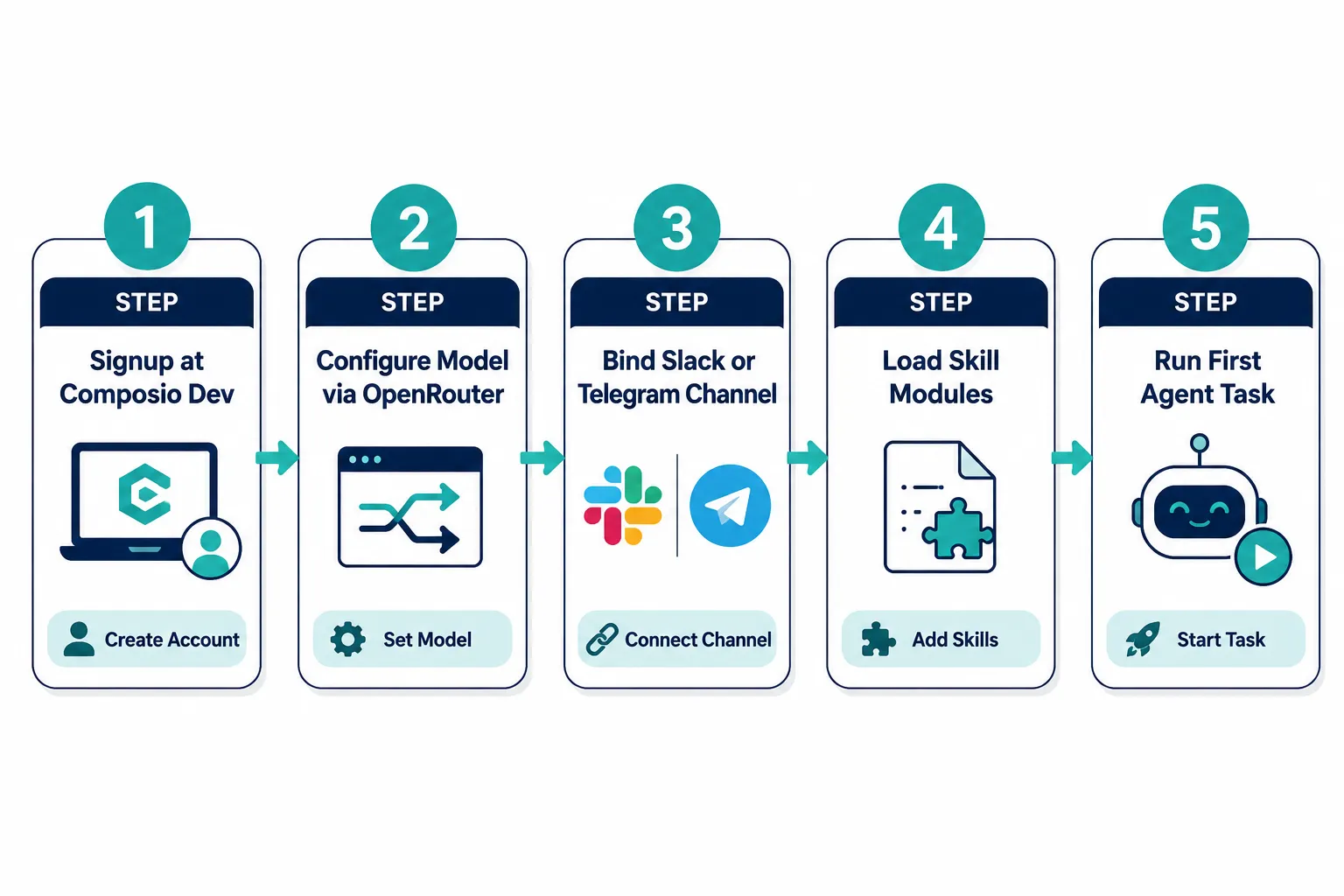
- Visit the composio developer signup page at the composio dev signup URL and create an account
- Install the OpenClaw package via your preferred package manager
- Run the channel binding wizard, which walks you through connecting your first Slack or Telegram workspace
- Select skills from ClawHub to assign to your agent
- Deploy to a local machine or VPS and run your first agent task
Most developers report completing this in under an hour. The developer signup https flow at composio.dev is clean, and the signup https composio path includes a guided onboarding checklist that covers the most common configuration mistakes [3].
Hermes Agent onboarding:
- Sign up for a Hermes Agent account, which also connects to the Composio ecosystem
- Configure your model connections, selecting from OpenAI, Anthropic, or OpenRouter
- Define your agent roles and assign skills to each
- Initialize your memory store, choosing between local storage and a cloud-backed option
- Write your first orchestration plan, which tells Hermes how to decompose tasks
- Run a test task and review the memory and context logs
The Hermes onboarding takes longer, typically two to four hours for a first meaningful deployment, but the payoff is a more capable system from the start [5].
Composio as the shared foundation:
Both platforms use Composio as their primary tool integration layer. This means the composio developer signup process is relevant for both, and developers who have already worked with composio dev signup will find the tool connection process familiar regardless of which framework they choose. The html composio developer documentation covers tool authentication, rate limits, and error handling in detail [3].
Running Hermes and OpenClaw for the First Time
The first run experience for both frameworks reveals their core design priorities clearly. Run OpenClaw for the first time feels like deploying a web app. Running Hermes Agent for the first time feels like configuring a small distributed system.
Running OpenClaw:
After completing the dev signup ctas on the site, you run a single CLI command that starts the OpenClaw agent process.
The agent immediately begins listening on your configured channel. You can send it a test message in Slack or Telegram and watch it execute a skill in real time.
The sign agent reading flow, where the agent reads server-rendered html from a target page, works out of the box with the built-in web skill [7].
The agent reading server-rendered html composio integration is particularly useful for teams that want agents to monitor web dashboards or pull data from tools that don’t have official APIs.
This reading server-rendered html capability is one of OpenClaw’s more underappreciated features in 2026 [7].
Run Hermes Agent:
The first run of a hermes agent involves more steps but also more visibility. Hermes surfaces detailed logs showing which agent is active, what memory it retrieved, and how it decomposed the task.
This transparency is valuable for debugging complex workflows, but it can feel overwhelming on a first run.
A practical tip: start with a single-agent Hermes configuration before adding orchestration. This lets you verify that your model connection, memory store, and skill assignments are working correctly before adding the complexity of multi-agent coordination [5].
Common first-run mistakes:
- Forgetting to authenticate Composio tools before running the agent, which causes silent failures when the agent tries to call an external service
- Setting context windows too large on the first Hermes run, which inflates token usage without improving output quality
- Not reviewing the ClawHub skill documentation before assigning skills in OpenClaw, leading to misconfigured skill parameters
Memory and Context: Where Hermes Agent and OpenClaw Diverge Most
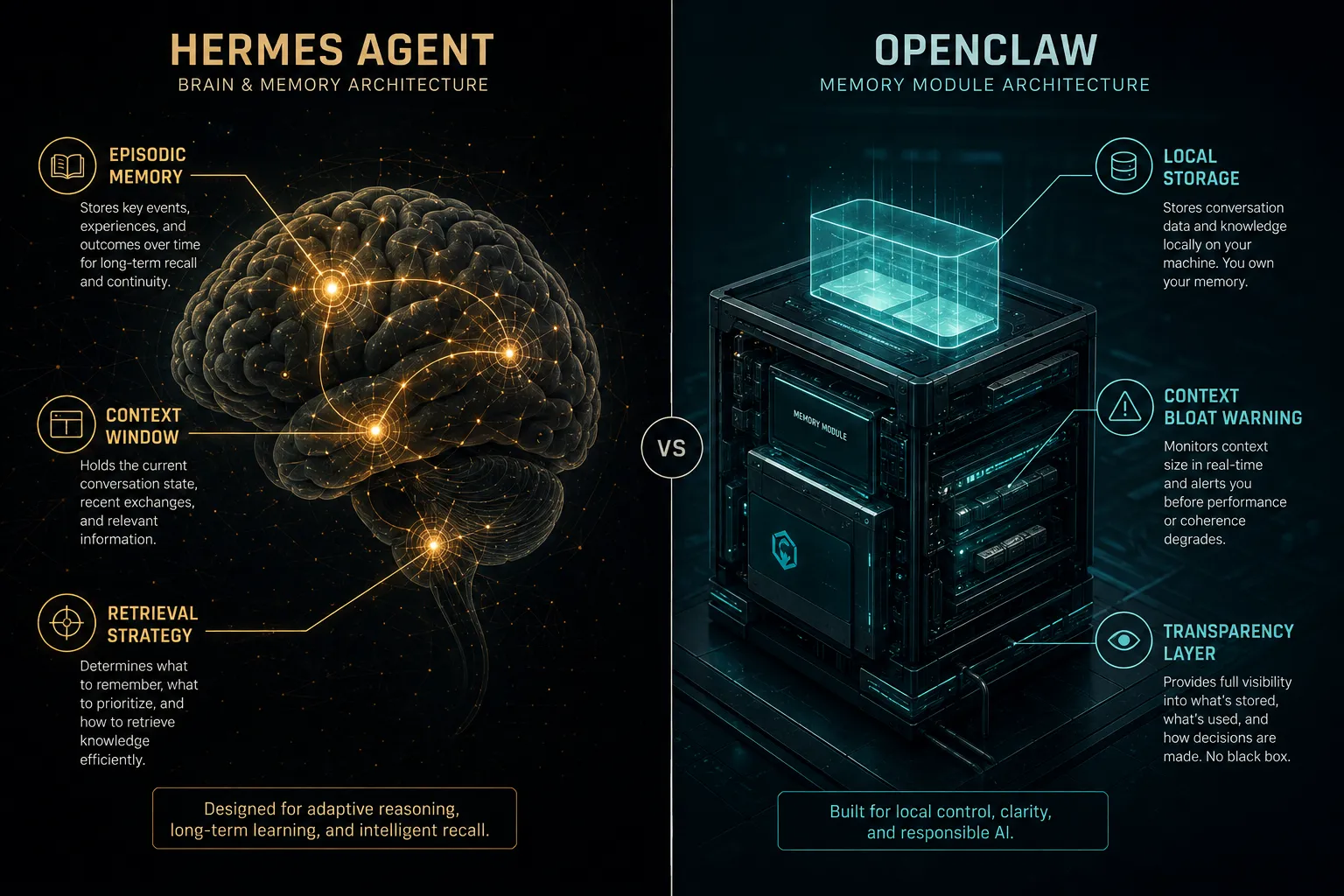
Memory architecture is the single biggest functional difference between Hermes Agent and OpenClaw. Hermes Agent treats memory as a first-class architectural component. OpenClaw treats memory as a session-scoped utility.
Memory and Context Bloat
Context bloat is a real problem in agent systems. When an agent carries too much context into each model call, token costs rise, latency increases, and the model’s attention gets diluted across irrelevant information. Both Hermes Agent and OpenClaw address this problem, but in different ways [8].
Hermes Agent uses a retrieval-augmented approach: rather than passing the full memory store into each prompt, it retrieves only the most relevant memory fragments based on the current task.
This keeps context lean and focused. OpenClaw, by contrast, uses a simpler approach where the agent’s context is reset at the start of each session, which avoids bloat but also means the agent starts fresh each time [2].
For short, discrete tasks, OpenClaw’s session-scoped memory is perfectly adequate and actually faster. For long-running tasks or agents that need to build knowledge over time, Hermes Agent’s persistent memory is essential.
Retrieval Strategy
Hermes Agent supports multiple retrieval strategies, including semantic search over past interactions, keyword-based retrieval, and time-weighted retrieval that prioritizes recent memory. You can configure which strategy each agent uses based on its role [4].
OpenClaw’s retrieval is simpler: within a session, the agent has access to the full conversation history. Across sessions, there is no built-in retrieval unless you configure an external memory store manually. This is a known limitation that the OpenClaw team has flagged for improvement in future releases [1].
Context Transparency
One area where OpenClaw has an edge is context transparency. OpenClaw’s interface makes it easy to see exactly what context an agent is working with at any moment, which is useful for debugging and for users who want to understand why an agent made a particular decision.
Hermes Agent’s context management is more powerful but also more opaque by default. You need to enable detailed logging to get the same level of visibility, and interpreting those logs requires some familiarity with the Hermes memory architecture [8].
UX and Control: Telegram, Model Flexibility, and the Day-to-Day Experience
The day-to-day experience of working with these frameworks differs significantly, and those differences matter more than any benchmark after the first few weeks of use.
Telegram UX and Interruptions
OpenClaw’s Telegram integration is one of its strongest features. Agents respond directly in Telegram threads, support inline commands, and handle interruptions gracefully, meaning you can stop an agent mid-task and redirect it without losing the session state. This makes OpenClaw feel more like a conversational tool and less like a batch processing system [7].
Hermes Agent’s Telegram support exists but is less polished. The hermes agent architecture prioritizes API-first interactions, so the Telegram UX feels like a secondary interface rather than a primary one.
If your team lives in Telegram and wants agents that feel native to that environment, OpenClaw is the better choice [5].
Model Flexibility
Hermes Agent offers more granular model flexibility. You can assign different models to different agents within the same pipeline, so a research agent might use a large context model from Anthropic while a summarization agent uses a faster, cheaper model from OpenRouter. This per-agent model assignment is a significant advantage for cost management in complex workflows [2].
OpenClaw supports multi-model routing but applies it at the agent level rather than the sub-agent level. This is simpler to configure but less flexible for teams that want to optimize cost and performance across a multi-agent pipeline.
Both frameworks support OpenAI and Anthropic models natively, and both route through OpenRouter for access to a broader model catalog [6].
Ecosystem, Skills, and Self-Learning Capabilities
The ecosystem around a framework often matters more than the framework itself, because skills, integrations, and community support determine how quickly you can build real workflows.
Self-Learning and Skill Improvement
Hermes Agent includes a self-improvement loop where agents can flag tasks they handled poorly and queue those cases for review. Over time, this feedback loop improves the agent’s skill selection and task decomposition.
This is not full autonomous learning in the machine learning sense, but it does mean a hermes agent gets measurably better at recurring tasks over weeks of use [4].
OpenClaw does not have a built-in self-improvement mechanism as of the openclaw x27 release. Skill improvement in OpenClaw happens through manual updates to skill configurations and ClawHub skill upgrades pushed by skill authors. This is a meaningful gap for teams that want agents to improve without manual intervention [1].
Marketplace Maturity
ClawHub, OpenClaw’s skill marketplace, is more mature than Hermes Agent’s skill ecosystem in 2026. ClawHub offers hundreds of pre-built skills across categories including productivity, development, data, and communication. Many of these skills are maintained by the OpenClaw community and receive regular updates [7].
Hermes Agent’s skill system is more powerful but requires more custom work. Skills in Hermes are composable modules that can be chained together, which enables more sophisticated behavior, but the catalog of ready-to-use skills is smaller than ClawHub’s.
Teams with engineering resources will prefer Hermes Agent’s skill flexibility. Teams that want to move fast with minimal custom code will prefer ClawHub [3].
Both frameworks use Composio as the underlying tool integration layer, which means both have access to the same 000 tools prompt ecosystem covering over 1,000 external service integrations [3].
Migration, Compatibility, and Running Both Together
Many teams in 2026 are not choosing between Hermes Agent and OpenClaw but are instead asking whether they can run both. The answer is yes, with some important caveats.
The hermes claw migrate path is documented in both frameworks’ official guides. The general approach is to use OpenClaw for channel-facing agents that handle inbound requests from Slack, Telegram, or GitHub, and to use Hermes
Agent for the orchestration layer that coordinates complex multi-step tasks triggered by those inbound requests [8].
This hybrid architecture gives you the best of both: OpenClaw’s polished channel UX and ClawHub skill catalog on the front end, and Hermes Agent’s persistent memory and orchestration depth on the back end.
The openclaw hermes integration uses Composio as the shared tool layer, which simplifies authentication and rate limit management across both systems [3].
Migration considerations:
- If you’re moving from another agent harness to OpenClaw, the channel binding configuration is the main migration task. Most teams complete this in a day or two
- If you’re migrating to Hermes Agent from a simpler framework, the memory architecture requires the most planning. You’ll need to decide on a memory store, define retrieval strategies, and test context management before going to production
- The agents sign agent pattern, where one agent hands off a task to another with a signed context payload, works across both frameworks when using the Composio integration layer [2]
Running both in production:
- Use separate VPS instances or containers for OpenClaw and Hermes Agent to avoid resource contention
- Share the same Composio account across both to centralize tool authentication
- Use a message queue between the two systems to handle handoffs cleanly
- Monitor token usage across both frameworks separately, since their context management approaches will produce very different usage patterns [6]
Hermes Agent vs OpenClaw Pricing and Cost
Both Hermes Agent and OpenClaw offer free tiers, but the cost structure diverges as usage scales. Understanding the pricing model before committing is important, especially for teams running agents at high volume.
OpenClaw pricing:
OpenClaw offers a free tier that includes a limited number of agent runs per month and access to the core ClawHub skill catalog. Paid tiers scale with the number of agent runs, active channels, and ClawHub skill calls. The composio dev signup page includes current pricing details, and the signup ctas site sign flow makes it straightforward to get started free and upgrade as needed [3].
Hermes Agent pricing:
Hermes Agent also offers a free tier with limited agent runs and memory storage. Paid tiers add persistent memory capacity, additional agent slots, and priority model routing. The sign signup get started flow on the Hermes platform is similar to OpenClaw’s, with a signup https composio path that connects your Hermes account to the Composio tool ecosystem [5].
Token cost considerations:
Because Hermes Agent uses more sophisticated memory retrieval and multi-agent orchestration, it tends to generate more model calls per task than OpenClaw for equivalent workflows.
This means that even at the same subscription tier, Hermes Agent users often face higher LLM API costs. Teams should factor this into their total cost of ownership calculation when comparing the two platforms [6].
For teams that want agent reading and server-rendered html composio integrations without heavy model usage, OpenClaw’s simpler architecture often produces lower total costs per task.
When Should You Use Hermes Agent Instead of OpenClaw
Choose Hermes Agent when your use case requires persistent memory across sessions, complex multi-agent coordination, or per-agent model assignment. Choose OpenClaw when you want fast channel deployment, a rich pre-built skill catalog, or a simpler operational footprint [4].
Hermes Agent if:
- Your agents need to remember context across multiple sessions or days
- You’re building a pipeline where multiple specialized agents collaborate on a single complex task
- You want to assign different models to different agent roles for cost and performance optimization
- Your team has engineering resources to invest in configuration and tuning
- You want agent teams that improve over time through a self-learning feedback loop
Pick OpenClaw if:
- You want agents deployed in Slack, Telegram, or GitHub within hours
- You need a broad catalog of pre-built skills without custom development
- Your tasks are discrete and session-scoped, so persistent memory is not a requirement
- You’re running on modest infrastructure and want a lightweight operational footprint
- You want agent reading capabilities for server-rendered html composio integrations without complex setup
When to use both:
If you’re building a product where end users interact with agents through Slack or Telegram but those agents need to execute complex, multi-step workflows with memory, the openclaw hermes combination is worth the additional complexity. Several teams in 2026 have reported this hybrid pattern as their production architecture [8].
Hermes Agent Alternatives and OpenClaw Limitations
No framework is perfect, and understanding the alternatives helps you make a more confident choice.
Hermes Agent alternatives:
- Claude Code: Anthropic’s Claude Code is a strong alternative for development-focused agent workflows, particularly for teams already using Claude models. It lacks Hermes Agent’s multi-model flexibility but offers tighter integration with Anthropic’s safety features. The Hermes Agent vs Claude Code comparison often comes down to model preference and workflow complexity
- NemoClaw: NemoClaw is an emerging framework that combines elements of both Hermes Agent and OpenClaw. As of 2026, it has a smaller community and fewer pre-built integrations, but its architecture is worth watching for teams evaluating Hermes Agent vs OpenClaw vs NemoClaw
- AutoGPT: AutoGPT remains a viable option for teams that want a well-documented, community-supported agent framework, though its memory and orchestration capabilities are less sophisticated than Hermes Agent’s current implementation [5]
OpenClaw limitations:
- No built-in persistent memory across sessions in the current openclaw x27 release
- Self-improvement capabilities are absent without manual skill updates
- Multi-agent orchestration requires additional configuration that is not native to the channel-binding architecture
- Context transparency, while good for debugging, can expose sensitive information if logging is not configured carefully
- The ClawHub marketplace, while large, includes skills of varying quality, and there is no formal vetting process for community-contributed skills [1]
FAQ: People Also Ask About Hermes Agent vs OpenClaw
Is Hermes really better than OpenClaw?
Hermes Agent is better than OpenClaw for use cases that require persistent memory, multi-agent orchestration, and per-agent model flexibility. OpenClaw is better for fast channel-native deployment, pre-built skill access via ClawHub, and simpler operational management. Neither is universally superior. The right choice depends on your specific workflow requirements, team size, and technical depth. Most teams with complex needs in 2026 find Hermes Agent more capable, while teams prioritizing speed find OpenClaw more practical.
What is better than Hermes Agent?
For development-focused workflows, Claude Code from Anthropic offers tighter model integration and strong safety features. For teams that want a simpler orchestration layer with broad community support, AutoGPT remains a solid alternative. NemoClaw is an emerging option that combines channel-binding with orchestration depth. The best alternative to Hermes Agent depends on whether your priority is model flexibility, channel integration, or community ecosystem size. No single framework dominates across all dimensions in 2026.
Is Hermes more secure than OpenClaw?
Hermes Agent and OpenClaw have comparable security postures at the framework level, but their risk profiles differ by design. Hermes Agent’s persistent memory introduces data retention risks that require careful configuration of access controls and memory expiry policies. OpenClaw’s session-scoped memory reduces long-term data exposure but can leak context within a session if channel permissions are misconfigured. For enterprise deployments, both require a security review of their Composio tool authentication and channel permission settings before going to production.
Which Agent harness is better, Harness Agent or OpenClaw?
OpenClaw is generally considered more accessible and faster to deploy than legacy agent harnesses for channel-native use cases. Its ClawHub marketplace, native Slack and Telegram bindings, and VPS-friendly architecture make it a strong choice for teams that want practical agent capabilities without deep infrastructure investment. For teams that need the orchestration depth and memory capabilities of a full agent harness, Hermes Agent is the more appropriate comparison point. The choice between any harness and OpenClaw ultimately comes down to workflow complexity and team resources.
Conclusion: Your Agents Decide, We Make It Happen
After working through both frameworks, the Hermes Agent vs OpenClaw decision is genuinely context-dependent, and that is not a cop-out answer. It reflects the fact that both platforms are mature, capable, and actively developed as of 2026.
If you want to get started free and have a working agent in Slack or Telegram by end of day, OpenClaw is your path.
The composio developer signup process is clean, the ClawHub skill catalog covers most common use cases, and the channel binding architecture means you spend more time using your agent and less time configuring it.
For teams that want agent reading of server-rendered html composio integrations, quick multi-channel deployment, or a broad skill marketplace, OpenClaw delivers.
If you want agent teams that remember context, improve over time, and coordinate across complex multi-step workflows, Hermes Agent is worth the additional setup investment.
The hermes agent architecture is genuinely more powerful for long-running autonomous tasks, and the per-agent model assignment gives you real cost and performance control at scale.
Actionable next steps:
- If you’re undecided, start with OpenClaw’s free tier. Run a real workflow for two weeks. If you hit memory or orchestration limits, that’s your signal to evaluate Hermes Agent
- If you already know you need persistent memory and multi-agent coordination, go directly to Hermes Agent and invest the time in the onboarding process
- If you want the best of both, plan the openclaw hermes hybrid architecture from the start, using Composio as the shared tool layer
- Visit the composio dev signup page to connect both frameworks to the same tool ecosystem and avoid managing separate authentications
- Review the ClawHub marketplace before committing to OpenClaw, since the available skills will largely determine what your agents can do out of the box
Both Hermes Agent and OpenClaw are ready for production use in 2026. The question is not which is better in the abstract, but which is better for what you are building right now.
References
[1] Openclaw Vs Hermes – https://www.firecrawl.dev/blog/openclaw-vs-hermes
[2] Openclaw Vs Hermes Agent Comparison – https://flowtivity.ai/blog/openclaw-vs-hermes-agent-comparison/
[3] Openclaw Vs Hermes Agent – https://composio.dev/content/openclaw-vs-hermes-agent
[4] Openclaw Vs Hermes Agent Comparison – https://innfactory.ai/en/blog/openclaw-vs-hermes-agent-comparison/
[5] Hermes Agent Vs Openclaw – https://autogpt.net/hermes-agent-vs-openclaw/
[6] Hermes Agent Vs Openclaw 2026 Which Ai Agent To Choose – https://www.nxcode.io/resources/news/hermes-agent-vs-openclaw-2026-which-ai-agent-to-choose
[7] Hermes Agent Vs Openclaw – https://openclawvps.io/blog/hermes-agent-vs-openclaw
[8] Openclaw Vs Hermes – https://cognio.so/resources/guides/openclaw-vs-hermes
[9] Watch – https://www.youtube.com/watch?v=jOK10k70XWE
[10] Watch – https://www.youtube.com/watch?v=zwqhemjHq3E

Pingback: BabyLoveGrowth AI Review: What It Does Who It Suits Best - A1Publishing
Pingback: Baby Love Growth AI Review 2026: Honest SEO Tool Analysis