
How to Be a Content Writer
Last updated: May 10, 2026
Quick Answer: How To Be A Content Writer, you need strong writing skills, a basic understanding of SEO, a portfolio of writing samples, and a strategy for finding clients or employers. Most people can start with zero formal experience by writing practice pieces, choosing a niche, and publishing work on free platforms. The path from beginner to paid writer typically takes two to six months of consistent effort.
Key Takeaways
- Content writing is a real, in-demand career in 2026, with roles spanning blogs, social media, technical documentation, UX copy, and more.
- You do not need a journalism or English degree to get started, but you do need demonstrable writing skill and a portfolio.
- SEO knowledge, AI collaboration skills, and multi-format fluency are now baseline expectations, not bonuses.
- Freelance writers can earn anywhere from $20 to $150+ per hour depending on niche, experience, and client type.
- Building a niche specialty makes you significantly more competitive than being a generalist.
- Your portfolio matters more than your resume for landing your first writing job.
- AI is a tool, not a replacement. Writers who combine genuine insight with smart AI use are the most hireable in 2026.
- Burnout is a real risk. Setting boundaries and systems early protects your long-term career.
Start Building Your Writing Workflow with Today —>
What Is Content Writing, and Is It the Right Career for You?
Content writing is the practice of producing written material for digital and print platforms to inform, engage, or persuade a target audience. This includes blog posts, website copy, email newsletters, social media captions, white papers, product descriptions, and more.
It is the right career if you enjoy research, can meet deadlines consistently, and are comfortable receiving editorial feedback. It is not the right fit if you expect immediate high income with minimal skill development, or if you dislike revising your work.
Who content writing is for:
- People who write clearly and enjoy the process
- Career changers who want location flexibility
- Subject-matter experts who want to monetize their knowledge
- Students or recent graduates building marketable skills
Who should reconsider: Anyone expecting passive income with no skill investment, or writers unwilling to learn basic digital tools.
What Types of Content Writing Jobs Actually Exist?
Content writing covers a wide range of formats and industries. Knowing the types helps you choose a direction rather than applying randomly.
| Type | What You Write | Typical Clients |
|---|---|---|
| Blog writing | Long-form articles, how-to guides | Brands, agencies, SaaS companies |
| SEO writing | Keyword-optimized web pages | Marketing agencies, e-commerce |
| Copywriting | Sales pages, ads, email sequences | Direct-to-consumer brands |
| Technical writing | Manuals, documentation, API guides | Software companies, manufacturers |
| UX writing | Button labels, error messages, onboarding flows | Product teams, app developers |
| Social media writing | Captions, threads, platform-specific posts | Brands, influencers, agencies |
| B2B content | Case studies, white papers, thought leadership | Enterprise companies, consultancies |
In 2026, UX writing and structured content design have become especially valuable, as companies need writers who understand user flows and can work alongside product and engineering teams.
What Skills Do You Need to Be a Content Writer?
The core skills fall into three categories: writing craft, technical literacy, and strategic thinking.
Writing Craft
- Clear, concise sentence construction
- Ability to match brand voice and tone
- Strong research and source evaluation habits
- Editing and self-editing discipline
Technical Literacy
- Basic SEO: keyword intent, on-page optimization, internal linking
- CMS familiarity (WordPress, Webflow, Contentful)
- Understanding of content structure (headers, metadata, alt text)
- Front-end basics are increasingly useful for writers working in product roles
Strategic Thinking
- Understanding audience psychology and content goals
- Multi-format fluency: writing for web, voice search, email, and social simultaneously
- AI collaboration: using tools like ChatGPT or Claude as research and ideation partners, not ghostwriters
- Prompt engineering: writing detailed, structured prompts that produce accurate AI outputs
Common mistake: Many beginners focus only on writing quality and ignore SEO and technical skills. In 2026, a beautifully written article that no one can find is not a career asset.
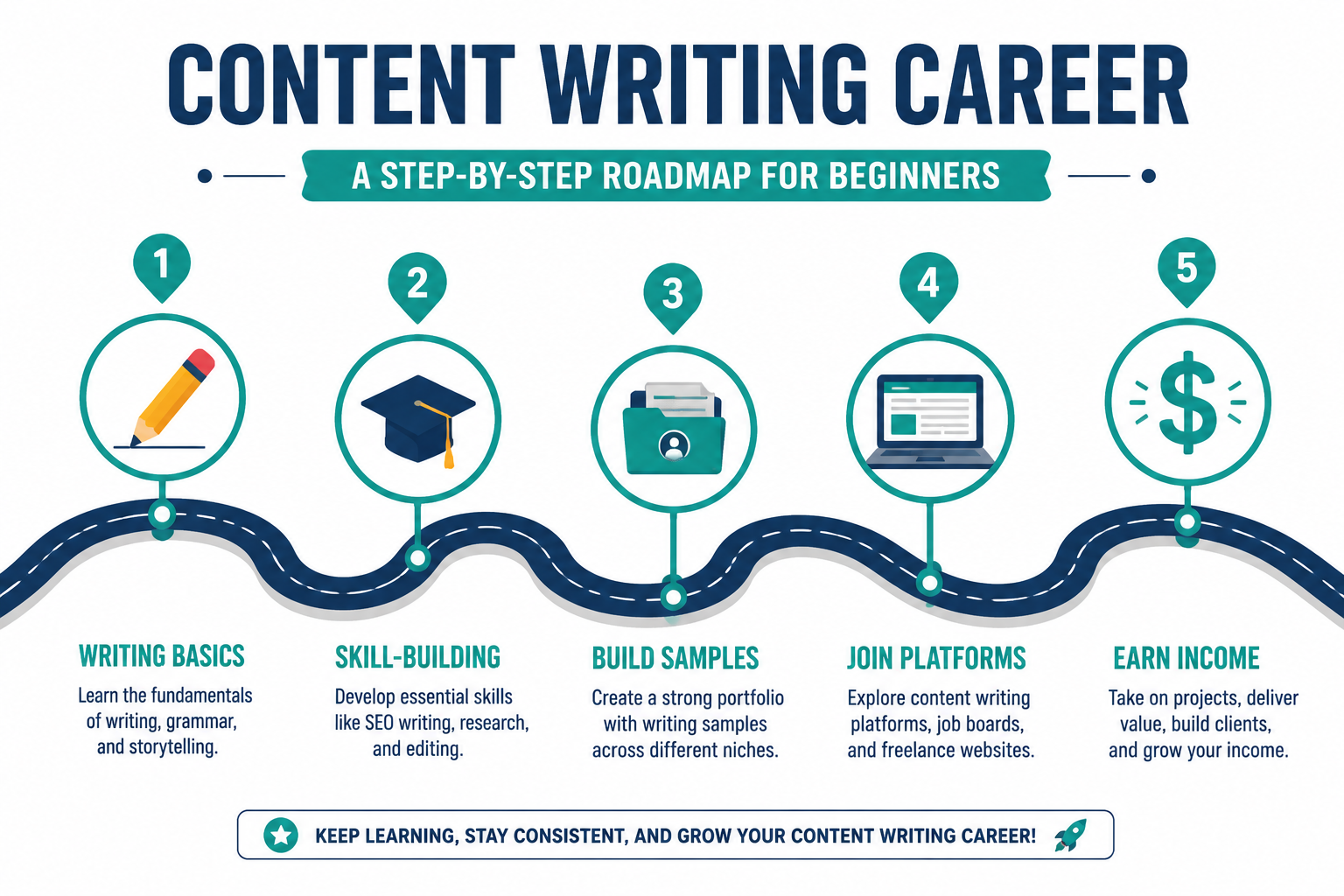
How to Be a Content Writer With No Experience: A Step-by-Step Guide
You can start a content writing career with no prior paid experience by building skills and samples simultaneously. Here is a practical sequence that works.
Step 1: Pick a niche (or two)
Choose a topic area where you have existing knowledge or genuine interest. Health, finance, technology, SaaS, travel, and education are consistently high-demand niches. Specializing makes you easier to hire and allows you to charge more over time.
Step 2: Study the basics of SEO writing
Spend two to four weeks learning how search intent works, how to use a keyword research tool (Ahrefs, Semrush, or the free Google Search Console), and how to structure an article for both readers and search engines.
Step 3: Write practice pieces
Write five to ten articles in your chosen niche. These do not need to be published anywhere immediately. Focus on quality, structure, and demonstrating that you understand your audience.
Step 4: Publish your work
Use Medium, Substack, LinkedIn Articles, or a free WordPress blog to publish your samples publicly. Having a live URL to share is more credible than attaching a Word document.
Step 5: Build a simple portfolio page
A one-page website (Carrd.co and Journo Portfolio are free options) with your bio, niche, and three to five writing samples is enough to start pitching clients.
Step 6: Apply for entry-level work
Start with content mills or job boards to get paid experience and testimonials. Then move to direct client outreach as your confidence and samples grow.
How to Build a Content Writing Portfolio That Gets You Hired
Your portfolio is your most important career asset as a content writer. Employers and clients use it to assess your writing style, range, and ability to deliver results.
A strong portfolio in 2026 does more than display polished prose. It shows your thinking process. Employers increasingly want to see how you frame a problem, what alternatives you considered, and how you made decisions.
What to include in your portfolio:
- 3 to 5 writing samples in your niche, each 600 to 1,500 words
- A brief case note for each piece: what the goal was, who the audience was, and what result it achieved (even if estimated)
- At least one SEO-focused piece showing keyword integration and structure
- One example of structured or multi-format content (an article repurposed into a social post or email, for instance)
Edge case: If you have no published clips yet, create spec work. Write a mock article for a real brand you admire, label it clearly as a spec piece, and include it. Hiring managers respect the initiative.

Start Building Your Writing Workflow with Today —>
Freelance vs. Full-Time Content Writing: Which Path Fits You?
Freelance writing offers flexibility and income variety; full-time writing offers stability and benefits. Neither is objectively better, but each suits a different lifestyle and risk tolerance.
Choose freelance if:
- You want to set your own hours and work from anywhere
- You are comfortable with income variability, especially in the first year
- You want to work across multiple industries or niches
- You have some financial runway while building a client base
Choose full-time if:
- You prefer predictable income and structured feedback
- You want to build deep expertise within one company or industry
- You value team collaboration, editorial mentorship, and career laddering
- Benefits like health insurance are a priority
Income reality check (estimates based on 2026 market conditions):
| Experience Level | Freelance Rate (per hour, est.) | Full-Time Salary (annual, est.) |
|---|---|---|
| Entry-level | $15–$35 | $35,000–$50,000 |
| Mid-level (2–4 years) | $40–$75 | $50,000–$75,000 |
| Senior/specialist | $80–$150+ | $75,000–$110,000+ |
These are estimates. Rates vary significantly by niche, geography, and client type. Technical writers, UX writers, and B2B specialists consistently command higher rates than generalist bloggers.
Where to Find Content Writing Jobs in 2026
The best place to find content writing work depends on your experience level and whether you want freelance or full-time roles.
For beginners:
- ProBlogger Job Board — curated blog and content writing roles
- LinkedIn Jobs — filter for “content writer,” “copywriter,” or “SEO writer“
- Contently and ClearVoice — freelance platforms with vetted brand clients
- Upwork — competitive but accessible for building early reviews
For intermediate and advanced writers:
- Direct outreach to brands in your niche via email or LinkedIn
- Referrals from existing clients (the most reliable source of consistent work)
- ASJA (American Society of Journalists and Authors) — connects professional writers with B2B and editorial clients
- Cold pitching to content marketing agencies that serve your niche
Networking tip: Join writing communities on Slack, Discord, or LinkedIn groups. Many writing jobs are filled through referrals before they are ever posted publicly. Showing up consistently in professional communities builds the kind of visibility that leads to inbound opportunities.
How AI Is Changing Content Writing (and What It Means for Your Career)
AI has not eliminated content writing jobs, but it has permanently changed what those jobs require. Writers who treat AI as a threat are losing ground to those who treat it as a collaborator.
In 2026, the most in-demand writers can do things AI cannot replicate on its own:
- Provide genuine subject-matter expertise and first-hand insight
- Build trust through authentic brand voice and storytelling
- Make editorial judgment calls about what an audience actually needs
- Fact-check and contextualize AI-generated drafts accurately
At the same time, writers who refuse to use AI tools at all are working slower than necessary. The practical workflow most professionals use looks like this:
- Use AI for research acceleration — generate an initial outline or surface related questions, then verify every fact independently
- Use AI for ideation — brainstorm angles, headlines, or structural approaches
- Write the actual draft yourself — this is where your voice, expertise, and judgment matter
- Use AI for editing passes — check for clarity, tone consistency, or gap coverage
- Final review is always human — you own the quality and accuracy
Writers who also understand how to structure content for LLM inclusion (clear definitions, direct answers, well-labeled sections) have a measurable advantage in organic discovery.
The differentiation in 2026 does not come from writing speed. It comes from genuine insight, strategic storytelling, and knowing how to make AI amplify your thinking rather than replace it.

How to Avoid Burnout as a Content Writer
Burnout is common in content writing, especially for freelancers managing multiple clients without clear boundaries. The writers who last in this career are those who build sustainable systems early.
Practical burnout prevention:
- Set a daily word count ceiling, not just a floor. Writing 2,000 words is productive; writing 5,000 every day is a path to exhaustion.
- Batch similar tasks. Research days, writing days, and editing days are more efficient than context-switching hourly.
- Create an offboarding process for bad clients. One difficult client who pays late and demands constant revisions can drain more energy than three good ones produce.
- Take real breaks. Freelance writers often feel guilty stepping away. Scheduled time off is not optional; it is what keeps your writing quality high.
- Track your income per hour, not just total earnings. Some clients pay well but cost you more time than they are worth.
Legal and Tax Basics Every Freelance Content Writer Should Know
This section applies specifically to freelance content writers in the US, though similar principles apply in other countries.
- Register as a sole proprietor or LLC. Most freelancers start as sole proprietors, which requires no formal registration in most states. An LLC adds liability protection as your income grows.
- Set aside 25–30% of income for taxes. Freelancers pay self-employment tax (roughly 15.3%) plus income tax. Quarterly estimated tax payments prevent a large surprise bill in April.
- Track all business expenses. Software subscriptions, home office costs, professional development, and equipment are often deductible.
- Use written contracts for every client. A simple contract covering scope, rate, revision limits, and payment terms protects both parties.
- Collect a W-9 from clients who pay you $600 or more in a year. They will need it to issue a 1099 form.
Consulting a tax professional in your first year of freelancing is worth the cost.
Frequently Asked Questions
Q: Can I become a content writer without a degree?
Yes. Most content writing jobs and clients care about your portfolio and demonstrated skill, not your educational credentials. A strong writing sample outweighs a degree in most hiring decisions.
Q: How long does it take to start earning money as a content writer?
Most beginners land their first paid work within one to three months of actively building a portfolio and applying. Reaching a sustainable full-time income typically takes six to eighteen months, depending on niche and effort.
Q: What is the difference between content writing and copywriting?
Content writing primarily informs or educates (articles, guides, blog posts). Copywriting primarily persuades or drives action (sales pages, ads, email sequences). Many writers do both, but copywriting generally commands higher rates.
Q: Do I need to know SEO to be a content writer?
Yes, for most roles. Basic SEO knowledge — understanding search intent, keyword placement, and on-page structure — is a baseline expectation for web content writers in 2026.
Q: How do I get my first content writing client with no experience?
Write three to five strong spec pieces in a specific niche, publish them publicly, then send personalized cold pitches to small businesses or startups in that niche. Offer a competitive introductory rate in exchange for a testimonial.
How to Be a Content Writer: FAQs
Q: Is content writing a stable career in 2026 with AI tools available?
Yes, for writers who adapt. AI handles volume and speed; human writers provide insight, expertise, and brand voice. The writers most at risk are those producing generic, low-effort content. Specialists and strategic writers are in high demand.
Q: What tools do content writers use daily?
Common tools include Google Docs or Notion for drafting, Grammarly or Hemingway Editor for editing, Ahrefs or Semrush for SEO research, and ChatGPT or Claude for ideation assistance.
Q: How do I raise my rates as a freelance writer?
Specialize in a high-value niche, document results your content has driven (traffic, leads, conversions), and raise rates with new clients first. Existing clients can be moved to new rates at contract renewal.
Q: What is a realistic starting rate for a beginner content writer?
Beginners typically charge $0.03 to $0.08 per word, or $15 to $35 per hour, depending on the platform and client. Rates should increase as you build a portfolio and niche expertise.
Q: Can I do content writing as a side job?
Absolutely. Many writers start part-time while keeping a day job. Even five to ten hours per week can generate meaningful supplemental income and portfolio growth within a few months.

Conclusion: Your Next Steps to Be a Content Writer
The path to becoming a content writer is more accessible in 2026 than it has ever been, and more competitive at the same time. The writers who build lasting careers are not necessarily the fastest or the most prolific.
They are the ones who combine genuine expertise with technical literacy, treat AI as a collaborator rather than a shortcut, and consistently deliver work that serves both the reader and the client’s goals.
Here is your action plan for the next 30 days:
- Choose one writing niche based on your existing knowledge or strong interest.
- Write three practice articles of 800 to 1,200 words each, focused on that niche.
- Publish them on Medium, Substack, or a free portfolio site.
- Complete one free SEO writing course (Google’s Fundamentals of Digital Marketing or HubSpot’s Content Marketing Certification are solid starting points).
- Send five personalized pitches to small businesses or content agencies in your niche.
You do not need to have everything figured out before you start. The portfolio you build in the next month will teach you more than any guide can.
Ready to accelerate your content writing career?
Start Building Your Writing Workflow with Today —>
References
[1] How To Become A Content Designer In 2026 – https://uxcontent.com/how-to-become-a-content-designer-in-2026/
[2] Content Writing Tips From Experts – https://www.searchenginejournal.com/content-writing-tips-from-experts/477016/
[3] Make The Most Of 2026 B2B Content Marketing Trends – https://www.asja.org/make-the-most-of-2026-b2b-content-marketing-trends/
[4] Writing Jobs Client Work – https://elnacain.com/blog/writing-jobs-client-work/


Pingback: Best SEO Tools For Agencies: 2026 Guide to a Winning Tool Stack - A1Publishing