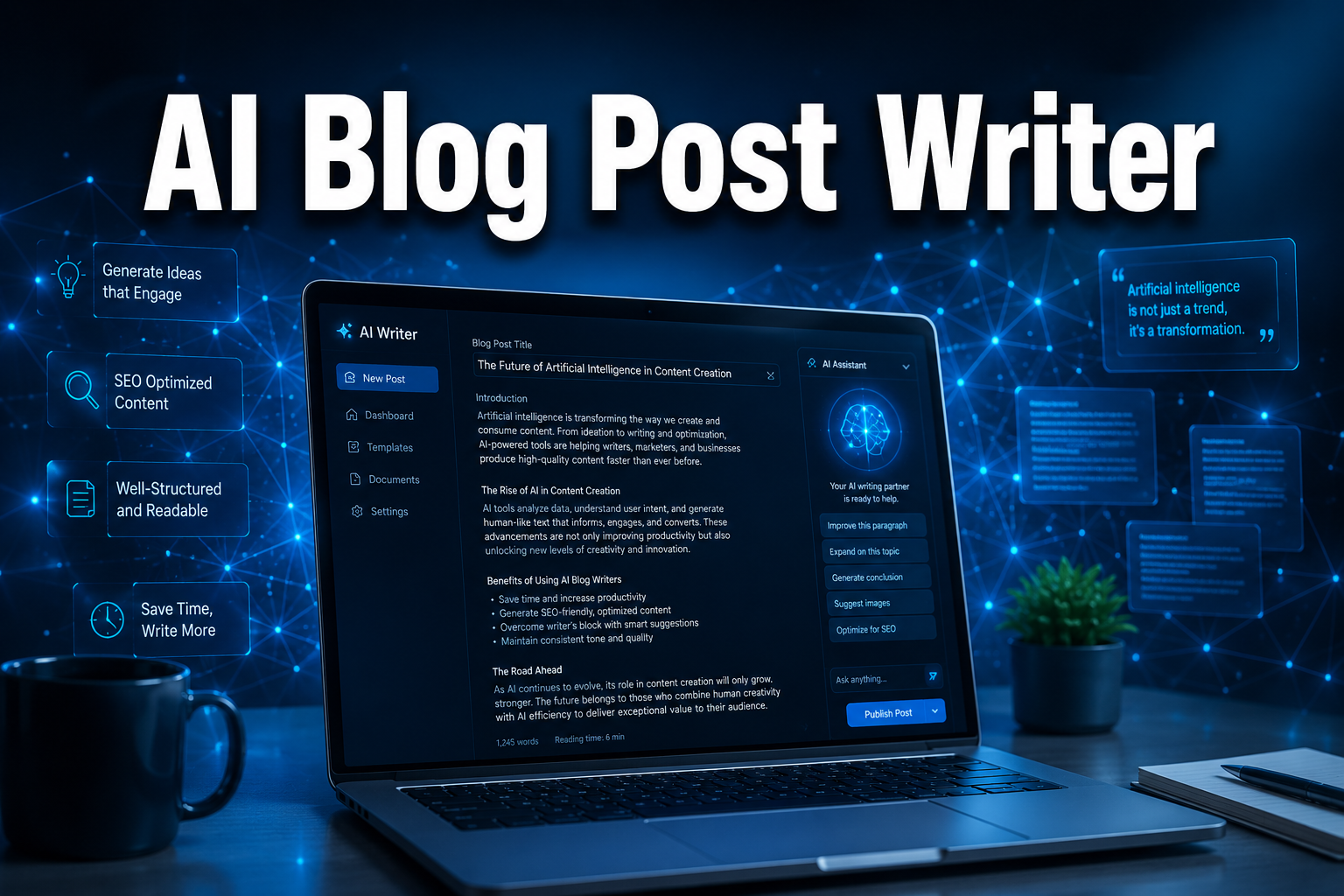
AI Blog Post Writer
Lastest Update : May 25, 2026
Quick Answer
An AI Blog Post Writer is software that uses large language models and natural language processing to generate draft blog content from a brief, outline, or set of keywords.
The best tools in 2026 can produce structured, readable drafts in minutes, but they work best when a human editor reviews and refines the output.
If you’re evaluating tools to buy, the right choice depends on your niche, SEO needs, publishing volume, and budget.
Key Takeaways
- AI Blog Post Writer use GPT-based or proprietary language models to generate draft content from prompts or outlines.
- Top tools in 2026 include WordRocket, Jasper, Surfer AI, Copy.ai, and Writesonic, each with distinct strengths.
- Pricing ranges from free tiers with limited output to $99+/month for full-featured plans.
- Google does not automatically penalize AI-written content; quality and helpfulness are what matter.
- Most AI-generated posts need 20–40% human editing to sound natural and accurate.
- AI writers work well for informational, listicle, and how-to content; they struggle with highly technical, legal, or deeply personal writing.
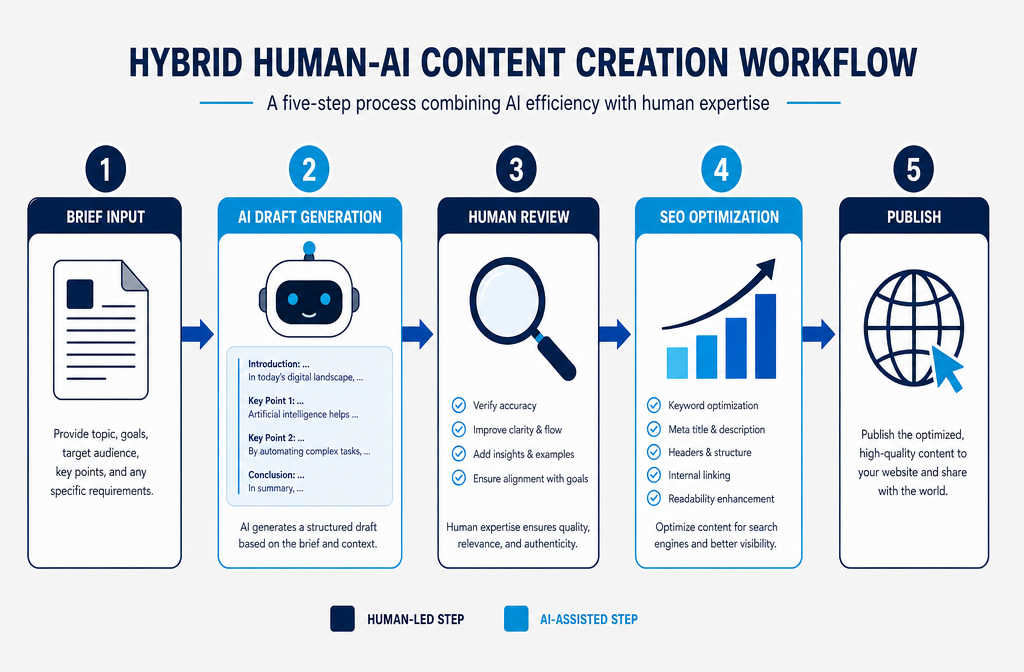
- Hybrid human-AI workflows consistently outperform fully automated pipelines in quality and engagement.
- Ethical use, copyright awareness, and fact-checking are non-negotiable when publishing AI content.
What Exactly Is an AI Blog Post Writer?
An AI blog post writer is a software tool that generates written blog content automatically, using large language models (LLMs) trained on vast amounts of text data.
You provide a topic, keyword, tone, or outline, and the tool produces a structured draft, often including an introduction, body sections, and a conclusion.
These tools are built on natural language processing (NLP) technology, most commonly GPT-4-class models or proprietary variants.
They don’t “think” in the human sense; they predict the most statistically likely next word or sentence based on training data and your input.
That distinction matters because it explains both their strength (speed, structure, breadth) and their weakness (occasional inaccuracy, generic phrasing).
Who it’s for: Content marketers, bloggers, SEO agencies, SaaS companies, and ecommerce brands that need to produce blog content at scale without proportionally scaling their writing team.
Who it’s not for: Writers who need original research, first-person lived experience, or highly regulated content (legal, medical, financial advice) without heavy expert review.
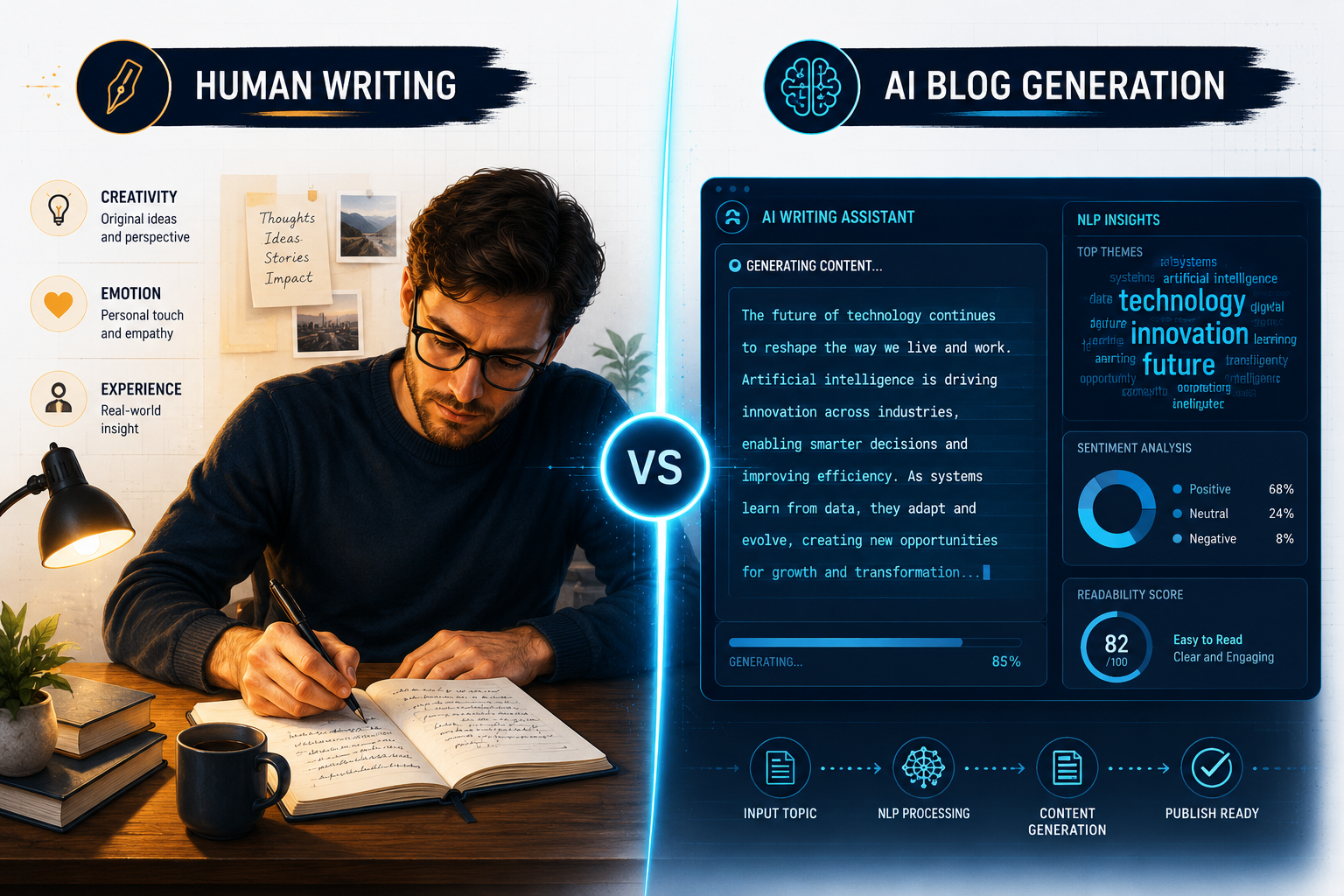
How Much Does AI Blog Writing Cost Compared to Human Writers?
AI blog writing tools cost significantly less per word than hiring human freelancers, but the comparison isn’t always straightforward.
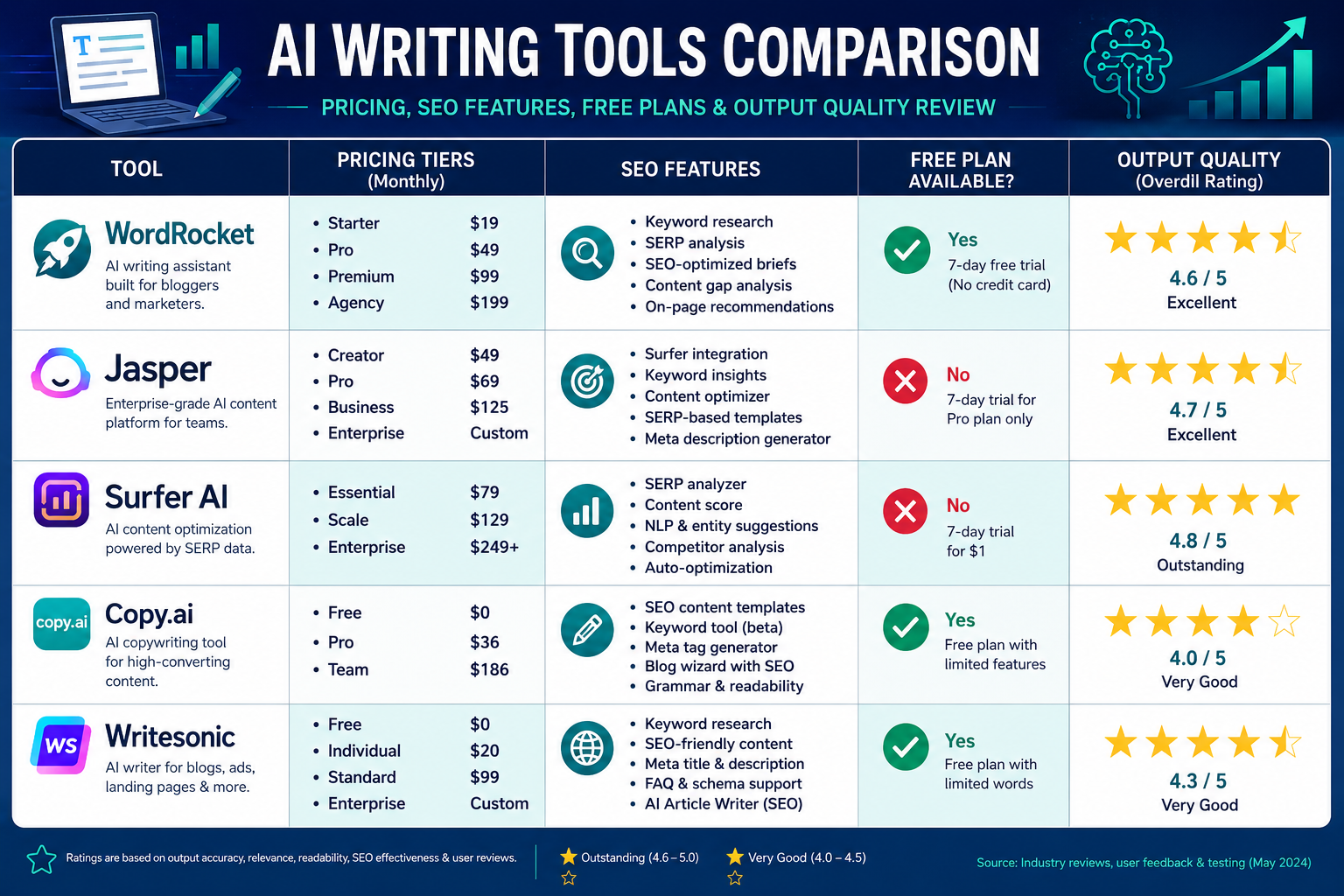
Typical AI tool pricing in 2026:
| Tool | Free Plan | Entry Paid Plan | Pro/Agency Plan |
|---|---|---|---|
| WordRocket | Yes (limited) | ~$19/mo | ~$79/mo |
| Jasper | No | ~$49/mo | ~$125/mo |
| Surfer AI | No | ~$89/mo (bundled) | ~$219/mo |
| Copy.ai | Yes (limited) | ~$36/mo | ~$186/mo |
| Writesonic | Yes (limited) | ~$20/mo | ~$99/mo |
Note: Prices are estimates based on publicly available information and may change. Always verify on the tool’s pricing page before purchasing.
A mid-level human freelancer typically charges $0.10–$0.25 per word for blog content, meaning a 1,500-word post costs $150–$375. An AI tool at $49/month can produce dozens of drafts for the same investment, though each draft will need editing time factored in.
The real ROI calculation: If your editor spends 1–2 hours refining an AI draft versus 0 hours managing a freelancer (who delivers a polished post), the cost savings are real but not as dramatic as vendors suggest. For high-volume content operations (20+ posts/month), AI tools offer clear financial advantages.
Can AI Really Write Good Blog Posts That Sound Natural?
Yes, with caveats. Modern AI blog writers can produce grammatically clean, logically structured drafts that read naturally at a surface level.
The best tools avoid obvious robotic patterns like repetitive sentence structure or hollow filler phrases, especially when given detailed prompts.
However, “natural-sounding” is not the same as “compelling” or “accurate.” AI-generated content tends to be:
- Correct in structure but sometimes vague in substance
- Confident in tone even when the underlying claim is imprecise
- Generic in voice unless you train it on your brand’s existing content
The fix is straightforward: treat AI output as a first draft, not a finished product. Add specific examples, personal anecdotes, updated data, and your brand’s distinct voice during the editing pass.
“The writers on our team who use AI tools as a starting point are producing 3x the content with the same quality bar, but they’re still the ones making it good.” A common sentiment from content managers who’ve integrated AI into their workflows.
Which AI Writing Tool Is Best for SEO Blog Content?
For pure SEO blog content, tools that combine AI writing with on-page optimization data give the best results. Surfer AI is widely regarded as the strongest option here because it integrates keyword density analysis, NLP term suggestions, and content scoring directly into the writing interface. You’re not just generating text; you’re generating text that’s calibrated to rank.
Choose by use case:
- Best for SEO-first content: Surfer AI (built-in SERP analysis)
- Best for brand voice and long-form: Jasper (tone customization, brand memory)
- Best for budget-conscious teams: WordRocket or Writesonic (solid output, lower price point)
- Best for workflow automation: Copy.ai (multi-step workflows, CRM integrations)
For most small-to-mid-size content teams in 2026, WordRocket offers a strong balance of output quality, SEO awareness, and pricing. Start a free trial at app.wordrocket.ai to see if it fits your workflow before committing to a paid plan.
What Are Common Mistakes People Make When Using AI Blog Writers?
The biggest mistake is publishing AI drafts without editing them. This leads to factual errors, stale information, and content that reads as generic because it is generic, it’s an average of everything the model has seen.
Other frequent mistakes:
- Giving vague prompts. “Write a blog about SEO” produces a mediocre draft. “Write a 1,200-word how-to guide for e-commerce store owners on fixing crawl errors in Google Search Console, targeting the keyword ‘GSC crawl errors fix'” produces something usable.
- Ignoring fact-checking. AI tools hallucinate statistics, misattribute quotes, and cite outdated information. Every factual claim needs verification.
- Skipping brand voice calibration. Most tools let you input style guides or sample content. Teams that skip this step get generic output that doesn’t match their audience.
- Over-relying on one tool. Different tools excel at different content types. Using only one tool for all content formats limits quality.
- Not tracking performance. Publishing AI content without monitoring rankings, engagement, and bounce rates means you can’t improve the process over time.
Is an AI Blog Writer Good for Tech Blogs or Just Lifestyle Content?
AI blog writers work across many niches, but performance varies by content type. For lifestyle, travel, food, marketing, and general business content, AI tools produce solid drafts with minimal friction. The subject matter is well-represented in training data, and factual precision is less critical.
For tech blogs, the picture is more nuanced. AI tools handle conceptual tech content (explainers, comparisons, tutorials on widely-used tools) reasonably well. They struggle with:
- Cutting-edge developments post their training cutoff
- Deep technical accuracy (code-heavy tutorials, architecture explanations)
- Proprietary or niche platform documentation
The practical rule: Use AI for the structure and boilerplate of tech content, then have a subject-matter expert fill in the precise technical details. This hybrid approach works better than either pure AI or pure human writing for most tech blogs.
Will Google Penalize Content Written by AI Blog Tools?
No, Google does not penalize content simply because it was written by an AI tool. Google’s guidance, consistent through 2025 and into 2026, focuses on content quality and helpfulness, not the production method. Content that is accurate, original in its perspective, and genuinely useful to readers is treated the same regardless of how it was created.
What Google does penalize is low-quality, spammy, or manipulative content, which AI tools can produce at scale if used carelessly. The risk isn’t the AI; it’s the absence of human editorial judgment.
Practical compliance checklist:
- Add original insights, data, or examples that aren’t in the AI draft
- Fact-check every specific claim before publishing
- Ensure the content serves the reader’s actual question, not just keyword density
- Use E-E-A-T signals: author bylines, expert review notes, and cited sources where relevant
How Do I Make Sure My AI-Written Blog Posts Don’t Sound Robotic?
The most effective technique is to give the AI a detailed, specific prompt that includes your audience, tone, and a few example phrases or sentences in your brand voice. The more context the model has, the less generic the output.
Post-generation editing checklist:
- Replace vague openers (“In this article, we will explore…”) with direct, specific statements
- Add at least one concrete example or anecdote per major section
- Vary sentence length, AI tends toward uniform medium-length sentences
- Remove filler transitions (“It is important to note that…”)
- Read the draft aloud; anything that sounds stiff when spoken should be rewritten
- Insert your own opinion or stance at least once per post
A good rule of thumb: if you can’t tell which sentences are yours and which are the AI’s after editing, the post is ready to publish.
What Industries or Niches Work Worst with AI Blog Writing?
AI blog writers perform worst in niches where accuracy is legally or ethically critical, and where the training data is thin or rapidly changing.
Niches with the most friction:
- Legal: Jurisdiction-specific advice changes frequently; errors carry liability
- Medical/clinical: Outdated or imprecise health information can cause harm
- Academic research: Requires citations, original analysis, and methodological rigor AI cannot provide
- Highly localized content: Hyperlocal news, community-specific guides, or regional regulatory content
- Emerging technology: Anything that moved significantly after the model’s training cutoff
In these areas, AI can still help with structural scaffolding or first-draft outlines, but the substantive content must come from qualified humans.
How Much Human Editing Does an AI Blog Post Typically Need?
Most AI-generated blog posts need between 20% and 40% revision before they’re publication-ready, based on the complexity of the topic and the quality of the initial prompt. Simple, well-defined topics (e.g., “5 ways to improve email open rates”) need less editing. Complex, nuanced, or rapidly evolving topics need more.
Editing time estimates by content type:
- Simple listicle (800–1,000 words): 20–30 minutes of editing
- How-to guide (1,200–1,500 words): 45–60 minutes
- Thought leadership or opinion piece: 60–90 minutes (heavy rewriting often needed)
- Technical tutorial: 90+ minutes (fact-checking and code review required)
The editing investment is still significantly lower than writing from scratch, which is where the productivity gain actually comes from.
Are There Free AI Blog Writing Tools That Actually Work Well?
Yes, several tools offer free tiers that produce genuinely usable output, though with limitations on word count, features, or monthly usage.
Free tiers worth trying:
- WordRocket: Free plan covers basic blog drafts; good starting point for solo bloggers
- Copy.ai: Free plan includes limited monthly credits; solid for short-form content
- Writesonic: Free tier with word limits; quality is competitive with paid entry-level plans
Free plans are best for writers who want to test AI tools before committing, or for low-volume bloggers publishing 2–4 posts per month. For teams publishing weekly or more, paid plans pay for themselves quickly in time saved.
What Kind of Writer Should Use an AI Blog Post Generator?
An AI blog post generator is most valuable for writers and teams who already know what good content looks like but are bottlenecked by the time it takes to produce first drafts.
Strong fit:
- Content marketers managing 10+ blog posts per month
- SEO agencies scaling content production for multiple clients
- Solo bloggers who want to publish consistently without burning out
- Ecommerce brands building out informational content for organic traffic
Weaker fit:
- Writers whose value is in original research or investigative reporting
- Authors building a personal brand on a distinctive, hard-to-replicate voice
- Teams without an editorial review process (the risk of publishing errors is too high)
The honest framing: AI blog post writers are productivity tools, not replacement writers. The humans who use them well are the ones who treat AI output as raw material, not finished work.
FAQ
Q: What is the difference between an AI blog writer and a standard grammar checker?
A grammar checker reviews and corrects existing text. An AI blog writer generates new content from scratch based on your prompt or outline. They solve different problems and are often used together.
Q: Do AI blog writing tools require technical knowledge to use?
No. Most tools are designed for non-technical users with simple prompt interfaces. You type your topic, adjust settings like tone and length, and the tool generates a draft.
Q: Can I use AI-generated blog content for affiliate marketing sites?
Yes, but quality control is critical. Thin, generic AI content on affiliate sites has historically underperformed in search. Focus on adding genuine product expertise and original comparisons.
Q: How do AI blog writers handle different languages?
Most major tools support multiple languages, but output quality varies. English, Spanish, French, and German tend to be strongest. Less common languages may produce lower-quality output.
Q: Is AI-generated content considered plagiarism?
AI tools generate original text rather than copying existing content directly, so it’s not plagiarism in the traditional sense. However, you should run outputs through a plagiarism checker before publishing, as models can occasionally reproduce training data closely.
Q: How often should I update AI-generated blog posts?
Treat AI-generated posts like any other content: review and update them when the information becomes outdated, when rankings drop, or at least annually for evergreen topics.
Q: Can AI blog writers generate content with citations?
Some tools can suggest citations, but they frequently hallucinate sources. Always verify any citation an AI tool suggests before including it in a published post.
Q: What’s the best prompt structure for getting a high-quality AI blog draft?
Include: target keyword, audience, desired word count, tone, key points to cover, and any specific examples or data you want referenced. The more specific the prompt, the better the draft.
Conclusion: How to Move Forward
AI Blog Post Writers have matured significantly by 2026. The best tools produce structured, readable drafts that give content teams a real productivity advantage.
But the teams getting the most value aren’t the ones using AI to replace writers, they’re the ones using it to remove the blank-page problem and speed up the drafting phase while keeping human judgment in the loop.
Your next steps:
- Identify your content volume and budget. If you’re publishing fewer than 4 posts per month, a free tier may be enough. Higher volume justifies a paid plan.
- Pick one tool and run a real test. Use it to draft 3–5 posts on topics you know well, then evaluate how much editing each needed.
- Build an editorial checklist. Fact-check, voice-match, and SEO-review every AI draft before publishing.
- Track performance from day one. Monitor rankings, organic traffic, and engagement for AI-assisted posts so you can refine your process.
If you’re ready to test a capable, budget-friendly option, WordRocket offers a free trial at app.wordrocket.ai that lets you evaluate the output quality before spending anything.
The writers and teams who treat AI as a skilled first-draft collaborator, not a magic publish button, are the ones building content operations that scale.
Get a Free Trial Before You Buy See If It’s For You Click Here