AEO Answer Engine Optimization
Last updated: May 01, 2026
Quick Answer
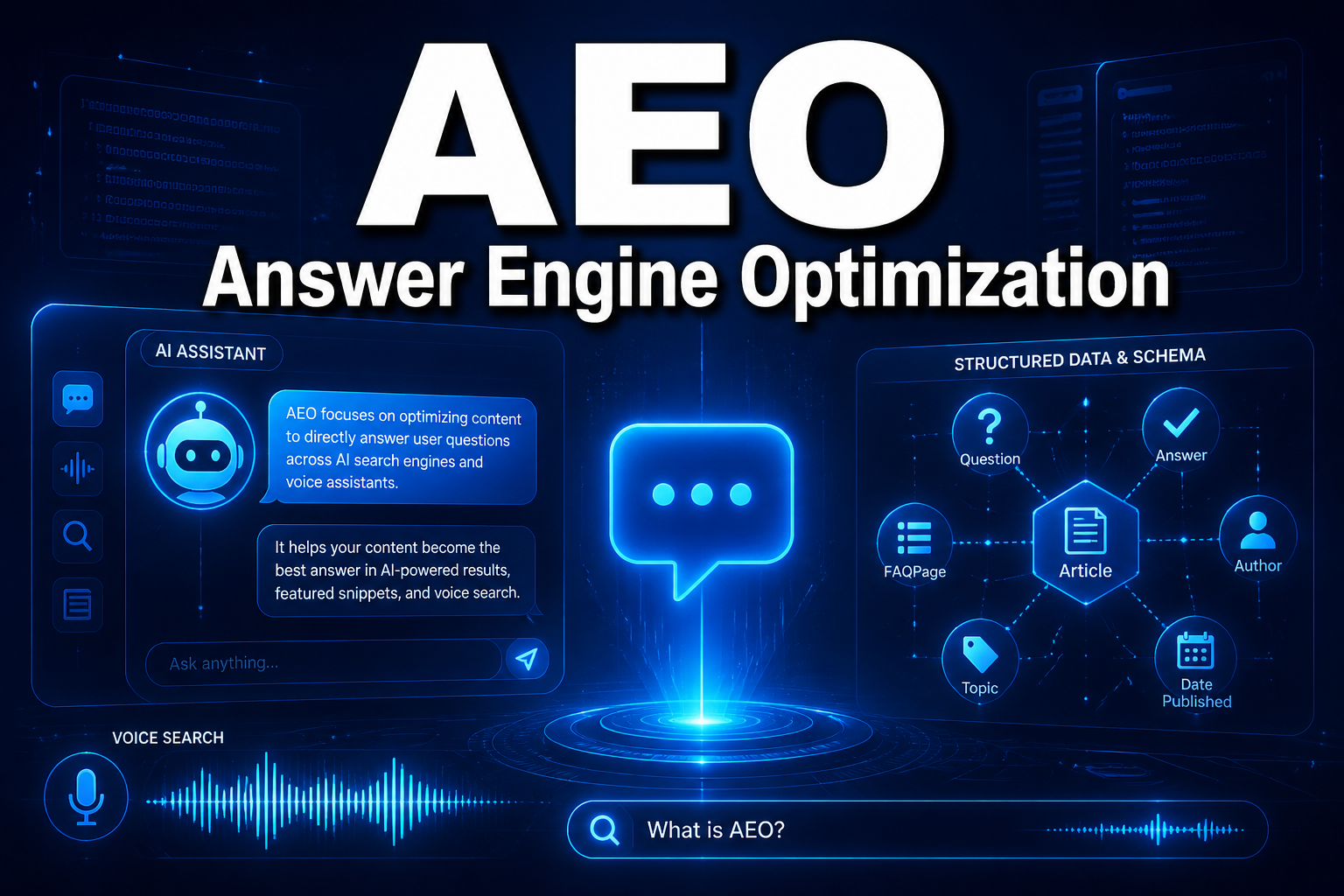
AEO Answer Engine Optimization is the practice of structuring content so that AI-powered answer engines, such as ChatGPT, Perplexity, Google’s AI Overviews, and voice assistants, can extract and cite it as a direct response to user queries.
Unlike traditional SEO, which targets ranked links, AEO targets the answer itself. It applies to any brand or publisher that wants to remain visible as AI systems increasingly replace the classic search results page.
Key Takeaways
- AEO Answer Engine Optimization focuses on getting content cited inside AI-generated answers, not just ranked in a list of links.
- The core technique is writing self-contained, direct-answer passages that an AI can quote without additional context.
- Structured data (FAQ, HowTo, and Speakable schema) significantly improves the chance of being selected as an answer source.
- Short, question-matching headings help AI systems map your content to specific user queries.
- AEO does not replace SEO, it extends it. Pages that rank well are still more likely to be cited by AI engines.
- Voice search and AI chatbots reward concise, conversational answers under 50 words for simple queries.
- Entity clarity matters: name your subject explicitly in every key passage rather than relying on pronouns.
- Measuring AEO success requires tracking AI citation mentions, featured snippet wins, and zero-click query coverage, not just organic traffic.
What Is AEO Answer Engine Optimization?
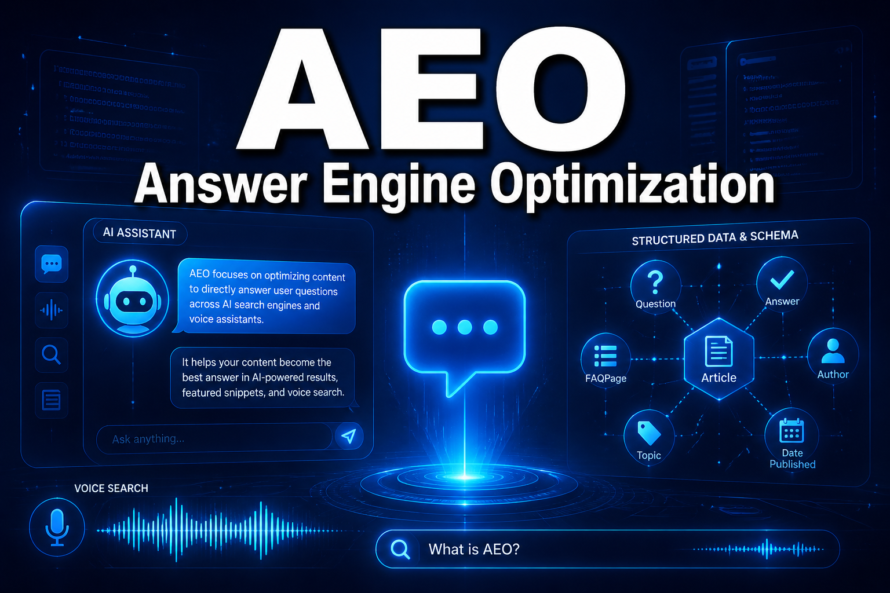
AEO Answer Engine Optimization is the discipline of making content machine-readable and answer-ready so that AI systems select it as the source for a direct response.
It emerged as a distinct practice when AI-powered search interfaces began delivering single synthesized answers instead of a list of links.
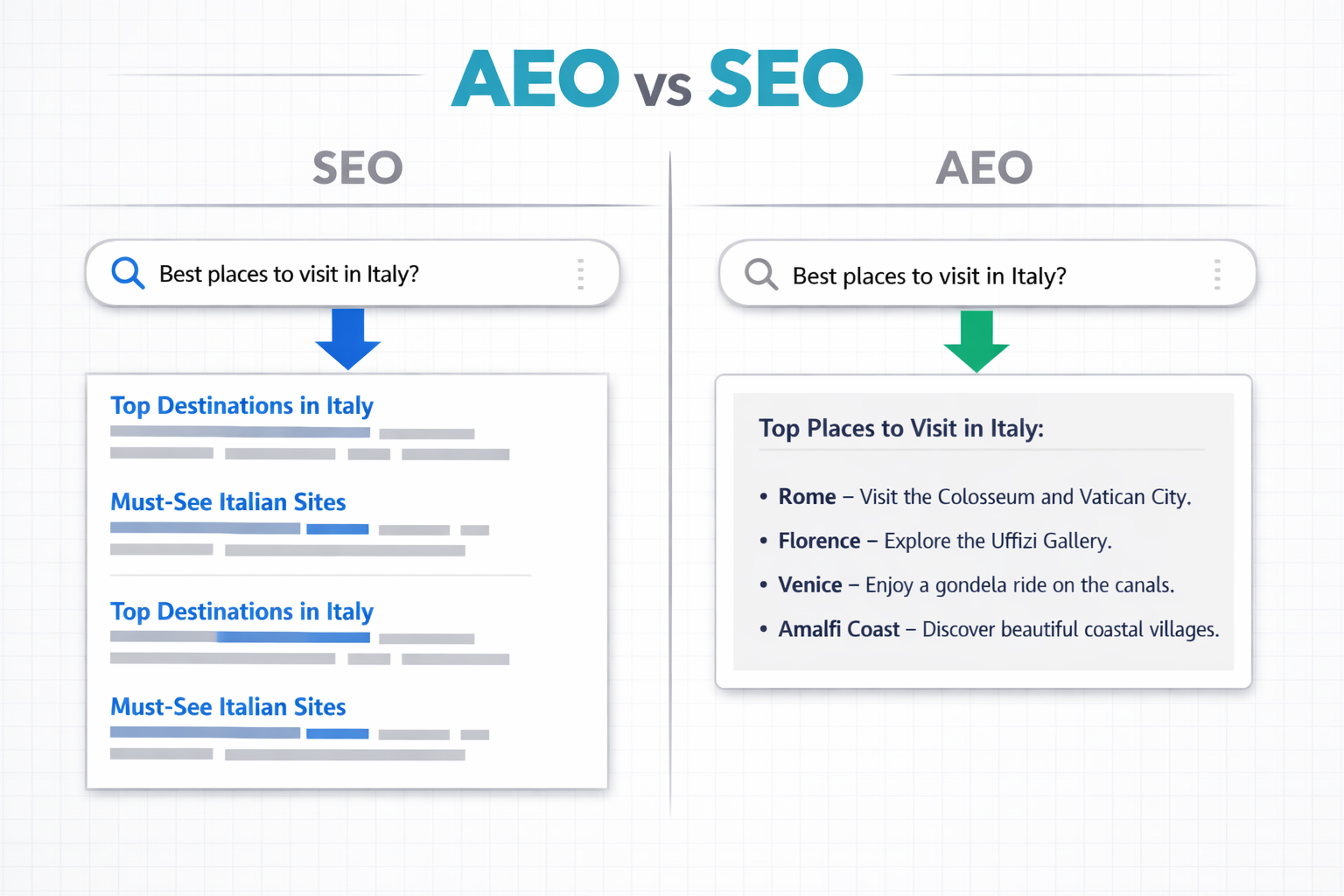
Traditional SEO asks: How do I rank on page one? AEO asks: How do I become the answer?
The shift matters because a growing share of searches now end without a click. When Google’s AI Overview or a chatbot answers a question directly, the user may never visit any website.
Brands that do not appear in those synthesized answers lose visibility entirely, even if they rank on page one.
Who needs AEO?
- Content publishers, bloggers, and media sites that depend on search traffic
- B2B and B2C brands building topical authority
- E-commerce sites answering product and comparison questions
- Any organization targeting voice search or AI assistant queries
Who can deprioritize it for now?
- Highly local businesses where map-pack and review signals dominate
- Sites where the primary traffic source is social or email, not search
How Do Answer Engines Differ from Traditional Search Engines?
Answer engines synthesize a response from multiple sources and present it as a single, authoritative reply. Traditional search engines return a ranked list of links and leave the user to find the answer themselves.
The table below shows the key differences:
| Dimension | Traditional Search Engine | Answer Engine (AI) |
|---|---|---|
| Output format | Ranked list of links | Single synthesized answer |
| User action required | Click through to source | Often none (zero-click) |
| Ranking signal | Backlinks, on-page SEO | Clarity, structure, entity authority |
| Content format rewarded | Long-form, keyword-rich | Concise, direct, self-contained |
| Success metric | Organic traffic | Citation frequency, brand mentions |
| Examples | Google (classic), Bing | Perplexity, ChatGPT Search, AI Overviews |
The practical implication: content written only for keyword density will often be skipped by AI engines in favor of a shorter, cleaner passage from a competitor.
What Are the Core Techniques of AEO Answer Engine Optimization?
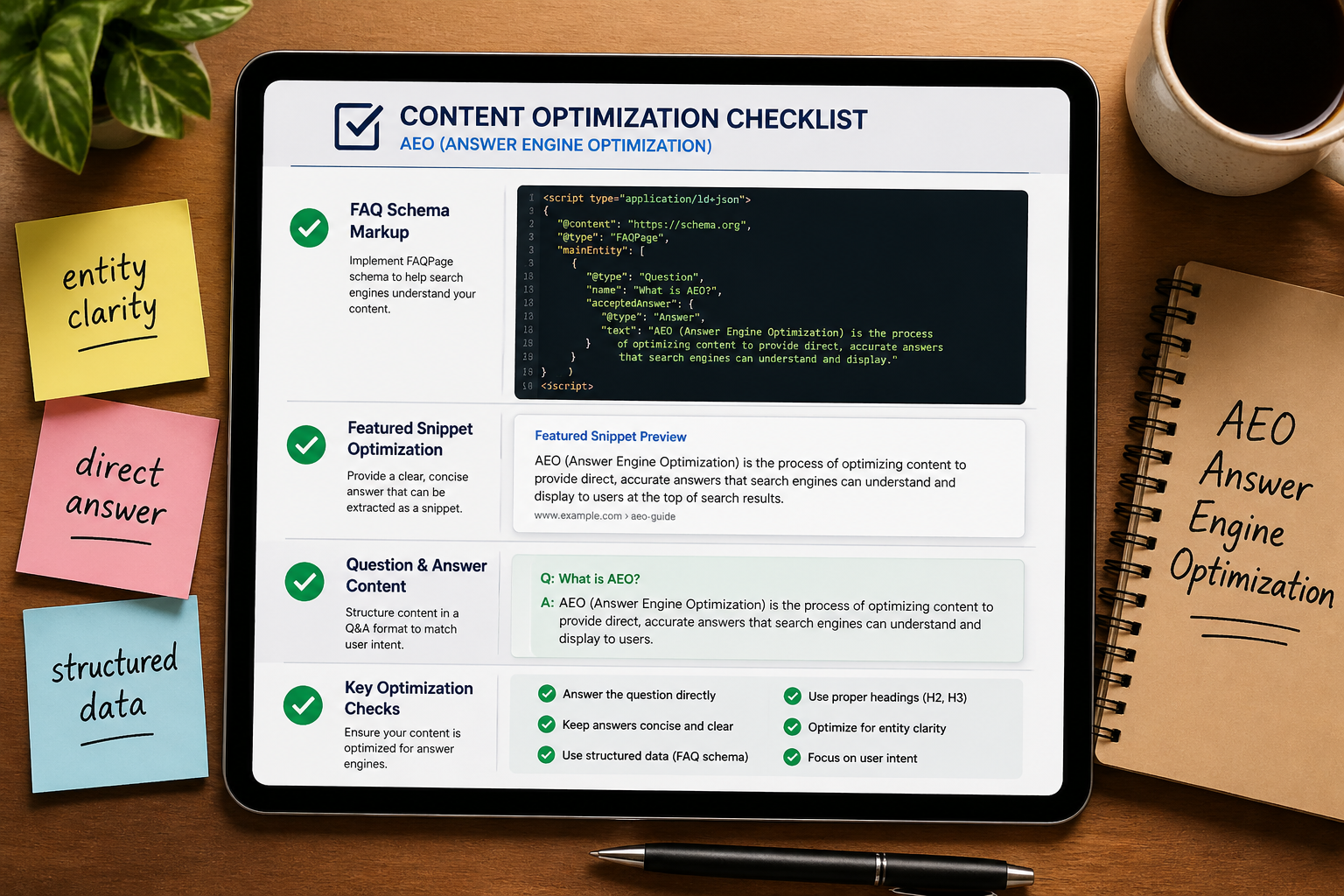
The foundation of AEO Answer Engine Optimization is writing passages that are self-contained, directly answer a specific question, and include enough context to be quoted without the surrounding page.
Add structured data on top, and you give AI systems a clear signal about what your content covers.
Write answer-first passages
Every major section should open with a one-to-three sentence direct answer. Don’t bury the response after three paragraphs of background.
AI systems scan for the passage that most closely matches the query intent, if your answer is buried, it won’t be selected.
Use question-based headings
Match your H2 and H3 headings to the exact phrasing users type or speak. Tools like Google’s “People Also Ask” boxes, AnswerThePublic, and AlsoAsked.com surface these question patterns.
A heading like “How long does AEO take to show results?” is far more likely to be matched to that query than “Timeline Considerations.”
Add structured data markup
Three schema types are especially valuable for AEO:
- FAQ schema — marks up question-and-answer pairs directly in your HTML
- HowTo schema — signals step-by-step instructional content
- Speakable schema — flags passages optimized for voice assistant playback
Keep key passages under 50 words for simple queries
For factual, definitional, or procedural questions, shorter answers win. For complex topics, a two-to-three sentence summary followed by supporting detail gives AI engines both the quotable snippet and the depth to verify accuracy.
Name your entities explicitly
Instead of writing “it works by processing data,” write “AEO Answer Engine Optimization works by structuring content so AI systems can extract a direct answer.” Every key passage should be understandable in isolation.
How Do You Measure AEO Performance?
AEO performance is measured by tracking how often your content appears as a cited source in AI-generated answers, how many featured snippets you hold, and what share of your target queries return zero-click results that reference your brand.
Standard organic traffic metrics will undercount AEO impact because many AI citations don’t generate a click. Use a combination of:
- Brand mention monitoring (tools like Brandwatch or Mention) to catch citations in AI overviews and chatbot responses
- Featured snippet tracking in rank-tracking tools (Semrush, Ahrefs) as a proxy for answer-engine readiness
- Search Console “Impressions” data for queries where you appear but receive no clicks — these are often zero-click answer placements
- Manual spot-checks in Perplexity, ChatGPT with browsing, and Google AI Overviews for your top target queries
💡 Quick tip: Set up a simple spreadsheet. List your 20 most important target questions. Check each one monthly in two or three AI engines. Note whether your brand is cited, paraphrased, or absent. This low-tech audit is often more actionable than any automated tool.
AEO vs. SEO vs. GEO: What’s the Difference?
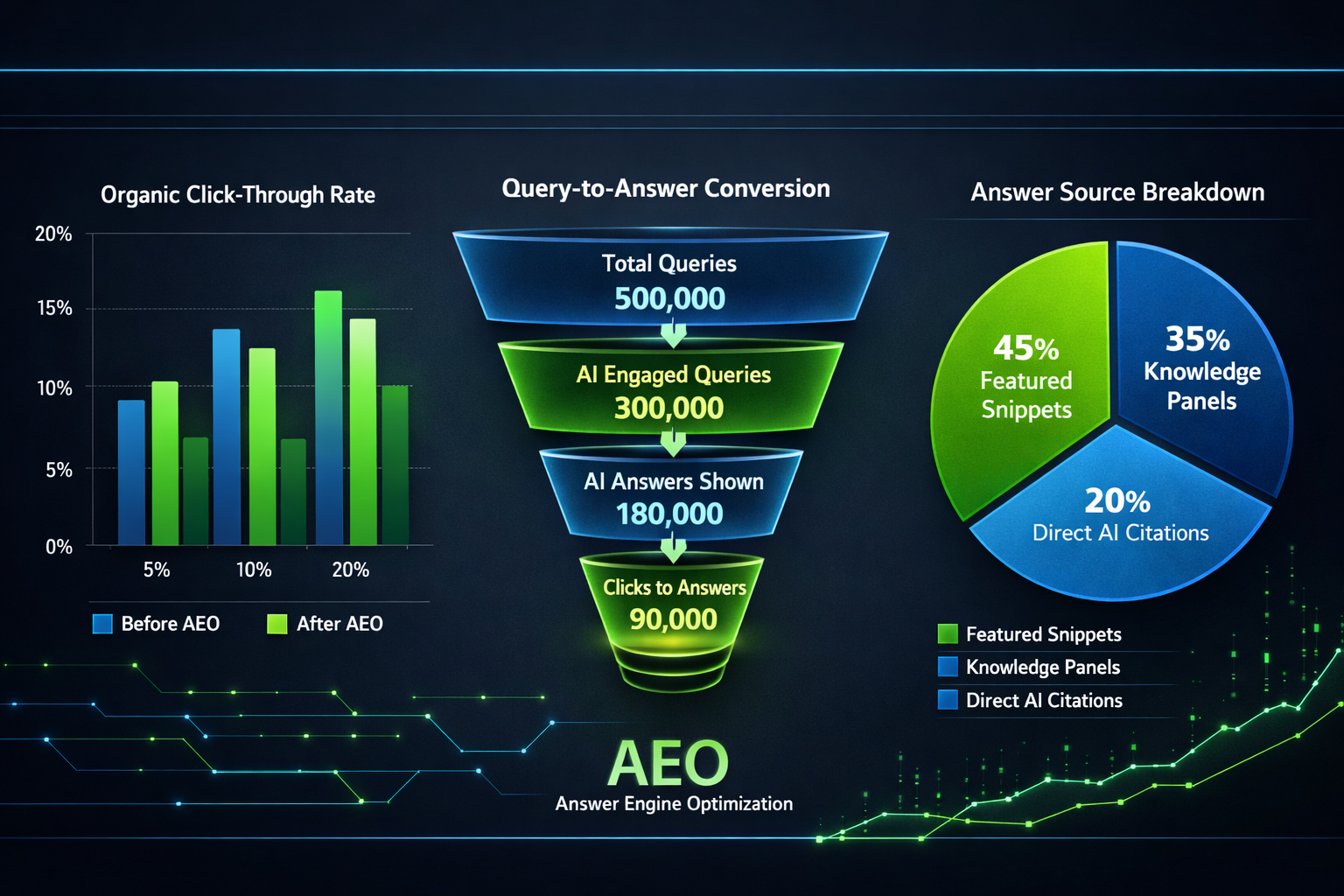
AEO Answer Engine Optimization, traditional SEO, and GEO (Generative Engine Optimization) are related but distinct disciplines. They overlap in many tactics but differ in their primary targets and success metrics.
| SEO | AEO | GEO | |
|---|---|---|---|
| Primary goal | Rank in link results | Be cited as an answer | Appear in generative AI outputs |
| Key content format | Long-form, keyword-rich pages | Direct-answer passages | Authoritative, entity-rich content |
| Main platforms | Google, Bing (classic) | AI Overviews, voice assistants | ChatGPT, Gemini, Claude |
| Core metric | Organic traffic | Citation rate, snippet ownership | Brand presence in AI responses |
In practice, strong SEO creates the foundation. AEO and GEO build on top of it by adding answer-first structure, schema markup, and entity clarity. You don’t need to choose one, a well-structured page can serve all three simultaneously.
Common AEO Mistakes to Avoid
The most common AEO mistake is writing for human readers only, without considering how an AI system will parse and extract meaning from the content. Here are the errors that most often cause content to be skipped:
- Burying the answer — Starting sections with background or history before stating the direct answer
- Vague pronoun use — Writing “it helps users do this” instead of naming the subject and action explicitly
- Missing schema markup — Publishing FAQ content without FAQ schema, so AI systems can’t identify the structure
- Overly long answer passages — Writing 300-word answers to simple factual questions when 40 words would do
- Ignoring question intent — Optimizing for keyword phrases (“AEO tips”) instead of question phrases (“How do I implement AEO?”)
- No entity linking — Failing to connect your content to recognized entities (organizations, products, people) that AI knowledge graphs can verify
Step-by-Step: How to Implement AEO Answer Engine Optimization
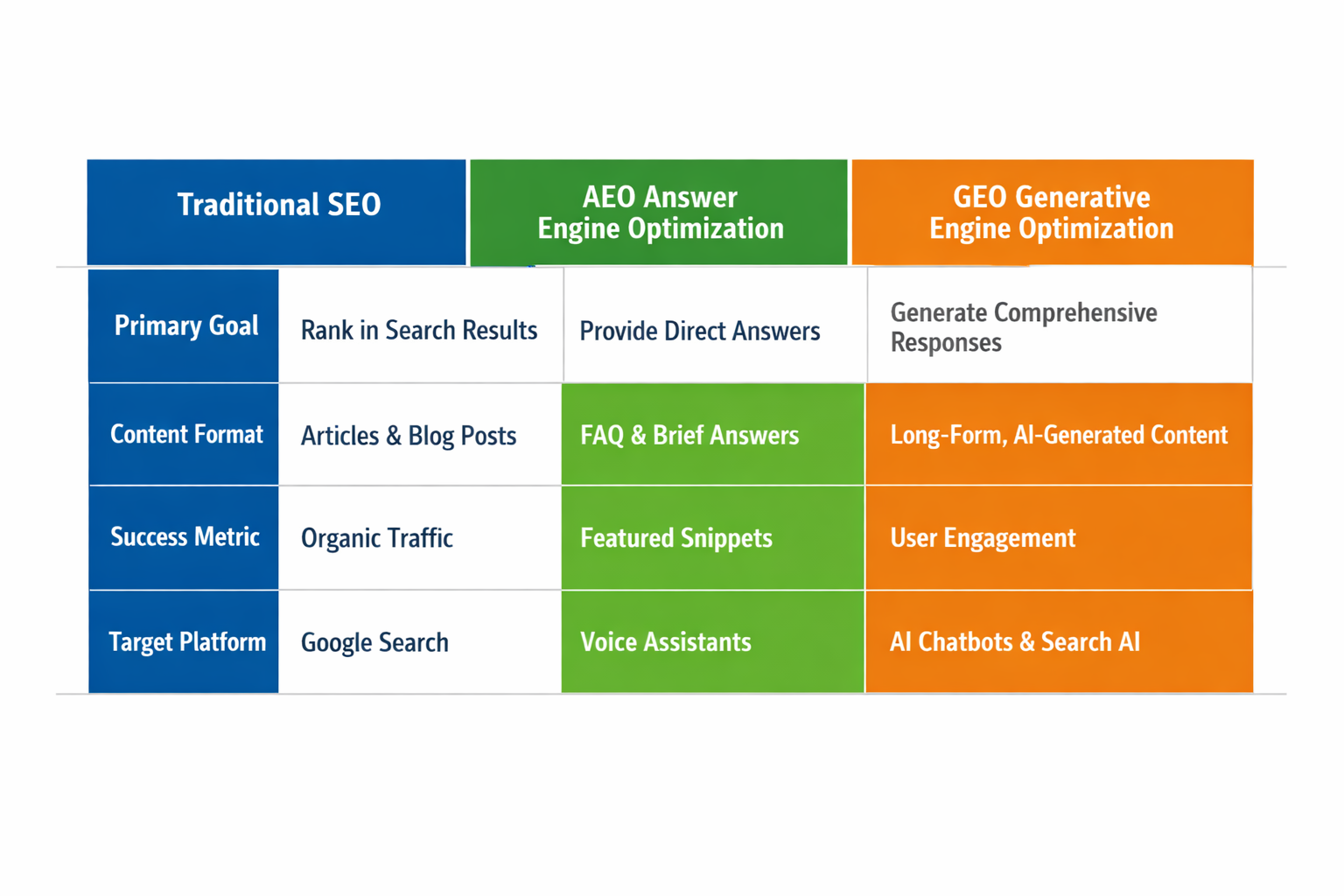
Implementing AEO Answer Engine Optimization follows a repeatable process: identify the questions your audience asks, restructure existing content to answer them directly, add schema markup, and then monitor citation performance.
- Audit your top 20 target queries. Run each through Google, Perplexity, and ChatGPT. Note which queries already return AI answers and whether your brand appears.
- Map questions to existing content. Identify which pages already cover each query. These are your AEO candidates.
- Rewrite section openings. For each H2 on those pages, add a direct one-to-three sentence answer at the top of the section.
- Add FAQ sections. Append a FAQ block to each page covering the five to ten most common follow-up questions on the topic.
- Implement schema markup. Add FAQ schema (and HowTo or Speakable where relevant) using your CMS plugin or manually in the page’s JSON-LD block.
- Publish and index. Submit updated URLs to Google Search Console for recrawling.
- Monitor monthly. Track featured snippet ownership, brand citations in AI tools, and Search Console impressions for target queries.
- Iterate. For queries where you’re still not cited, shorten your answer passage, improve entity clarity, or add more specific schema.
FAQ: AEO Answer Engine Optimization
What does AEO stand for?
AEO stands for Answer Engine Optimization. It refers to the practice of structuring content so AI-powered answer engines can extract and cite it as a direct response to user queries.
Is AEO the same as voice search optimization?
They overlap significantly. Voice search optimization is a subset of AEO, focused specifically on spoken queries and short spoken answers. AEO is broader and covers text-based AI answer engines as well.
Does AEO replace SEO?
No. AEO extends SEO. Pages that rank well in traditional search are still more likely to be cited by AI engines. Strong technical SEO, quality backlinks, and topical authority remain foundational.
How long does it take to see AEO results?
Results vary. Featured snippet wins can appear within days of a page being recrawled. AI engine citation patterns are less predictable — most practitioners report noticeable changes within four to twelve weeks of implementing answer-first content and schema markup.
AEO Answer Engine Optimization: FAQs
What schema types matter most for AEO?
FAQ schema, HowTo schema, and Speakable schema are the three most directly relevant to AEO. Article and BreadcrumbList schema support general crawlability and should also be in place.
Can small websites compete with large brands in AEO?
Yes, more so than in traditional SEO. AI engines prioritize answer clarity and structure over domain authority alone. A small site with a well-structured, direct answer can outperform a large site with a vague, buried one.
Does AEO work for e-commerce?
Yes. Product comparison questions, “best X for Y” queries, and how-to-use questions are all strong AEO targets for e-commerce brands. FAQ schema on product pages is a practical starting point.
What tools help with AEO?
Semrush and Ahrefs for featured snippet tracking, AlsoAsked.com and AnswerThePublic for question research, Google Search Console for zero-click impression data, and Brandwatch or Mention for AI citation monitoring.
Conclusion: Your Next Steps for AEO in 2026
AEO Answer Engine Optimization is no longer optional for brands that depend on search visibility.
As AI systems handle more queries end-to-end, the brands that structure their content for direct answers will maintain visibility while others fade into zero-click obscurity.
Your immediate action plan:
- Pick your top five target questions this week and check whether your content appears in AI-generated answers for each.
- Rewrite the opening paragraph of your three highest-traffic pages to lead with a direct, self-contained answer.
- Add FAQ schema to any page that already contains question-and-answer content.
- Set up a simple monthly tracking sheet for AI citation monitoring across your priority queries.
The investment is modest. The compounding advantage, being the cited source across AI platforms that millions of users trust, is significant.
Start with one page, measure it, and scale what works.
References
- Google. (2023). Structured data documentation: FAQ, HowTo, Speakable. https://developers.google.com/search/docs/appearance/structured-data
- Semrush. (2024). State of Search 2024. https://www.semrush.com/state-of-search/
- SparkToro & Datos. (2024). Zero-click searches study. https://sparktoro.com/blog/2024-zero-click-search-study/
- Search Engine Land. (2024). What is GEO? Generative Engine Optimization explained. https://searchengineland.com